
 On a recent episode of the drama House, the medical team finds that a patient improves from his illness when he's infected with a particular species of bacteria, Legionella pneumophila. Though mysterious at the time because the cause of the patient's illness was unknown, it was later determined that the patient was infected with naegleria, an amoeba. Legionella is an intracellular bacterium that just happens to naturally live in amoeba. Therefore, when the patient was co-infected with the amoeba and Legionella, the Legionella killed off the amoeba--using one microbe to attack another.
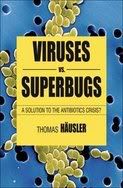
This strategy will sound familiar to those versed in the history of microbiology. Before the advent of antibiotic drugs, one method used to treat bacterial infections was to attack them with another microbe as well: with viruses called bacteriophage. In a new book, Viruses vs. Superbugs, Swiss journalist Thomas Häusler details the extraordinary history of this treatment method.
Introduced in 1915, this treatment was used for a time in the United States. However, the widespread acceptance of antibiotics essentially eliminated the use of phage therapy as a treatment for bacterial infections in this country. Nevertheless, phage therapy flourished in the Soviet Union, particularly in Georgia, where it has been used routinely throughout the last century--and continues to be employed today.
Phages have a number of advantages over conventional antibiotics. As Häusler notes, they are an "intelligent drug:" phages are highly specific for certain species of bacteria. This is both an advantage and a disadvantage when using the viruses as medicine. If a patient has an infection with methicillin-resistant MRSA, for example, a phage can be selected to target that specific bacterium, leaving the rest of the host's natural bacterial flora untouched. Therefore, the side effects that other antibiotics cause due to their broad spectrum--notably, diarrhea and other digestive effects--can be avoided. However, this brings in an added complication not seen when using antibiotics: a "matching" phage needs to be determined for each strain of bacteria. Though this is somewhat akin to determining antibiotic susceptibility for an infecting bacterium, the panel of phage from which to select from is much, much larger than the selection of antibiotics, and the treating doctor needs to have 1) access to the phage, and 2) the know-how to grow them up correctly for treatment. Additionally, the bacterial species in which the phage are grown can affect the effectiveness of the therapy--these aren't something one can just pull off a shelf and pop in a patient's mouth.
Because of this and (and many other factors that Häusler discusses), the efficacy of phage treatment has been difficult to establish. Providing this type of treatment takes not only proficiency in disease diagnosis, but also laboratory skill to determine, and then cultivate, the correct type of phage that will treat the infection. As one can imagine, therefore, difference in skill in these latter steps can result in large differences in the effectiveness of the treatment. This is one factor that is a major hindrance to approval of the treatment in the modern United States--the use of these live, potentially finicky cultures as cures, and the inability to employ one universal formulation makes approval difficult (though I disagree with Seed's characterization of phage drugs being "squelched" by the FDA--it's simply a lot more complicated than that).
Häusler does an excellent job of discussing not only these limitations, but also explaining ongoing research attempting to work around these problems: research such as that done by Vincent Fischetti of Rockefeller University, who has worked to isolate phage lysins--the proteins that actually kill the bacteria--and use these as specific treatments. (He has lysins that work with anthrax, Streptococcus pyogenes and others; click on the picture on his webpage to watch the lysins actually destroy the bacteria). By isolating the bacteriophage lysins and using them as drugs, this eliminates much of the guesswork involved in phage therapy (and ethical and safety concerns that make using a live virus as a treatment daunting). Will they be as effective as live phage, though--and how many lysins will be needed to treat, for example, all strains of MRSA? That remains to be seen, but it's a novel approach to an old therapy.
Overall, Viruses vs. Superbugs is a fascinating, and layman-friendly, book. Though I've emphasized a bit of the science here, Häusler discusses much more of the personalities involved in the research and developments in the past century of experimentation with--and therapeutic treatment using--phage therapy. Many people have devoted their lives to the study of phage, and stuck with it through political instability, lack of pay and resources (including heated buildings), and other hardships that would send most scientists packing. It's a fascinating journey, complete with friendships, intrigue, personality clashes, even murder--and ultimately, the possibility of redemption and more widespread acceptance of their life's work.
Will phage therapy help us win battles against bacteria that are resistant to multiple antibiotics? Häusler paints an optimistic picture, laced with a heavy does of realism. There are many obstacles, such as those I mentioned above. Additionally, because of the spotty record of efficacy of phage therapy here in the United States, many scientists remain highly skeptical of the use of phage, despite the enthusiasm and confidence of Georgian scientists (who have used and refined the treatment essentially continually since its initial description). With antibiotic resistance increasing and no breakthroughs on the horizon, we are increasingly finding that beggars can't be choosers. Phage therapy may not be ideal, but if harnessed correctly, has great potential. The coming years will show whether it will become another weapon in our arsenal against bacteria, or merely a footnote to history. Either way, Hausler's book is a fascinating documentation of the history of phage therapy to date.
For more information, check out Häusler's website, which he hopes to make into a "clearinghouse" of information on the topic.
- Log in to post comments
I guess you didn't read my entry for animalcules last week? :(
I think Fischetti's work is pretty cool, but it seems to me that purified lysin's will reduce the problem for the bacteria back down to the same one as they confront when they confront a novel antibiotic, i.e. what sort of resistance mechanism will effectively circumvent it (change the target, destroy the drug). For Staph v. phage lysin, given how many proteases Staph makes, it seems that the route to resistance will involve evolution of new protease specificity, and will occur fairly quickly.
I've sort of wondered about this, actually - I know why the Fischetti lab is working on this (expand the value to other bugs besides staph), but the protocol for using phage to fight MRSA seems pretty straight forward. Step 1, phage typing, Step 2 dose with appropriate phage. There might be follow up with strong putatively useful antibiotics to clean up (i.e one of the synergistic cocktails; I forget what is in each). I'm sort of surprised that no one is trying something like this packaged as a single therapeutic. Given the rising prevalence of CA-MRSA, this seems like a growing market, from the pharma perspective.
I did! But I just didn't want to sidetrack things into a discussion of how effective Legionella would actually be as an amoeba killer.
Regarding Fischetti's work, I heard him give a talk on the topic a few years back, and his idea was that, since the bacteria hadn't evolved resistance to it in all these years (despite much pressure to do so), it was likely something that was very difficult (impossible?) to do. I think this was weakened when it was shown bacteria could evolve resistance to antimicrobial peptides (despite some people claiming the same thing Fischetti did), but nevertheless, I think the purified lysins are one way to avoid some of the hoop-jumping live phage therapy necessitates.
As far as phage for MRSA--are you sure no one's trying that? Hausler does mention a number of phage therapy start-ups here; I'm not familiar with them or their work.
Actually, I'd be shocked if noone is trying it. It might be that the market (i.e. people w/ MRSA infections) is still too small, or that the kinks haven't been worked out.
In terms of the resistance thing, presumably resistance hasn't evolved to phage (in some sense, I'd say it has, but that's another story) because the spectrum is so narrow (i.e. only one strain of one bug is susceptible). Add in complications such as the potential benefits of lysogeny, and it's no wonder. However, if you strip away the specificity and potential positive impact of phage infection, it's hard to imagine that applying that kind of selective pressure won't have the usual impact.
In fact, if you think about it, that might be why it isn't being used - in order to use phage proteins/particles in an economic way, you have to strip away the things that make it so promising. Once you remove the host specificity, I suspect that you can breed resistance in very short order.
I'm inclined to agree, but according to Fischetti, resistance hasn't been a problem:
From Trends Microbiol. 2005 13:491-6.
You also have to find phage that are primarily lytic phage and not lysogenic phage. Lysogenic phage don't always lyse the host bacterium. Sometimes they insert into the host chromosome and wait for some signal to activate the lytic cycle. The signal is still unclear in most cases.
I haven't been keeping up w/ the lit on this topic, since I'm no longer officially in the field (at least for now...). I would have been shocked if they hadn't done something like what the paper outlines as you quoted. However, as I suspect you agree, that is a far cry from the generations, HGT events, and pressures of the infectious milieu. Still, criticism is easy, while doing is hard! I say, good luck to Fischetti et all (sincerely!), and I look forward to swallowing a beaker full of phage lysate to cure my infections someday.
As far as Zach's comment, there is a likely set of cues that signal the conversion from lysogeny to lysis. In the lab, UV and mitomycin C are often used (this probably is related to the induction of the SOS response in the bacterium). This was mostly worked out with the classic temperate phage lambda. I know this because it absolutely killed me on my oral exam, when I was completely unprepared for a question on this topic... The repressor system in that phage seems to be a good model for the mechanisms in other temperate phage. There certainly are lytic phage that don't integrate (the T-even phage, for example). The evolutionary pressures are different (simpler) in that case.
Tara,
That is awesome! What is the process of phage selection? This also reminds me of Nabi's StaphVax--they tried to get around the specificity problem by using polyclonal antibodies.
**Regarding Fischetti's work, I heard him give a talk on the topic a few years back, and his idea was that, since the bacteria hadn't evolved resistance to it in all these years (despite much pressure to do so), it was likely something that was very difficult (impossible?) to do.**
An extremely silly thing for Fischetti to assert. Almost certainly the reason the bacteria don't develop resistance is that the phage does multiple things that are fatal to the bacterium. It is much much harder to develop resistance to, say, three things at once than to one thing, then another, then another.
Well, before being too harsh, keep in mind that this is something I'm remembering from a talk ~3 years ago.
IIRC, the Russians have also done a lot of work on developing probiotics, as well as phages.
I love the book review above; however, I think many of the problems raised in the subsquent comments have been dealt with in phage therapy research.
I believe phage therapy should be used by well-informed doctors when other options have failed. In fact, I believe not to offer the option of phage therapy to patients dying of superbug infections is unethical and should be a crime.
Perhaps the question that every person informed on phage therapy should answer is: If you or a close relative/friend were dying of a superbug infection would you want to have phage therapy available as a treatment option? Think of a situation where some VIP was dying of a superbug infection and a doctor suggested phage therapy - I bet it would be made available. In other words, what we need is a VIP with a boil (antibiotic-resistant) on his/her VIA and phage therapy would be on the way!! All the dithering of regulatory agencies would melt away.
Here is some more information on phage therapy:
The Absurdity of the Superbug Crisis.
The absurdity of the superbug crisis consists of the fact that it can be demonstrated that we had technology, namely bacteriophage therapy, which can cure many superbug infections, long before we created the antibiotic-resistance superbug crisis through massive abuse of antibiotics. In spite of a voluminous literature attesting to the scientific validity and medical effectiveness of phage therapy, there are still phage therapy deniers who would resist the careful deployment of these weapons of mass destructions for specific pathogens in the war with superbugs. Superbugs are winning most battles with an estimated 17 million human casualties due to microbial infections worldwide annually. Many of these infections are acquired by patients after entering hospitals for unrelated illnesses, making hospitals significant killing fields in the war with superbugs.
Phage therapy may even be the scientific explanation for the following passage:
"Then went he down, and dipped himself seven times in Jordan,
according to the saying of the man of God: and his flesh came
again like onto the flesh of a little child, and he was clean."
From the Holy Bible (II Kings 5:14)
What is Phage Therapy? from Bacteriophage Therapy
by Alexander Sulakvelidze, Zemphira Alavidze, and J. Glenn Morris Jr.
"Prior to the discovery and widespread use of antibiotics, it was suggested that bacterial infections could be prevented and/or treated by the administration of bacteriophages. Although the early clinical studies with bacteriophages were not vigorously pursued in the United States and Western Europe, phages continued to be utilized in the former Soviet Union and Eastern Europe. The results of these studies were extensively published in non-English (primarily Russian, Georgian, and Polish) journals and, therefore, were not readily available to the western scientific community. In this minireview, we briefly describe the history of bacteriophage discovery and the early clinical studies with phages and we review the recent literature emphasizing research conducted in Poland and the former Soviet Union. We also discuss the reasons that the clinical use of bacteriophages failed to take root in the West, and we share our thoughts about future prospects for phage therapy research.
Bacteriophages or phages are bacterial viruses that invade bacterial cells and, in the case of lytic phages, disrupt bacterial metabolism and cause the bacterium to lyse. The history of bacteriophage discovery has been the subject of lengthy debates, including a controversy over claims for priority. Ernest Hankin, a British bacteriologist, reported in 1896 on the presence of marked antibacterial activity (against Vibrio cholerae) which he observed in the waters of the Ganges and Jumna rivers in India, and he suggested that an unidentified substance (which passed through fine porcelain filters and was heat labile) was responsible for this phenomenon and for limiting the spread of cholera epidemics. Two years later, the Russian bacteriologist Gamaleya observed a similar phenomenon while working with Bacillus subtilis, and the observations of several other investigators are also thought to have been related to the bacteriophage phenomenon. However, none of these investigators further explored their findings until Frederick Twort, a medically trained bacteriologist from England, reintroduced the subject almost 20 (1915) years after Hankin's observation by reporting a similar phenomenon and advancing the hypothesis that it may have been due to, among other possibilities, a virus. However, for various reasons including financial difficulties Twort did not pursue this finding, and it was another 2 years before bacteriophages were "officially" discovered by Felix d'Herelle (1917), a French-Canadian microbiologist at the Institut Pasteur in Paris. The emergence of pathogenic bacteria resistant to most, if not all, currently available antimicrobial agents has become a critical problem in modern medicine, particularly because of the concomitant increase in immunosuppressed patients. The concern that humankind is reentering the "preantibiotics" era has become very real, and the development of alternative antiinfection modalities has become one of the highest priorities of modern medicine and biotechnology."
( http://www.phageinternational.com/phagetherapy/whatisphagetherapy.htm ).
Once one accepts the fact that it requires microscopes to see the world of bacteria and bacteriophages, phage therapy may be compared to any biological control methodology and can conceptually be described as: What a cat is to a mouse the right bacteriophage is to a specific bacterium or superbug. Lytic phages are the weapons of mass destruction in the war with superbugs! And as can be seen above, phage therapy has been going on in nature as a balancing force in the evolution of microbes. Medical phage therapy is simply the intervention of humans to ensure that the balance is in favour of bacteriophages (or patient) over susceptible bacterial pathogens!
From the Jordan (2 Kings 5:1-14) and Ganges rivers to the phage therapy centers in Georgia
( http://www.phagetherapycenter.com/ , http://www.phageinternational.com ) and Poland
( http://surfer.iitd.pan.wroc.pl/phages/ASM0408.html ) bacteriophages have, are and will continue to cure bacterial disease in spite of what phage therapy deniers say!
References: http://www.relax-well.co.uk/MRSA-information-2.html ,
http://www.theepochtimes.com/news/5-5-31/29150.html , http://www.cheminst.ca/sections/ottawa/phage.PDF ,
http://www.cheminst.ca/sections/ottawa/news/Ottawanews_spring2003.pdf
Phage therapy jump off websites: Georgia - http://www.phagetherapy.org
Poland - http://surfer.iitd.pan.wroc.pl/phages/ASM0408.html
USA - http://www.evergreen.edu/phage , http://www.mansfield.ohio-state.edu/~sabedon/bib_pt.htm
http://www.phageinternational.comIsrael - http://www.phage-biotech.com/index.html
"Too many regulatory-scientific misadventures. It's a time to be humble! It's a time to apologize!"
Disclaimer: This information was produced as a public good. It is the opinion of the author based on extensive study of published literature. Readers are encouraged to study the references and additional literature to form their own opinion. This information may be referenced, used or quoted with or without giving credit to the author. It may be distributed, copied or stored by any means. Readers and users are responsible for any outcomes from any use of this information.