
A woman is feared to have died from ebola after taking ill on a plane home from Africa yesterday.
Passengers and crew on the flight to Heathrow are understood to be panicking that they have contracted the contagious virus.
They helped the Briton when she was vomiting and bleeding. Some even shared their drinks with her.
Last night, tests were being run to confirm whether she had the haemorraghic fever.
The 38-year-old was on Virgin Atlantic flight VS602 from Johannesburg. It is understood she worked at an embassy in Lesotho.
(Continued after the jump)
First, I'll note that this story was dated May 20th, and I wasn't able to find any updates (but admittedly, I'm not familiar with the London newspapers, so if anyone has any additional info, please pass it along...) So whether this actually happened, and if it did, if it was Ebola, is a bit fuzzy. Still, it's a nice jumping-off point to discuss viral hemorrhagic fevers and their spread via travel.
So, first--just because she was vomiting blood and died, while obviously horrible, doesn't necessarily mean that it's Ebola. Other hemorrhagic fevers are much more common, such as Lassa, Crimean-Congo haemorrhagic fever (CCHF), Rift Valley fever (RVF), and even yellow fever (YF) can cause hemorrhagic disease.
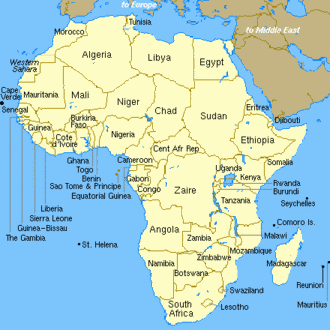
I've put up a map of Africa above so you can quickly see where Lesotho is in southern Africa (surrounded by South Africa, actually). Lassa generally occurs in west Africa, so that's probably unlikely, but the others either are endemic to southern Africa or at least have cases on record from that area of the continent, so they're possibilities and seem more likely than Ebola.
It should be noted that 2 cases of Ebola have been diagnosed in South Africa previously, but they didn't originate there: a traveller from Gabon was treated at a hospital in Johannesburg, where he infected a nurse (who died from the infection). Marburg is another possibility; it's also been introduced to South Africa by a traveller (from Zimbabwe this time), causing secondary infections in a nurse and the traveller's companion. Especially if the deceased woman had been travelling throughout the continent before heading to London, she could have come into contact with a number of agents of hemorrhagic fever besides Ebola.
The good news is that none of these viral hemorrhagic fevers mentioned are highly contagious. Both Ebola and Marburg have spread to others, but close contact has always been involved: nursing sick relatives, sharing needles, being exposed to contaminated body fluids. (The Reston strain of Ebola seems to be an exception, but it also hasn't caused any known illness in man). CCHF is tick-borne (though it can also be acquired by direct contact with infected tissue) and doesn't spread by casual contact. Lassa fever is generally spread to humans via infected rodent droppings or very close human contact (including, again, direct contact with infected body fluids). The same situation exists with RVF and YF: both are mosquito-borne diseases, but can also be transmitted via direct contact with infected tissues. So, it's unlikely that a planeful of passengers has to worry about contracting Ebola (or a similar hemorrhagic fever disease). However, they do mention that some passengers shared drinks with the infected woman. I can't imagine that someone would drink from the same cup or straw after they'd just provided it to someone who's visibly ill, but if they did, the would be the ones to focus on as far as future development of symptoms (though even that seems like a stretch to me). If any passengers or medical personnel had direct contact with blood from the patient, they also have a chance of becoming infected (though simple barriers, such as gloves and lab coats, significantly reduce the risk of transmission of these types of viruses).
This does, however, highlight just how quickly one of these "exotic" agents can be in our own backyard. It's certainly happened previously, where a businessman travelled through Sierra Leone through London and died in New Jersey from Lassa fever. It's happened before, and it will likely happen again, whether it's due to Ebola or another virus.
Image from http://rhodesian.server101.com/AFRICA_MAP.gif; thanks to David for the link to the story!

A very quick search of the BBC News website brings up nothing recent on Ebola, so it's probably nothing. I hope.
Unfortunately, neither the Daily Record or the Daily Mirror are reliable sources of news. They are closer to the National Enquirer than to the New York Times.
No mention of this on BBC / Sky.
Yeah, I checked out BBC first--one of the Brit sources I do know. And I should have noted in the article that there was nothing via ProMed, though they've sometimes been slow on news I find interesting. Even so, there are a few possibilities. One, the story was a bit embellished or outright phony, and the woman wasn't vomiting blood and didn't actually have a hemorrhagic fever. Good for everyone involved, and I still get to write about Ebola, so I'm happy. If it's real, two, they've not finished the tests yet and don't want to release anything until they're done. It's only been a few days, so this is certainly possible. Three, they tested it and it's not Ebola--but you'd think this would at least deserve a "tests were negative" mention. Four, the tests are done, they're positive for ebola (or another nasty virus), but they're keeping it under wraps for now. Unlikely, I think--that would be tough to keep quiet.
I'm probably missing a few permutations as well...
X-posted with Tan...man, I wish our rags would run more stories like this! Ours are all about 2-headed alien babies and celebrities. This one, assuming it's fake, at least lends itself to discussion of the topic.
So, first--just because she was vomiting blood and died, while obviously horrible, doesn't necessarily mean that it's Ebola.
You are talking sense, Doc Smith.
Hank B
The story sounds somewhat hoax-y at this point. This line is particularly puzzling:
"Virgin Atlantic cabin crew who came into contact with the woman have been told to monitor their health."
You mean they weren't immediately at least put under close observation and tested? Not even a mention of possibly quarantining them?
And since when has anyone shared drinks on a flight? I know airlines are cheap, but c'mon. If they meant that they gave her their drinks, then so what, that's not a risk for them.
I wonder why all we have is this 3 day old story with no new updates. I smell a rat. The initial story seems surprisingly detailed. How did the reporter know that she had seen her doctor beforehand and had complained of flu-like symptioms? I doubt she was fit to be asked.
You'd be surprised about people sharing drinks. I've had people at a concert previously offer a drink to my kids (from their container) when they mentioned they were thirsty. If, for some reason, the flight attendant wasn't available, I could see someone sharing a drink (though as I mentioned, I'd hope they wouldn't drink from it afterward!). And since none of the known VHFs are spread via the air, a quarantine really wouldn't be necessary (or indeed, very useful). I don't know the quarantine laws in London, though.
They mention a hospital spokesman in the story--he could have mentioned it.
Again, I'm not sayin' the story's valid (indeed, "hoax-y" is a good adjective), but it's plausible, at least.
Nothing in the Guardian either.
Tara -
Oh, I agree it's possible this could be an accurate story. It's certainly plausible that a very sick woman was pulled off that flight. And it might be true that she indeed had ebola.
I'll still need to see more to make this story credible, since one 3-day old story with no follow up and no independent verification will not cut it.
Something strange is going on here.
And I totally agree with that. Like I said, my main interest in it is to discuss the broader issue of exotic viruses (especially Ebola, which I've said before is my favorite) and travel.
I contacted the CDC, and this was their response to my inquiry:
"We are monitoring the situation. At this time it seems that both Ebola and Marburg virus infection are unlikely. We are awaiting a definitive diagnosis in this patient."
So, it's no hoax. Even if the dx isn't Ebola or Marburg, I'm willing to bet that it's some other kind of VHF - otherwise, the CDC wouldn't be involved at this point.
Interesting. I sent out a few emails yesterday to folks who might be in the know but haven't even had a chance to check yet if they've responded. Busy today...