
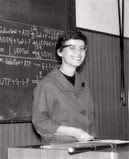
Stanford University microbiologist Esther Miriam Zimmer Lederberg, a trailblazer for female scientists and the developer of laboratory techniques that helped a generation of researchers understand how genes function, has died at Stanford Hospital.
Professor Lederberg, who lived at Stanford, was 83 when she died Nov. 11 of pneumonia and congestive heart failure.
She discovered the lambda phage, a parasite of bacteria that became a key tool for the laboratory study of viruses and genetics, and was the co-developer with her husband [Nobel prize winner Joshua Lederberg] of replica plating, a technique for rapid screening of bacteria for desired mutations.
"She developed lab procedures that all of us have used in research," said cancer researcher Stanley Falkow of the Stanford University School of Medicine.
She was also a pioneer of women's rights, becoming a full professor at a time when women were rare on the faculties of Stanford and other major universities. "She was a real legend," said Dr. Lucy Tompkins of Stanford.
(More after the jump...)
She laid the groundwork for demonstrating how phages can transfer genes between bacteria, and her findings were crucial to advancing the understanding of how genes are regulated, how pieces of DNA break apart and recombine to make new genes, and how the process of making RNA from DNA is started and stopped.Building on her work, Joshua Lederberg won the 1958 Nobel Prize for Physiology or Medicine for his discoveries on how bacteria swap genes.
The article notes how she not only pioneered this early work in phage genetics, but also worked on a method for replica plating bacterial colonies, initially using a rather unorthodox method:
Although the team eventually settled on sterile velvet cloth for the transfer, the original experiments were performed using the makeup applicator from Esther's compact.
Anyone who's done experiments mutating bacteria has probably used one of the techniques that are possible because of her work. I still cringe when thinking about all the replica plating I've done in my day, and my PhD research heavily used phage to move transposons between bacterial strains.
The article also discusses her interests other than science; sounds like she would have been a fascinating lady to know.
(Image from http://www.sfgate.com/c/pictures/2006/11/28/ba_obit_lederberg.jpg)

- Log in to post comments
Shoulders of giants.
It seems that molecular biology/microbiology has always been a pretty popular hard science field for women. Off the top of my head I can think of as many (if not more) outstanding female as male microbiologists.
I am curious about what studies have been done on this? I checked the Nobel site and there have been seven female laureates in physiology and medicine (most recently 2004) and only five in physics and chemistry combined. The most recent in 1964.
This is not to say that women have not been and are not now being treated unfairly compared to men in all of these fields.
BTW, Since when has Stan Falkow been a Cancer researcher?
I just checked the full article and Stan is now a molecular biologist. I guess that is better than being a cancer researcher but he is really a microbiologist.
D
"BTW, Since when has Stan Falkow been a Cancer researcher?"
Since it became sexier to be one. He's a cancer researcher in the sense that he's working to understand how H. pyroli infection might trigger cancer.
See:
http://med.stanford.edu/profiles/Stanley_Falkow/
But studying bacterial pathogenesis is his core area.
Tara writes: "I still cringe when thinking about all the replica plating I've done in my day...
Anyone who hasn't done replica plating can't cell themself a microbiologist...
Oh, my goodness!A truly great and almost forgotten lady that most have forgotten her important contributions.I note she was a student of Tatum where she met Joshua in New Haven (she was two years his senior). He received the Nobel in 1958 after which Joshua and Esther obviously divorced. He married Parisian Marguerite Stein Kirsch in 1968.How much did Esther actually contribute to his part of the work recognized in the joint Nobel with Beadle and Tatum, "his discoveries concerning genetic recombination and the organization of the genetic material of bacteria"?Did receiving the Nobel in 1958 have anything to do with their divorce as it did with the now notorious Dr. Tonegawa when he divorced his traditional Japanese wife who supported his work through the hard years to marry the NHK (Japan's top news agency) reporter who interviewed him after the win?Is the husband-wife team of Lederberg story another example of conceptual husband and practical wife?Despite who got the accolade, perhaps Esther's practical contribution has had greater impact in the long term than hubby's contribution.Oh, my goodness, how I love gossip about the private lives of scientists!Polly A.
Not only was she an amazing scientist, she one heck of a nice lady who gave beautifully clear and concise seminars. Perhaps pioneer is too small a word for this fine lady of science. Could we call her "McClintockian?" Maybe we should call Barbara McClintock "Lederbergian?"