

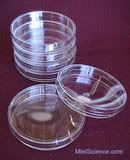
 Speaking of microbiology basics, along comes an article in the San Diego Union-Tribune about the petri dish, a staple of microbiology labs everywhere:
Before 1877, scientists exploring the nature and mechanics of microscopic life had a real problem. Bacteria used for study were typically cultured or grown in bottles or bowls of broth. Koch greatly improved the situation by developing ways to grow microbes in gel, which allowed researchers to separate and investigate individual types of bacteria.
But practical problems remained. It was hard to manipulate bacterial colonies through the small openings of bottles. Worse, there was the issue of contamination. Nothing stayed sterile, pure.
Enter Petri, whose lasting and eponymous contribution to science was the invention of a shallow, cylindrical glass dish with a transparent lid.
More below the fold...
It's amazing sometimes how the simplest things have made such huge differences in science. I mentioned previously the death of microbiologist Esther Lederberg, whose contributions to the field included the technique of replica plating. Here, a piece of fabric is placed over the colonies growing on the agar, lifted up, and laid down on a second (and third, fourth...) agar surface, so that the colonies can be amplified repeatedly (and different mutations can be screened for, etc.) This itself seems like such a simple thing, but it really helped to drive the field forward. Such was the case with the Petri dish as well:
"The discovery was the lid," said Moselio Schaecter, a microbiologist and adjunct professor at UCSD and San Diego State University. "The way (many earlier scientists) had worked was with plates stacked with glass rods separating them, the whole thing put under a glass bell. It was about as awkward as could be. You couldn't keep anything from becoming contaminated."
The article contains a nice overview of not only the history of the Petri dish, but also novel current uses (examining drug toxicology in cultured liver cells, for instance) and potential future uses (fake meat, anyone?). There's also the suggestion that the Petri dish may lose its usefulness one of these days:
Shugang Zhang at the Massachusetts Institute of Technology's Center for Biomedical Engineering argues that the two-dimensional dishes limit what scientists can learn about - and do with - three-dimensional life.
"The time has come to move on," he said.
Zhang and colleagues have done so, culturing stem cells on tiny three-dimensional scaffolds composed of protein nanofibers, each 5,000 times smaller than a human hair and containing pores up to 20,000 times smaller than the eye of a needle.
They suggest that computers will eventually replace the dish:
Some observers of the biological sciences say it may be possible, perhaps even probable, that the petri dish will ultimately disappear altogether, that computer models will replace live cultures.
Computer modeling has come a long way, agreed Potter at Georgia Tech. "We use it ourselves. But one of the reasons we still use petri dishes is to answer the questions modelers don't know.
Exactly--and this is why live cultures are still so important. Models are a great way to explore things, but they're only as good as the data that they're built on. If this is incomplete or lacking, the model will be much less robust. We're still only scratching the surface as far as understanding pure cultures of microbes, much less how they interact with other organisms in their environment--and to really dig into this, we need live cultures. I doubt that I'll see the disappearance of the Petri dish during my career.
Image from http://www.miniscience.com/kits/LAB1A/Petri-dish.jpg

- Log in to post comments
I don't see how we could ever do away with live cultures completly. Life I think will always find new ways to surprise us, so we'll never have knowledge so complete as to render live specimens obsolete.
Did there happen to be a formal article published which first described the Petri dish? And is it just me, or were nearly all basic microbiology techniques and equipment in use today invented in or around Victorian-era Germany?...
We often think of progress in science as limited by the ability to phrase the next big question or insightful theory. But there are always opportunities for those of use who are tinkerers, who recognize that a roadblock to progress is the perfect little bit of simple technology. As you show wonderfully here, it's often the tools that hold us back. You don't need the telescope, microscope, x-ray crystallography, or petri dish as an example of this...just see how many citations a good, prosaic, "methods" paper earns.
Getting things done in Academia
advice for graduate students in the sciences
I'm with Dave S.; I think we'd need something like a science / technology Singularity to completely replace live cultures with models.
Right now it seems that the closer we look at the basic functions and interactions of living systems, while we are getting answers to some old questions, new ones keep popping up. Or maybe it would be more accurate to say that we keep needing to rephrase the old questions.
Nice post, Tara. I'm fascinated by the history of science and technology, and here is a key part in your field.
I love living in this age. The wonders of the observed universe are EXPLODING!
Follow up: Found it:
Petri, R. J. 1887. "Eine kleine Modification des Koch'schen Plattenverfahrens." Centralblatt fur Bacteriologie und Parasitenkunde, Vol 1, pages 279 - 280 .
Adding that one to my list...now if I could only find the reference for the Schaeffer-Fulton endospore stain...
Models only substitute for living cells/animals when you already understand what all the pieces are, what they do, and how they all fit together, but it's too complicated to immediately understand what they all do together. That's almost never the case in biology. We're still trying to figure out what the parts do and how they fit together. So computer models are mainly used to work out the predictions of a complicated biological hypothesis. But then you still have to go back to your living cells or organism to see if your hypothesis is right.
I guess I'm going to have to write about the square petri dish...
wright writes:
> I love living in this age. The wonders of the observed universe are EXPLODING!
You say more than you perhaps realize. The universe itself is undergoing a new age of inflation (Google universe and inflation). So, as part of this current human age in which our knowledge about so many things is exploding, we have found out that, quite unexpectedly to our limited minds, the universe itself is exploding.
Computer models will never replace the skills we need to work with real bacteria. A computer model can not obtain a culture from a patient. And, at least now, a computer model will not transmit smell, something important for students (nurses) to learn.
We still have some old glass Petri dishes that we don't use for culturing. We use them for a number of things now such as the catalase test and we wet them out as match trays so the students don't put them in the desk sink or the bio-hazard container. I'm friends with the college plumber and he complained that the last time he snaked our pipes thousands of paper match sticks came out.
thanks sir..
I like to post this comment .It helps a lot.The one thing I do know for sure, if that day comes, is that when it's wedding cake cutting time, I will NOT make the same mistake I witness at every wedding. I will not be serving Champagne with dessert, but rather the slightly sweet and fizzy dessert wine,..
Thanks and Regards