
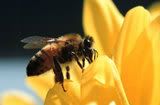
Something is wiping out honey bees across North America and a team of researchers is rushing to find out what it is.What's being called Colony Collapse Disorder (CCD) has now been seen in Pennsylvania, North Carolina, Florida, Georgia and way out in California. Some bee keepers have lost up to 80 percent of their colonies to the mysterious disorder.
Now, I'm admittedly not much of a bee fan. Several of my relatives are highly allergic, and I've only been stung once and hope I'll be fine if it happens again, but they do kind of make me nervous when I see them buzzing around. And a bee die-off might not sound like a huge deal at first--I mean, we can go without honey, right?--but recall that many of these bees are also put to work pollinating crops, so a large-scale die-off isn't so mundane, especially when they're currently unsure about what's causing it, or how to stop it:
Among the possible culprits are a fungus, virus, or a variety of microbes and pesticides. No one knows just yet. On first inspection, the pattern of die-offs resembles something that has been seen in more isolated cases in Louisiana, Texas and Australia, vanEngelsdorp said.
It's interesting how they're tracking and investigating it, though. Of course they're examining the bees themselves for any clues to the illness, but they're also using Google Earth to compare any geographic similarities between the outbreak sites, and using "a groundbreaking audio analysis technique that allows them to hear specific changes in bee colony sounds when specific chemicals are present. Chemical air sampling in hives is also being planned."
We've seen how an invasive fungus is spreading and killing amphibians; it will be interesting to see if this is another example of the spread of an infectious agent, a toxic chemical, or another factor altogether as investigations continue and other colonies become active in the spring.
Image from http://www.pnas.org/misc/honeybees.jpg

- Log in to post comments
I remember reading about something like that a while back. Different story, but increased temperatures in the mountains were resulting in evenings being warmer and daytimes being cooler, I believe due to increasing cloud cover due cloud cover trapping the heat at night and keeping the mountains themselves cooler during the day. More moderate temperatures in the mountains meant that a certain fungus was better able to grow. This was killing off frogs. If I remember correctly, the story I am thinking about is something that was covered by Carl Zimmer. Always a joy to read even if the stories themselves are sometimes disturbing.
This is the second whammy for honeybees, the first being the Varroa mites that wiped out something like 50% of them in the 1990s. 20 years ago I could stand in the midst of branches of one of our apple trees in blossom and the hum of dozens -- hundreds -- of bees pollinating away like ... erm ... bees was very audible. Last spring if I saw just one honeybee in a day in blossom time it was an event.
Yeah, my first thought on seeing the lead to this article was "again??". As someone who's family business is agriculture, this is definitely of interest to me.
Though the family doesn't currently keep bees, we definitely depend on them for pollinating some of our crops. We also have arrangements with beekeepers to place hives on our property. I'll have to see if anyone we know has been affected, and what we can do to help.
Lastly, there are (or were) numerous wild hives on our land. The oaks that are the most common tree tend to develop hollows after dropping limbs; these make attractive sites for bees to move into. There's one stretch of road that must have had at least a dozen hives within hearing range some years back. It would be a sad thing if all that busy humming fell silent.
Tara, you do make the distinction between yellow jacket wasps and bees, don't you? So many people don't and the bees get unfairly blamed for stings.
Honeybees have no interest in your picnic meat and typically don't approach people at all. Getting one in through an open car window and then brushing it off without looking is perhaps the easiest way to get nailed by one.
It is the wasps that are aggressively persistent about getting their share of ham or chicken. I've had them riding on a sandwich I was raising to my mouth. I am always bemused by those who start flinging their arms about while ducking and dodging around. Sitting still and knowing where the wasp is located seems much safer.
In my experience, it is also easier to accidentally come across a wasp's nest and get the whole lot in attack mode. Since I have done that a couple of times, it is a good thing I do not have the hypersensitivity to stings that my mother and sister do.
Yeah, I've literally stumbled across yellow jacket nests before. The old run-through-thick-brush trick works pretty well, not that I had a choice at the time...
Quite true about wasps being far more aggressive and likely to sting than bees. Interestingly, though it hasn't happened in some time, I always had a far more severe reaction to bee stings than wasps'.
Again. Bee's are a critical part of the ecosystem. The are the only pollinator for a large number of Angiosperms.
There are at least two colonies of bees in our yard. The land was original a pecan grove and we still have 5 pecan trees on the land. They are old and have lots of hollow parts. One of the colonies is at about head level and we can look right into it. The bees just fly right by and don't even seem to notice us. About a year ago we called a bee keeper because there was a swarm of bees on a palo verde in our front yard. He remarked that the were the gentlest bees he had ever worked with.
Our bee's look fine and hope they stay healthy. The CA almond growing area is not far from here but there is a desert (and sand dunes) between us, hope we stay uninfected.
The beekeeping industry works by trucking colonies long distances around the continent to keep pace with the seasonal flowering of crops. Any disease that emerges anywhere will be spread just about anywhere else in short order. This sounds like a classic example of the virulence/vector relationship where easy dispersal leads to increased virulence of the pathogen. From what I've heard, this is one reason why Varroa mites have been so problematic as well.
Unfortunately, large-scale beekeeping only works efficiently when the bees are productive all the time. Restricting the movement of hives, an obvious management strategy, will mean unproductive hives (in terms of cash flow for the beekeeper) for much of the year. Sadly, as pollinator services get more expensive, the greater the incentive for the beekeepers to keep on trucking.
Also worth noting that the honeybee is an introduced species here in North America. It helps maintain our human-engineered monocultures but is probably detrimental to our native ecosystems. I won't shed a tear over a honeybee population collapse if it forces us to adopt a more sustainable pollination industry.
An article I read about the die-off quoted someone as suggesting the mite problem may have been a result of this mysterious illness.
Yeah The Varoa mites are causing big ramifications in New Zealand at the moment, but if there is another problem out there then that could be very bad for the fruit industry (which is threated here by the mites) and all others that need the bees for pollination.
Does our bee keeping encourage genetic diversity? If not, it's the potato famine all over again. I hate that when that happens.
This is an entry from the Sustainable Ag list SANET, that may be of interest:
Date: Tue, 13 Feb 2007 09:00:35 -0800
From: "Matthew Shepherd (Xerces Society)"
Subject: Bee death syndrome any ideas?
MIME-version: 1.0
Content-type: multipart/alternative;
boundary="Boundary_(ID_dew3c1GQPXv+9J64QGkRAQ)"
There has been a considerable discussion and exchange of information and opinion on the beekeepers listserv, Bee-L, about the die back of honey bee colonies. I've pasted in below the text of a posting from Jerry Bromenshenk, of the University of Montana-Missoula, who is one of the leading researchers looking into the situation. His email is the best summary of what's happening that I've seen.
It's also worth pointing out that this is a disorder that only seems to affect honey bees. I don't know if it affects feral honey bees (has anyone looked?). It doesn't seem to impact native bees. They have plenty of problems of their own, but this is one that appears, so far, to have missed them.
Matthew
************************************
Posted by Jerry Bromenshenk on Bee-L, 1/18/07
Yesterday, a group of us formalized a working group and named the current bee loss syndrome being seen in the U.S. As of this time, I have reports that major losses have been seen in the U.S., starting in the spring in places like Michigan, Wisconsin, and Iowa. Its still ongoing in Florida, with major losses occurring in Oklahoma, and a number of reports from California over the last few days.
We are no longer calling this Fall Dwindle Disease -- its not a fall phenomenon when looked at across the nation, its a rapid collapse (often in less than 2-3 weeks), and it may or may not be a disease in the strictest sense. So, we're terming it Colony Collapse Disorder (CCD).
We, a group of researchers, extension agents, and regulatory officials have formed a group to investigate this problem and will call ourselves the CCD Working Group. This group represents a diverse number of institutions including Bee Alert Technology, Inc. (a bee technology transfer company affiliated with the University of Montana), The Pennsylvania State University, the USDA/ARS, the Florida Department of Agriculture, and the Pennsylvania Department of Agriculture. We're planning on adding Eric Mussen to the group to represent California.
CCD Symptoms
Based on initial visits to affected beeyards, the CCD drew up a list of the following symptoms, typical of the disorder:
1) In collapsed colonies,
a. The complete absence of adult bees in colonies, with no or little build up of dead bees in the colonies or in front of those colonies.
b. The presence of capped brood in colonies,
c. The presence of food stores, both honey and bee bread
i. which is not robbed by other bees, and
ii. when attacked by hive pests such as wax moth and small hive beetle, the attack is noticeably delayed (days, weeks)
2) In cases where the colony appear to be actively collapsing
a. An insufficient workforce to maintain the brood that is present
b. The workforce seems to be made up of young adult bees
c. The queen is present
d. The cluster is reluctant to consume provided feed, such as sugar syrup and protein supplement
Initial results from the online survey (http://www.beesurvey.com) has revealed that beekeepers think that this started at least 1-2 years ago, in its present form. As this list has mentioned, similar syndromes have been reported in the U.S., dating back to 1896. It certainly looks identical to the disorder reported by Oertel in 1965 (from bee losses in 63-64).
Finally, if you've experienced this, please fill out the survey - regardless of how convinced you are that you know what caused it in your bees. Too many factors, too few returns to sort this out without the help of the nation's beekeepers.
Thanks
Jerry
______________________________________________________
The Xerces Society for Invertebrate Conservation
The Xerces Society is an international nonprofit organization that
protects the diversity of life through invertebrate conservation. To
join the Society, make a contribution, or read about our work,
please visit www.xerces.org.
Matthew Shepherd
Director, Pollinator Conservation Program
4828 SE Hawthorne Boulevard, Portland, OR 97215, USA
Tel: 503-232 6639 Cell: 503-807 1577 Fax: 503-233 6794
Email: mdshepherd@xerces.org
______________________________________________________
"Bees" are actually a fairly large and specious group of insects. Honeybees are not native to the Americas. The genus Apis comes from Southeast Asia, with Apis mellifera widespread in the old world (naturally or historically moved around by people?) . Apis mellifera L. is the insect equivalent to the cow. The subspecies introduced to the America primarily come from Italy and rest of Europe, and represents only a small proportion of the genetic diversity.
It is not surprising that the honeybee is being hit hard in the Americas. It would be worrying if the honey bee population in Southeast Asia crashed as the genetic diversity there is far greater than it is here.
Honeybees have actually been somewhat of a problem ecologically, because they are an invasive species. Honeybee's population have suppressed or even exterminated many native bee populations. This is especially true in the tropics were many eusocial stingless bees have become very rare due to competition with honeybees. Which in turns has caused some flowers, which required native species to become rare themselves.
For example, I don't remember seeing many Halictid bees before the mite problem wiped out the honeybee. Now I see them fairly frequently. Native bees tend not to be eusocial, and usually are not as big or as noticeable as honeybees, or they tend to be mistaken for bumblebees. So the increase of their populations is not as noticeable. So while the honey bee populations are crashing, native bee populations are increasing. In the long run, especially in the tropics, a decrease in Apis mellifera is not a bad thing.