
As I've noted before, filoviruses are some of my favorite pathogens. I don't work on them myself--though in the pre-children era I certainly thought about it--but I find them absolutely fascinating to read about and follow the literature. Mostly, I think, this is because after knowing about them for so many years (Marburg was discovered in 1967), and so much research (over 1500 papers in Pubmed, or roughly a paper for every person these viruses have killed), we still know relatively little about the most basic questions--such as where there viruses are maintained in nature, and how they enter the human (or non-human primate) population, and why they're so deadly.
Anyway, after a long time in Ebola's shadow, Marburg virus has been in the news recently. As such, this is part one in a mini-series on Marburg virus, with an introduction to the virus and its history after the jump.
[See also Marburg in bats: has the elusive reservoir species been found?]
The year was 1967. Several laboratory workers, all from the same lab in Marburg, Germany, were hospitalized with a severe and strange disease. The physicians on staff realized the workers were all suffering from the same ailment, with symptoms that included fever, diarrhea, vomiting, massive bleeding from many different organs, shock, and eventually circulatory system collapse. An investigation began in an attempt to uncover the source of the outbreak. This led to the identification of the source of the virus in Germany: a species of African green monkeys, imported from Uganda, which were being used by the scientists for polio vaccine research. The virus was isolated, and found to exhibit a unique morphology, leading to the designation of a new group: the Filoviridae In that outbreak, a total of 31 human cases were observed, and the disease presented with a 23% mortality rate (7 deaths occurred out of 31 total infections).
After this episode, the virus went back into hiding for almost a decade, not surfacing again until 1975 in South Africa. The origin of this outbreak is unknown, although based on epidemiological studies it is assumed that the index case (the first person known to have been infected), a young man hitchhiking through Africa, acquired the disease in Zimbabwe, and then infected 2 others in South Africa when he arrived there. Only the index case died from the disease; the secondary cases (those infected due to contact with the index case) survived.
Marburg again disappeared until one case was reported in Kenya in 1980, and again in 1987 in the same area. In the first outbreak, again only the index case died, while a second patient survived. Only one infection was noted in the 1987 outbreak, resulting in death of the patient. Both of these Kenyan outbreaks occurred in the vicinity of a volcano named Mount Elgon, and there is evidence both index cases had spent time in a cave inside the mountain. This has led to (unconfirmed) speculation that bats may be a reservoir for filoviruses; a hypothesis which will be discussed in more detail in later posts.
Between 1987 and 1998, the only cases of Marburg were due to laboratory accidents, both in the former Soviet Union. One of these cases was fatal. However, in 1998, the largest natural outbreak of Marburg virus disease to date began in northeastern Democratic Republic of the Congo (DRC). This time, the focus of the outbreak was a town called Durba (population 16,000). A large number of men in this region work for the Kilo Moto Mining Company, which runs a number of illegal gold mines in the area. Working in this area is precarious; civil war broke out in 1996, and the socio-economic situation has deteriorated since then. Infectious diseases of all types are common, as vaccinations and medication are in short supply. The Marburg outbreak is thought to have started in November of 1998, although it was not reported to any international agencies until late April of 1999, following the death of the chief medical officer in the area from the disease.
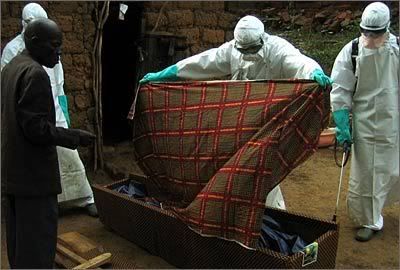 At this time, local officials contacted the Medecins sans Frontieres (Doctors without Borders) in Belgium regarding the ongoing hemorrhagic fever epidemic. Both this group and their sister group in Holland sent officers to investigate and to stem the spread of the epidemic. Patient samples were immediately sent to the National Institute of Virology in Johannesburg, South Africa; a diagnosis of Marburg virus as the cause of the illness was made on May 6th. Barrier nursing procedures were instituted, and isolation wards were fashioned at the hospital. Over the course of the epidemic, 149 cases with 123 deaths were recorded (83% fatality rate). Miners were found to be at a significantly higher risk of contracting Marburg than the general population of this area, suggesting they may be more frequently exposed to the natural reservoir of Marburg virus.
This outbreak was eclipsed beginning in 2004, when Marburg hit Angola in the fall. Due to civil war in the country and a non-existent public health infrastructure, the outbreak wasn't identified until almost 6 months later, in March of 2005. 252 people were infected, with 227 deaths (90% fatality rate). The outbreak was declared over in November of 2005, after no additional cases had been reported since summer.
This brings us to present-day Uganda, where another Marburg outbreak is ongoing, again associated with miners. So far, this one has been minor, and seems to be contained; meanwhile, back in the DRC, there comes a report of another outbreak of hemorrhagic fever. It's not known at the time what the causative agent is, but a hundred deaths have already been reported:
The deaths began following the funeral of 2 village chiefs. "Everyone that attended those funerals is now dead," said the medical inspector. According to Kanow, haemorrhagic fever is transmitted by contact with an infected person.
In all, 4 villages are affected and 217 people have come down with the illness.
Is this the next Marburg or Ebola outbreak? A number of other pathogens can cause hemorrhagic fever, but the geography and epidemiology do point to either Marburg or Ebola as likely agents. It appears that Marburg infection is endemic in this area of the DRC; thus, sporadic cases are expected. The instability and conflict in this region makes it difficult to supply regular international aid; thus, it is likely that we will see future outbreaks in this region. More information on the reservoir and transmission of this virus would go a long way toward controlling both Marburg and Ebola virus infections in this region.
Images from http://www.who.int/features/marburg/02.jpg

Additional references and resources:
Bausch DG, et al. 2003. Risk factors for Marburg hemorrhagic fever, Democratic Republic of the Congo. Emerg. Infect. Dis. 9:1531-1537.
Beer B, Kurth R. 1999. Characteristics of Filoviridae: Marburg and Ebola Viruses. Naturwissenschaften, 86:8-17.
Burton, A. Marburg Miner Mystery. The Lancet Infections Diseases, Vol. 4, 2004
Preston, R. 1994. The Hot Zone. New York: Random House.
If enough voices are heard things can be changed.
And I assume you have seen that bats may be vectors as well.
Indeed, which was one thing that spurred this post (the second being the recent outbreak)...more on bats tomorrow.
How can you be sure this is the virus that causes Marburg? I mean, weren't the victims all poor and with compromised immune systems?
;-P
Is Ribavirin effective against Marburg? It seems effective against other filoviruses. Has this been examined?
Jeb, you may laugh but in a recent exchange with a HIV/AIDS denialist the discussion turned to the ability of a virus to evade the immune system and survive in the presence of antibodies against it. Along with other examples of infectious organisms evading the immune system I mentioned Hep C., only to face the retort that the ability of Hep C to evade the immune system and cause liver cancer was unproven.
I might have to try Marburg on him, but I suspect that I know what his response will be.
I guess the lesson is that no matter how silly you think you're being they've already beaten you to it!
Great post. Thanks Tara.
Tara--
thanks for this post. Considering the relative differences among mortality rates, is there a possibility that different strains of Marburg are responsible? 23% and 90% are quite different.
JakeB: Or could it be that Germany was better equipped to handle the outbreak then Angola?
Piling on- thanks for this interesting post.
That's great thank you.
Eagerly looking forward to the follow-up.
Jake,
I'll have to look into Marburg strain differences. There haven't been any designated like there has been with Ebola (Zaire, Reston, Ivory Coast, and Sudan strains) to my knowledge, but I'll double-check. I'd guess that the differences in fatality rates are for numerous reasons: better hospital care (even if it's just rehydration); potentially exposures to higher levels of infectious virus in Angola; potentially other factors (nutrition, co-infections) that were present in Angola and less so in Germany.
hightrekker, no, ribavirin isn't effective against filoviruses.
Are you going to cover treatments in future posts? Ebola is always described as a death sentence, and description sof marburg seem similar but obviously it is not. Is it easy to treat or are those survivors just getting lucky?
D'oh! Somehow, despite the name of the virus, I fixated on its source being Uganda and completely forgot about differences in medical care available in the different countries.
The wikipedia article on filoviruses is seriously lacking. Would you consider contributing to it, if you're in a civic mood?
As I've noted before, filoviruses are some of my favorite pathogens.
I think people shouldn't have favorite pathogens. At all.
I think people who have favorite pathogens may be tempted to keep their little treasures alive by all means.
I think people who have favorite pathogens may be tempted to show off with their little darlings and make anybody believe that their cuties need a lot of attention.
I think people who have favorite pathogens are likely to get mixed up between information and indoctrination in their attempt to make everybody else worship their favorites.
I think people who have favorite pathogens are sick.
23% vs. 90%. Well-fed German researchers on one side, poor African peasants on the other. Could the latter be weakened by poorer food and the exposure to a lot of other diseases? Could the climatic differences be involved?
Tara wrote:
"As I've noted before, filoviruses are some of my favorite pathogens. I don't work on them myself"
Those BSL-4 suits are just *so* fetching, I think.
Some nut with a crap website replied:
"I think people shouldn't have favorite pathogens. At all."
Why not? I've got some favorite carcinogens (TCE, arsenic, benzene). Why can't they invite some pathogens around for a party?
jspreen,
What does it matter to you even if people would "be tempted to keep their little treasures alive by all means"? Don't you deny that these "little treasures" cause disease?
And as I noted, I don't work on Ebola or Marburg, so that concern isn't applicable to me anyway.
Oh, and to answer a question earlier, yes, Marburg does have identified strains, similar to Ebola. However, I've not found a nice overview of them yet to know how many there really are. I'll see if I can ferret more of that out for the third post in the series next week.
Long, long time ago I was travelling and I went from Frankfurt to a town north of there on a train I don't remember the name and I went through Marburg and stopped for lunch and saw the castle on the hill and twisted my ankle but not to bad. Cute town.
If filoviruses aren't real I wander what kind of "stress" made those people die of the disease from the research lab? Maybe they wanted to walk up that hill to the castle but they were scared they would twist their ankle on the cobble stone like I did?
I'm sorry Tara responding here it'll ruin a prefectly good thread but I'm amazed at your composure.
Does Jan have a clue how lucky he is he wasn't banned last year for using homo phobe expressions? Also people call you "Terror Smith" and "Ann Coulter" and they just don't get it you've never banned anyone. The worst dafamatory lewd lying nonsense stays up there you don't take it down. Free speech all the way. This stuff would get rejected at their OWN boards like AME with its control freaks.
And they call YOU names? Keep givin em that rope, Tara they're doing a great job.
What does it matter to you even if people would "be tempted to keep their little treasures alive by all means"?
What would it matter? Don't you understand, Tara? They'd be tempted to fill the world with fairy tales about their treasures, they'd be tempted to tell other people - who are made believe that their own opinion makes no sense because they have no expert experience - that said little treasures are the cause of their ill-being.
People who would "be tempted to keep their little treasures alive by all means" might even be tempted to push miraculous killer drugs and pretend they heal the "I myself have no opinion" patients suffering from "Never heard of before" diseases caused by brand new pathogens.
Doesn't it sound strange to you Tara, that "new" viruses causing "unknown" diseases are discovered exactly the day mankind disposes of techniques unheard of some decades before?
Doesn't that sound like an astronomers shouting "A new star is born!" just now he's equiped with a new telescope?
It's not a new star, Tara, it's a star he simply couldn't see without his new telescope. But the astronomer forgot because his brain is narrowed by his exclusively watching the universe through a tube.
Get away from PubMed for a while, Tara. Stop watching exclusively in the same direction all the time. Wake up and do some some research for your own. Start with Antoine Béchamp, you won't be disappointed.
"Start with Antoine Béchamp, you won't be disappointed."
----------
I did. I was. Not surprising, as everything you say is either total bullshit or a deliberate lie.
What is really, truly funny about this is that supposedly, Jan Spreen thinks that virii and bacteria are mankind's little helpers, healing the body after cancer. So he should be in favor of having as many of them around as possible, and he should have favorites (after all, some must be better little helpers than others.) This would make him, by his own lights, sick.
But we knew he was a sick and depraved person already. Because spreen really does want people to die, and really does offer aid and comfort to a murderer.
who are made believe that their own opinion makes no sense because they have no expert experience
Well, when a bunch of yokels build a rocket that makes it to the moon and returns safely then I'll start believing the opinion of people with no expert experience or training (that people WITH the training show to be wrong) matters.
Doesn't that sound like an astronomers shouting "A new star is born!" just now he's equiped with a new telescope?
It's not a new star, Tara, it's a star he simply couldn't see without his new telescope. But the astronomer forgot because his brain is narrowed by his exclusively watching the universe through a tube.
Life cycles of stars are fairly well documented and understood. Astronomers know the difference between a new star and a young star. But perhaps Steven Hawking is a big pharma shill too?
Wonder what Jan's opinion is how did those filoviruses show up in 31 scientists in Marburg? Why were those workers all so stressed all together and not anyone else? Did they have a mean boss? Were the wall of they're lunchroom the wrong color? Was it really what I said the cobble stones to the castle scared them?
I wish Jan would tell us what his opinion was or the opinion of his master.
"I wish Jan would tell us what his opinion was or the opinion of his master."
--------
Trust me when I tell you that the last thing anyone wants or needs to hear is Jan's opinion.
I wish Jan would tell us what his opinion was or the opinion of his master.
I don't know what the opinion of my master might be because I have none. As for my opinion, I think maybe the filoviruses showed up because their 31 hosts were partying. It's either that or the people who start this nonsense each time and come up with about one new pandemic provoking virus per month drink too much whiskey and smoke too much pot during working hours.
Every scientist that gets sick is secretly a drunk party animal. They all got the memo on using microbes as their cover up for living Animal House.
I used to think that all of those simplistic plots that become SciFi Channel movies, replete with idiots who are willing to destroy the world, as well as deny anything/everything, in order to live in their own well-ordered version of reality, were complete fiction.
Then I come here, see jspreen at work, and realize that these aren't always completely fictions.
As for the filovirus's, there is a lethal elegance to the Shepherd's Crook of Ebola, that the simple rods that characterize Marburg miss out on. I can easily see the fascination in either of these viruses however, as they both present a mystery begging to be discovered.
And I assume you have seen that bats may be vectors as well...
Lol, a favorite pathogen? I know what you mean, but perhaps you should have said 'one of the most interesting pathogens' or something like that. 'favorite' pathogen just sounds weird.
As for the bats... of course they could be carriers. Those little animals are probably carrying a lot of diseases... I'm surprised no one has thought of it before! Have you seen how ugly those creatures are?? We have a few of them around here, but when they live in caves and stuff who knows what they eat? Or what they are exposed to? I wouldn't be surprised if the disease sits in some rock and infects the bats somehow... I don't know. But they're ugly, flying rats, and they must be responsible for this disease!
As for the filovirus's, there is a lethal elegance to the Shepherd's Crook of Ebola, that the simple rods that characterize Marburg miss out on. I can easily see the fascination in either of these viruses however, as they both present a mystery begging to be discovered.
I used to think that all of those simplistic plots that become SciFi Channel movies, replete with idiots who are willing to destroy the world, as well as deny anything/everything, in order to live in their own well-ordered version of reality, were complete fiction.
I just found your great website, and would like to comment on those people who think people who have favorite pathogens are sick. I have many favorites, myself; Bubonic Plague has been my all-time favorite, with gangrene coming in at a close second. I find the hemmoragic virus' to be utterly fascinating. I had a boyfriend many years ago who went to Africa as a Medical Anthropologist and died from Ebola.
How can you be sure this is the virus that causes Marburg? I mean, weren't the victims all poor and with compromised immune systems? thank you
thank you nice sharing :D