
 Salmonella species are frequent human pathogens. An incredibly diverse genus, different types of Salmonella infect an enormous variety of species, from mammals to fish to invertebrates. They are typically acquired via ingestion of contaminated food or water, and the bacteria then seed the intestine and replicate there. These gram-negative organisms are the cause of typhoid fever (Salmonella enterica serovar typhi) and can also cause acute gastroenteritis (multiple types, including Salmonella enterica serovars enteritidis and typhimurium).
Of these types, S. typhi is the most deadly, and generally the best known. Typhoid fever, while no longer common in developed countries, is still a significant burden in developing areas, where ingestion of S. typhi leads quickly to fever, nausea, and vomiting. The bacterium can also spread from the intestine to the blood and other organs, causing a systemic infection that can rapidly be fatal. Here in the U.S., however, S. enteritis and S. typhimurium are more common--indeed, they rank among the most common food-borne pathogens here. These bacteria also are ingested and cause gastrointestinal symptoms, but disease is typically more mild than with S. typhi. The victim becomes symptomatic ~12-48 hours after ingestion of the bacteria, experiencing vomiting, nausea, abdominal cramping, and diarrhea. The illness can last from 3-7 days in healthy individuals; in the very young or old or those with other types of compromised immune systems, symptoms may be prolonged and more severe, and more frequently result in death.
There has been much work over the past 50 years examining factors that allow Salmonella to cause disease, and to characterize the bacterium's interaction with its hosts. However, a novel study takes this research to another level, quite literally--looking at how space travel affects the virulence of Salmonella typhimurium in a mouse model of disease. More after the jump...
Published in PNAS earlier this month, the paper looked both at virulence directly via inoculation into mice, and also looked at changes in the global production of proteins (the "proteome") and the gene expression of bacteria that were grown aboard the space shuttle Atlantis last September. All these variables were then examined alongside Salmonella that were treated in the exact same manner, only they remained on earth instead of taking a space jaunt.
Within 2.5 hours of landing, the bacterial cultures were analyzed, and varying doses of the bacterial samples were inoculated into two sets of mice (one for the earth-bound cultures, one for the well-traveled bacteria), and the mice were observed at least twice a day for a month. They found that the space bacteria were both killed mice more quickly, and killed them at lower doses of bacteria than did those grown here on earth (see figure 1B-D, reproduced below). Examining the bacteria themselves, they also found that the bacteria themselves looked different between the two groups, with those who'd gone on the flight producing a slimy goo that wasn't seen in the ordinary bacteria.
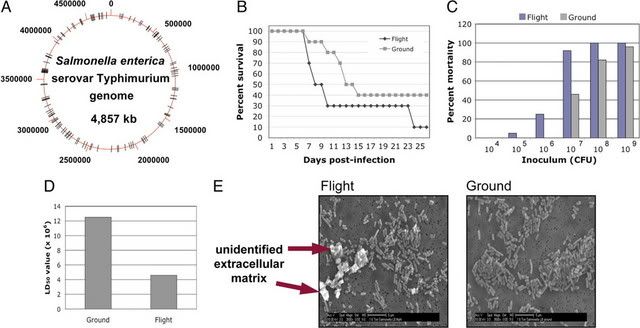
The researchers analyzed gene expression differences between the bacterial cultures using a microarray, looking at a minimum of 2-fold differences in expression between the earth and space cultures. They found that 167 genes were differentially expressed--98 of those were down-regulated in the flight samples, and 69 that were up-regulated. The affected genes were distributed throughout the chromosome, so it wasn't a particular area that showed changes in gene expression.
The genes that showed increased expression included fliC (part of the flagellum) and several genes encoding membrane proteins; the remainder included housekeeping genes, as well as a number of plasmid genes (including several involved in antibiotic resistance). A few genes relating to biofilm formation also were increased, potentially resulting in the sticky matrix observed under the microscope.
Those that decreased in expression in space included several other flagellar genes and a hefty number of regulatory genes. These included one called hfq.
The Hfq protein in Salmonella, E. coli, and other species acts as a global regulator--that is, it can affect the expression of a whole lot of genes, particularly in response to stress. When the amount of Hfq decreases, as it appears to have done during the flight, other genes that it usually keeps repressed can increase in expression. Therefore, changes in just this one gene can have a big effect on global gene expression, and potentially bacterial growth and survival. They went on to test the role of Hfq in additional experiments conducted here on earth, but using an apparatus that simulates microgravity. In the wild-type strain, they found that the organism survived both an acid stress and growth in macrophage much better when they were grown at normal gravity versus microgravity. However, bacteria with a mutation that rendered the hfq gene non-functional grew equally well regardless of gravity conditions, suggesting that it's advantageous to have low levels of Hfq in microgravity conditions.
So, this research has led to headlines like Spaceflight boosts bacterial deadliness, Lethal bacteria turn deadlier after space flight, and Germs taken to space come back deadlier. Does the research support this? I don't think so. For starters, while this was a cool experiment, it's looking at one strain of one species of bacteria. It's a mistake to generalize results from a single strain of Salmonella to an attention-getting (but scientifically wrong) generalization that "space makes bacteria more deadly." Indeed this may be universal among bacteria (though I doubt it--there are few "universals" in bacteria), but we don't have the data to claim any such thing at this point (though others are on their way to finding out). Perhaps this is a phenomenon unique to Salmonella. Perhaps if they repeated the experiment with the same bacterial strains but using slightly different conditions, you'd get different results. (This seems somewhat unlikely given the earth-bound microgravity experiments, but still). Either way, it seems way too soon to draw conclusions here for anything but this particular experiment carried out.
What's also not known is how long this change in gene expression (and hence, virulence differential) remains after re-acclimating to gravity. The expression assays were done with RNA whose transcription was halted while still in zero gravity, but the live cultures had over 2 hours on the ground prior to inoculation into the mice. Would they have been equally virulent had they been allowed to grow for another 2 hours back on earth? 4, 6? Are the changes in gene expression they showed permanent or transient? Was the hfq gene sequence unchanged in space isolates, or had a population of bacteria which had a mutation causing them to express low levels of Hfq simply overtaken the wild-type?
This research has implications for more than just knowledge for the sake of knowledge. Space tourism has already become a reality, and space programs are broadening elsewhere. You certainly can't sterilize a human before they head into space, so therefore each astronaut is also their own little experiment. Are their own intestinal bacteria, for instance, becoming more virulent during their stay in zero gravity? Do they remain that way indefinitely? There are many unanswered questions stemming from this pilot (/rimshot) study and the news reports are a bit overblown, but definitely a fascinating line of investigation nevertheless.
Reference
 Wilson JW et al. 2007. Space flight alters bacterial gene expression and virulence and reveals a role for global regulator Hfq. PNAS. 104:16299-16304. Link.
Image from http://www.dimaggio.org/images/AIG/Newsletters/Astronaut.gif

(See also my post at Correlations on this topic).
Would the fact that the bacteria that went into space were probably exposed to greater levels of radiation than the control sample make a difference ? I am assuming that the greater levels of radiation would increase the number of mutations but of course I could be wrong in that, and also wrong in thinking that even if there were a greater number of mutations the difference would be significant.
Are they really exposed to much greater levels of radiation? The shuttle should have shielding to protect the humans plus they aren't high enough to be into things like the Van Allen belt correct?
I think you're correct, apy, but I don't see them address that at all in the paper. If they are exposed to higher levels, it could potentially affect the results.
I am not sure about the Shuttle but I do recall that when Concorde was flying the passengers and crew were exposed to two or three times the background level of radiation at sea level. Concorde flew between 50-60000 ft which still left a fair bit of atmosphere above it. As I recall the levels were high enough that there would have been cause for concern had the flights not been of short duration and limited in number.
I didn't realize that, about the concorde, here is a reference if anyone else wants it:
http://en.wikipedia.org/wiki/Concorde#Increased_radiation_exposure
I'm not sure at this point, I had difficulty finding any hard numbers on the amount of radiation at the altitude the shuttle flies at. At best, I could find people are concerned about the amount of radiation between here and Mars. It has also been reported that those who went to the moon got exposed to much more radiation than those on the ISS or shuttle. The evidence being almost all astronauts that went to the moon have developed cataracts, believed to be caused by radiation even for only the short time they were gone. That leads me to suspect the shuttle is shielded in some way, both due to its construction but the earth. But I really don't have any facts to back that up with other than the extended trips people take on the ISS/shuttle with seemingly no ill effects.
The shuttle flies above much of the atmosphere, but it doesn't fly above the magnetosphere, which provides most of the radiation protection. A typical 8 day shuttle mission would expose the astronauts to radiation the equivalent of living in Denver for a year. If they flew higher, longer, more often, nearer the poles, or if there were a solar flare bursts, then there'd be more radiation.
I wonder what changes you'd see if you grew them in a centrifuge at, say, 3-5 gravities.
It's hard to believe that absence of gravity would affect something that small. Do we know the viscosity of the medium they were grown in?
An ill omen for long-term space, Moon or Mars trips.
Does anybody have any info on long-term studies on
the microflora of manned space projects so far---the ISS,
Soviet-era projects, etc..
Who's going to be monitoring microflora and virulence
problems on privitized manned space projects if they
ever get going?
How about the virulence of the pathogens IN and ON the astronauts themselves?
Someone who used to work for NASA was telling me years ago that some sort of bacteria had evloved on the ISS to consume the insulation on the wiring. I don't know if this is true or not and I've never seen anything about it since.
Speaking of gastrointestinal staph infections.
I have on occasion had bouts of food poisoning. Basically infection of me guts by staph. The incubation period is about 8 hours, symptoms are a thorough purging of the GI tract, all this accompanied by a 48 hour period of near continuous sleep. I must ask, does this sort of thing happen to others?
Really good questions, and that's what I ask about a bit more over at my Correlations post. I don't know if any longitudinal studies have been done on this or not; if so, I've not seen them.
One thing that I wish they'd done also would have been to grow the bacteria on agar rather than in broth and see if the same effects were found. The authors suggest that their model both in space and their earth-based microgravity model are "biomedically relevant":
...but I'm not 100% convinced of that.
Nat, I've not heard that--sounds like an Andromeda situation. But bacteria can eat damn near anything, so I suppose it's possible.
Even assuming a higher background mutation rate because of cosmic radiation, I am having trouble thinking of selective pressures for bacteria to switch from a completely different substrate to wiring insulation in the ISS versus down here on earth. I suspect that if there are bacteria that like to munch on fluoropolymers (given the existence of nylon-eaters, no doubt if there aren't such bacteria yet, there will be), they are more likely to have traveled to ISS with the equipment than to have evolved there.
Maybe they could cut the Gordian Knot by sending some infected mice up (in a sealed container) and compare them to controls on Earth.
Thinking about the pattern of changed expression, my first guess would be an alternate state related to a change in viscosity or fluid shear patterns. Altered membrane, flagellum, and biofilm properties packaged as a module.
Can bacteria maintain a "remembered" expression state using methylation the way many eukaryotes can?
But I don't know that there's really any way to control for the stress space travel itself would have on the mice. I assume this is why they kept the mice at home.
And yes, they do mention specifically fluid shear patterns. And likewise, bacteria do use methylation to regulate gene expression, but I can't really answer beyond that.
I have a small question on terminology that is unrelated to the topic posted here: Is there a difference between the verbs "to cure" and "to treat", when used scientifically? Does "to cure" mean to "eliminate the problem"?
Yes. "To cure" means to eliminate the underlying problem, whereas "to treat" means to attempt to address the underlying problem or its symptoms (the subjective, usually negative, experience of the problem reported by the patient.) Treatment may be successful or not; cures are successes by definition.
I suspect they would have seen the exact same thing with mutagenized cultures on earth. We've known for decades that bacteria grown in orbit experience much higher mutation frequencies than bacteria grown on earth (folks publish about this every couple of years in Mutation Research). The simplest model is that they've mutagenized their culture and found a more virulent mutant.
I read this paper when it came out and filed it under the "So what?" label.