
I really need more time to fill in a gap in my microbiology education: environmental microbiology. I run across papers all the time that are absolutely fascinating, and wish I had a free year to just take some additional coursework in this area. For instance, a paper in today's Science magazine discusses how atmospheric bacteria result in the formation of snow; more after the jump.
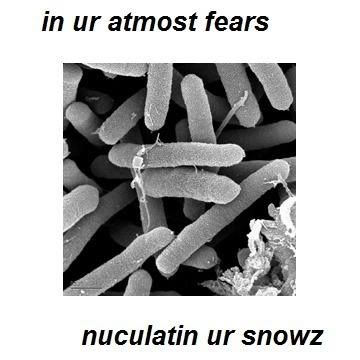
The authors here were looking at ice nucleators (IN) in snowfall. Think of this like crystal experiments you did as a kid--you had to stick something into the solution to serve as a seed for the crystal to grow. Snow (and other precipitation) does the same thing in the atmosphere; as the Atlanta Journal-Constitution story on the research notes, " under most conditions, the moisture needs something to cling to in order to condense." According to the Science paper, those seeds are frequently bacteria, including, as the author notes in the news interview, some pathogens of plants (such as Pseudomonas syringae, pictured above). Apparently (unbeknownst to me), P. syringae is already used to make fake snow, so the fact that it can serve as a seed for precipitation isn't new. However, the authors note just how important these biological nucleators (including P. syringae) appear to be in the atmosphere:
The samples analyzed were collected during seasons and in locations (e.g., Antarctica) devoid of deciduous plants, making it likely that the biological IN we observed were transported from long distances and maintained their ice-nucleating activity in the atmosphere...our results indicate that these particles are widely dispersed in the atmosphere, and, if present in clouds, they may have an important role in the initiation of ice formation, especially when minimum cloud temperatures are relatively warm.
Bacteria...is there anything they *can't* do?
[Edited to add: Ed and Michael also have posts on this paper.]
Works cited
Christner, B.C., Morris, C.E., Foreman, C.M., Cai, R., Sands, D.C. (2008). Ubiquity of Biological Ice Nucleators in Snowfall. Science, 319(5867), 1214-1214. DOI: 10.1126/science.1149757
- Log in to post comments
Can they do the macarena? I think not.
A quick Google search pulled up this video. Bacteria can even keep my ice cream from getting freezer burn. Awesome.
Doh. I just posted a write-up of the same paper. Great minds etc.
Also, your image reminded me of something I've been wanting to do for a while: http://scienceblogs.com/notrocketscience/Lolbachia.jpg
Heh. I love the picture. Found another link besides yours as well; I'll include 'em both in the post.
"Bacteria...is there anything they *can't* do?"
That's a microbiologist for you... seeing bacteria at the root of everything, like the tree of life.
Tara is another example of the saying: "If you've only got a screwdriver, every problem looks like a nail".
Wait, that doesn't sound right, maybe it's: "If you've only got a hammer, every problem looks like a thrust bearing."
Gah! Or was it: "The nail that sticks up above the rest gets screwed down the hardest."
I can't remember. We ran out of orange juice at the party and had to finish the vodka neat.
Mind you, if Fred Hoyle was still alive, he'd probably be claiming that the microbes nucleating snow had interstellar origins and that it's another reason why our nostrils are located on the underside of our noses -- To reduce the uptake of the 'panspermic' sequences embedded in snow.
Unsympathetic Reader,you just being silly now. Of course Tara doesn't think bacteria can do everything. There are a couple of things only viruses can do
How does this prove the religion of evolutionism? The clouds stay clouds and the bacteria stay bacteria. Both maintain the same Bahrmin level. Why do evolutionists always attempt to mix real science with their fetid anti-Gospel?
Wow! Very cool -- I had no idea!
I think it was Richard Fortey who once asked why there was no huge zeppelin like creature to fill the niche of "air-whale". Now we know: snowfall!
Don't eat the yellow snow...
Every try eating the old pink snow? It really does exist at higher elevations in Colorado. Tastes a little like watermelon. Supposedly is due to a fungus growing in the snow.
*ahem*
All microbiology is environmental microbiology. You multicellular eukaryotes with your fancy nuclei are nothing but the HumVee's of the microbial world.
Well, true--but I guess I know more about the environment of the human body than that of, say, the upper atmosphere.
Mentioned this article, stole your picture, and linked to you ;) Thought you should know!
~Chris
The Book Swede
PS: I stop by fairly often now, so hi! And yes, my blog is totally unrelated to science! Well ... most of the time :)
I love the graphic. I was wondering at first "Why did she spell utmost with an 'a'? Must be a dialect thing." then I got it.. oh, ATMOSPHERES. I think I figured it out because on my way home for lunch I was thinking about how all my money ends up in the ATM-o-sphere.
Pole Greaser, you just gave the game away. You are clearly a parody.
So, was snow possible before atmospheric bacteria?
thanks