

Taking a brief hiatus from my hiatus to discuss a question I've been asked a number of times in recent weeks by friends and family: what about flu shots? Are you getting one for yourself? Your kids? The answer is yes to both, with more explanation after the jump.
First, for readers unfamiliar with this blog, let me be frank regarding my opinion on vaccine "controversies," such as "vaccines cause autism." As I've discussed here several times already (and more can be found by searching my older posts), this assertion is completely unsupported by many scientific studies, so this is not a concern to me as either a mother or an epidemiologist. (Orac is a wealth of information on this topic as well, for anyone who would like some further reading).
Second, I will be similarly frank that, despite the false association with autism, vaccines can cause other side effects. For flu, the most common side effect is soreness at the site of injection. Some individuals can have serious reactions to the shot, and for this reason a number of people should not get flu vaccinations: those who have had a previous serious reaction to a flu shot; those with known allergies to eggs (since the virus is grown in eggs); individuals who previously developed Guillain-Barré syndrome (GBS) shortly after a previous influenza vaccination; and infants under the age of 6 months, as well as anyone who is currently ill with an infection causing a fever. Serious reactions to influenza vaccinations are, however, quite rare outside of these groups, and my kids and I have had flu shots for many years now with no adverse reactions.
Third, it should be acknowledged that the influenza vaccine isn't 100% effective. It's actually quite a bit lower than 100%, but the efficacy varies from year to year, depending on how well the strains of virus included in the vaccine match those which actually end up circulating during the flu season. Additionally, the point of flu vaccination isn't only to prevent *cases* of influenza infection--it's also to prevent the serious complications that influenza can cause, so that if a vaccinated individual does develop an influenza infection, the symptoms will be milder.
What about the virus(es) themselves? This year it looks like we'll have several different viruses circulating: the remnants of the "seasonal" flu viruses that have been in the population for a number of years (thus far looking to be very much in the minority as far as total flu infections), and the novel H1N1 virus. We know that "regular" influenza kills roughly 36,000 Americans each year. Typically, fatalities tend to be concentrated among the youngest and oldest age groups, so I and my kids (ages 9 and 7) would be unlikely to die. For novel H1N1, however, we're seeing something different. For the most part, it seems to be a fairly mild virus--nothing like the 1918 pandemic, or anything close to the death rates we've seen from H5N1. However, it appears to be spread *very* easily and rapidly, and while deaths have been relatively rare, they're not like we've seen with "seasonal" influenza. Instead, most deaths have been in people between the ages of 5 and 64:
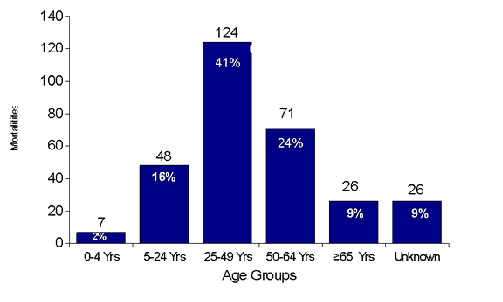
Two things should be noted here. One is that, while the numbers are highest in this middle age group, they're still small: only 302 deaths as of July 24, 2009 (though totals now show approximately double the number of deaths). Second, in many of the fatalities, patients had an underlying condition that put them at higher risk (obesity, pregnancy, neurological conditions, respiratory conditions, etc.) A recent report looking at H1N1 fatalities in kids noted that:
Two-thirds of the children who died had high-risk medical conditions. Nearly all of them had an illness related to the nervous system, including mental retardation, cerebral palsy, epilepsy and other seizure disorders....Of 10 children who were healthy before they got swine flu, eight had a bacterial infection such as bacterial pneumonia along with the flu.
So, it's not a perfect vaccine, and the odds of myself or my kids dying from influenza are pretty slim. Why, then, do I think it's worth it?
I view vaccination as akin to wearing seatbelts while traveling. Though I always buckle up, odds are good that I won't be in a car accident that day, and even if I am, I probably would only suffer minor injuries. There's even a small chance that the seatbelt itself could cause me--or the kids--some bruising or similar minor harm, and sometimes it annoyingly digs into the skin on my shoulder if I'm wearing a sleeveless shirt, but the little discomforts are worth it because I know that it dramatically increases my odds of living through a serious car wreck. That doesn't necessarily mean I'd be unscathed--I could still end up with whiplash, or broken bones, or even more serious injuries--but I'm doing what I can to protect myself and my family. Flu shots are the same thing--some initial discomfort from the shot and a bit of soreness for a day or so afterward, but I know that they increase the odds of staying healthy. This is especially true for my son, who has asthma and is therefore in a group with a high risk of influenza complications.
The bottom line for me is that the risks to my children that come from being infected with the influenza virus--be it novel H1N1 or the seasonal viruses--are far greater, and more serious to their health, than any risk that comes with influenza vaccination.
Getting the vaccinations
There are separate vaccines for the seasonal viruses, and for the novel H1N1. The former is rolling out right now, so it should be available in your area already, or it will be shortly. The H1N1 vaccine is expected in early to mid-October, so to be protected against all the circulating viruses this fall/winter, two different shots are required.
- Log in to post comments
Thanks for this, Tara. It was really insightful and interesting. I always can count on your for great info regarding vaccines.
Tara, on NPR a few days ago ( I don't have a link right now) I heard the reccomendations for H1N1 shots were : pregnant women, people 6-24 and older people with underlying health issues. From your graph, it looks like that age should be extended past 24. Why do you think they have limited it? (I'm a bit irked about being at the end of the list.) Is it because many of the older people in the "young" age group are in college, the best breeder of infections?
(Thank you for coming back!)
Walgreen's is advertising flu shots for $24 in my neck of the woods. Thanks for the posting, BTW.
JustaTech, when the guidelines were developed and released, they weren't sure how much vaccine would be available, and whether one or two doses would be needed to successfully immunize. Therefore, immunizing the groups they chose would give the most bang for the buck, as far as providing protection to high-risk groups, and reducing the spread of the virus (which is one reason to include the 19-24 yr old group, though that actually was a debated point--some panelists wanted to end it at 18 and keep the 19-24 yr olds off). Now it's looking like we'll have adequate vaccine for the seasonal demand, but I'm guessing they'll leave the recommendations as they are unless we see a real spike in illnesses or deaths in age groups outside of the current recommendations. Remember the numbers above still are pretty tiny relative to the number of people infected, so whether this pattern will hold throughout the season remains to be seen.
Tara:
Thanks for this. Didn't have the flu vaccine on the radar for me, wife, 3, 5 year olds... No brainer to vaccinate for flu now -- then get H1N1 when available.
BTW: talked with my aunt, a nephrology nurse practitioner back east. She treated a 26 yr old H1N1 patient, who survived, but was very touch and go. No underlying conditions... in a short bit went from very healthy to very sick (including kidney failure). Aunt is suggesting vaccination now, not just to avoid getting dead -- but to avoid a nasty-nasty bug.
Tara, my name is Snowy Owl and I am at flutrackers.com
Why I'll wont let my kids have their flu vaccines
As a sole parent and having a pretty good knowledge of what is going on since 2003, I just canhttp://www.emea.europa.eu/humandocs/PDFs/EPAR/pandemrix/H-832-en6.pdf
After I read that I became radical towards GSK vaccine with AS03 adjuvant.
I am not an expert and since I am in full outrage towards GSK adjuvantAS03 that will be insert in the blood of the majority of Canadians and a significant portion of people of U,K, I reach out to ask knowledgeable people that I respect to please give me a feedback on this GSK adjuvant AS03 (illegal in U.S. BTW) because as SusanC at Flu Wiki I am witnessing something that makes me Scream. Despite past differences I have ask the Reveres at Effect Measure and others in Europe.
Your observations would be really appreciated.
Thank You
Snowy Owl
So what is the problem Snowy Owl? You don't like vaccines for all those well established make believe reasons and then you found some key words that make you scream. Nvm, I figured it out.
*passes an extra tinfoil hat*
*keeps earplugs for self to avoid pain from incessant screaming*
Thank you, Tara, for this sensible article!
You can find the nearest vaccine clinic at flucliniclocator.org, a yearly service of the American Lung Association.
I am shocked that you only focused on the personal benefits to you and your children for getting vaccinated. You failed to mention that by getting vaccinated, you are also reducing the risk that other people will get the flu and, possibly, die.
Your "seatbelt" analogy is misleading. The better analogy is driving at a safe speed: you are not only making yourself safer, but everyone else on the road.
Good points, CPP, and especially true for people who live with, or frequently contact, people who can't get vaccinated (such as infants under the age of 6 months, or individuals who can't receive the vaccine because of the conditions I mentioned above). The reason I focused on personal benefits is simply because that's what most people tend to ask about--the personal outcome of the risk/benefit equation, and especially with all the misleading information out there about vaccination, it's largely become a question of "what's in it for ME" in the recent decade, with societal benefits lagging behind. But you are absolutely correct that everyone who gets vaccinated will also be reducing the risk to their community as well.
Great post! I have a slightly odd question.
I am 31 and as far as I can tell I have never had the flu in my life. At least, not with any symptoms that anyone else recognizes as flu (I get head colds, but never fevers for instance). I've also never had the flu vaccine (not anti-vax, I've had all the usual plus a few more), I never seem to get sick when everyone around me is (like now).
I don't recall where I ran across this, but I recall reading that some people who seem to otherwise have immunity to flu sometimes get very bad reactions, like coming down with a particularly bad strain of flu, after getting their first flu shot. Have you ever read anything like this? I can't find it again, but I almost hate to try my luck at this point :)
oh, and one more thing.... ;-)
Looking up vaccine stats, you'd be amazed at how few high risk people get their flu shot every year.
High risk groups:
health care workers ~50%
asthmatics 2-17 less than 30%
pregnant women 8%
A major campaign to improve vaccination could triple some of those numbers and still leave many people vulnerable. We can and need to do better. the >65% are best at getting their shots (that's who we usually ask to do it), but the efficacy is considered greater (70-80%) on younger people than older folks (~60%).
As a pediatric pulmonologist, the office question one hears most from parents is about safety of this 'new' vaccine, which isn't really new. it's the same old vaccine with the flu component swapped.
More Q&A on safety here:
General Information
* 2009 H1N1 Flu Vaccine: Q & A Aug 3
* H1N1 Flu: Free Materials
* 2009 H1N1 Influenza Vaccine and Pregnant Women Sept 3
* General Questions and Answers on 2009 H1N1 Influenza A Vaccine Safety Sept 15
* General Questions and Answers on Thimerosal Sept 14
* General Questions and Answers on Guillain-Barré syndrome (GBS) Sept 14
eh, that's greater than 65 years, not greater than 65%, who are best at getting their shots.
Snowy Owl -
How much of the adjuvant did the test animals get? and how did they get it? And how does that apply to humans?
It's like refusing vaccines because of the trace of formaldehyde, but eating oranges or beet roots which have a lot more formaldehyde than any vaccine.
"The dose makes the poison" (Paracelsus, a long time ago)
Tara -
I recently got the seasonal flu and the pneumovax ... I'm waiting for the H1N1 to show up.
http://en.wikipedia.org/wiki/File:H1N1_map.svg
A map of the infected countries of the H1N1 flu of 2009.
Black ones confirmed death and infections
Orange ones confirmed infections
Yellow ones unconfirmed infections
The map can be edited very rapidly because it is a current event which is changing hour by hour.
It is good example of swine influenza circle.
Just the thought of how I would feel if somehow, one of my kids had the terrible luck to be one of the fatalities...and I could have prevented it... No way I'll let them go without this vaccine.
Tara,
Thanks for this post. I have a question. I tried to ask the reveres but didn't get an answer, which could just mean they get so many comments that they didn't notice or didn't have time to respond to mine.
Is it true that immunity from flu vaccines only lasts a year, whereas the immunity our bodies develop when we actually come down with the flu lasts a lifetime? If so, is there any downside for healthy middle-aged people such as myself, who are unlikely to suffer death or serious complications from the flu, to getting vaccinated? The theory I have run into is that by getting vaccinated one is failing to acquire long-lasting immunity that would be beneficial in old age. E.g., the elderly seem to have some immunity to H1N1 because of exposure to somewhat similar virus that circulating up until sometime in the 1950s.
Thanks,
Marilyn
I thought this was a good explanation of "live attenuated" (nasal spray) versus "killed" (shot) as far as preventing the regular seasonal flu for a layperson like me.
http://health.usnews.com/articles/health/healthday/2009/09/23/injectabl…
ALSO, I am curious about WHY you are not supposed to get a flu shot if you have an infection causing fever. Can anyone clarify this in laypersons terms?
Marilyn, it's not that immunity to the flu from a shot wears off after a year, it's that the flu changes every year, so last year's shot or last year's bout of the flu won't protect you from this year's different flu. It is possible that a flu virus you get vaccinated against this year might come back in 40 years, as seems to be happening now, and you'd have a similar kind of protection.
I hope that makes sense.
There are reports coming out of Canada that those who have received the seasonal flu vaccine are 1.5-2 times more likely to acquire H1N1 than those who have not been vaccinated. (http://www.theglobeandmail.com/news/national/more-flu-programs-suspende…)
What do you think of this, Tara?
I would not be surprised if those who had been vaccinated were less careful about hand washing and other precautions, and so were more susceptible to H1N1. Or those who choose to get the seasonal vaccine might be those who figure they are most likely to contract some form of flu anyway because they frequent public places -- and they are right. They contract the flu for which they have no protection.
A recent news report on the view of the Public Health Agency of Canada:
http://www.google.com/hostednews/canadianpress/article/ALeqM5jcq8ACjwAG…
An unpublished study has suggested that people who got a flu shot last year had double the risk of catching swine flu compared to unvaccinated people.
However, the Public Health Agency of Canada has said a preliminary analysis of that study suggests there is no link between having a seasonal flu shot and developing a severe bout of pandemic flu.
Here is another good one.. Right wingers hate the census, not because they don't like data being collected, but because they data is then run through "statistics" to get usable results. They want to force the census to change things, to only the "raw" data is provided to the public. Sort of like how Andy Schlafly doesn't like the official paper on the development of Citrate consumption in Ecoli, but instead wants all the "raw data".
nice
Other CDC documentation reports yearly flu deaths in the US typically at about 500-2000 per year, not 36,000 per year as you state in this article. The advocates for flu vaccination render themselves dishonest for failure to correct this horrific statistical bait and switch.
The upcoming insert for Novartis's H1N1 vaccine will list adverse reaction data yet only acknowledge the events reported within 96 hours of administration of the vaccine. The study out of Tulane that found an association between squalene in certain lots of anthrax vaccine and Gulf War Syndrome is indicative of the lag time in vaccine-caused adverse reactions. I would be interested in the attack rate stats for autoimmune diseases in the vaccinated v. unvaccinated populations multiple years post-administration.
It's good that you mentioned this. It is important that everybody know about squalene and flu vaccines.
Here is what it is important to know: if anybody mentions the word "squalene" in connection with flu vaccine, you can safely assume that you are talking to a crackpot, and that anything else they say is almost certainly likewise wrong.
Bottom line is that there is no evidence of a relationship between squalene and Gulf War Syndrome, and it isn't in US flu vaccines, anyway.
Here's a good starting point if you want the details:
http://www.sciencebasedmedicine.org/?p=851
Tara thank you for your very informed post. I just want to mention how important it is to get the flu vaccine to help protect those around us that may be immune compromised. My daughter's friend has Asthma and is allergic to eggs. She is in the hospital every flu season with serious complications. We get our flu shot to protect her more than us. I would feel terrible if it was my daughter that got her sick this season.
A new article from Atlantic magazine cites a study that proves Flu vaccines don't even work! The mortality rate was the same (60%) higher in the non-flu season amongst the unvaccinated group, proving that its the self selection effect, ie healthier rich people tend to get vaccinated vs poor unhealthy people that don't!
The Atlantic Magazine
http://www.theatlantic.com/doc/200911/brownlee-h1n1
"Nonetheless, in 2004, Jackson and three colleagues set out to determine whether the mortality difference between the vaccinated and the unvaccinated might be caused by a phenomenon known as the âhealthy user effect.â They hypothesized that on average, people who get vaccinated are simply healthier than those who donât, and thus less liable to die over the short term. People who donât get vaccinated may be bedridden or otherwise too sick to go get a shot. They may also be more likely to succumb to flu or any other illness, because they are generally older and sicker. To test their thesis, Jackson and her colleagues combed through eight years of medical data on more than 72,000 people 65 and older. They looked at who got flu shots and who didnât. Then they examined which groupâs members were more likely to die of any cause when it was not flu season.
Jacksonâs findings showed that outside of flu season, the baseline risk of death among people who did not get vaccinated was approximately 60 percent higher than among those who did, lending support to the hypothesis that on average, healthy people chose to get the vaccine, while the âfrail elderlyâ didnât or couldnât. In fact, the healthy-user effect explained the entire benefit that other researchers were attributing to flu vaccine, suggesting that the vaccine itself might not reduce mortality at all. Jacksonâs papers âare beautiful,â says Lone Simonsen, who is a professor of global health at George Washington University, in Washington, D.C., and an internationally recognized expert in influenza and vaccine epidemiology. âThey are classic studies in epidemiology, they are so carefully done.â
The article in The Atlantic deals with the elderly. By my reading it does not make the claim that flu vaccines don't work. They keep you from getting the flu. What the article does claim is that flu vaccines do not have a major impact on mortality rates among the elderly. Specifically, they do not reduce those rates by 50%.
Isn't this old news? See this article in The Lancet, October, 2007:
http://www.thelancet.com/journals/laninf/article/PIIS1473-3099(07)70236…
And this from 2005:
http://www.doctorslounge.com/infections/articles/influenza/flu_vaccine/…
I've been following the news about the current pandemic rather closely, and I don't recall anyone suggesting it would reduce mortality by anything like 50%. Most sources indicate you get the vaccine to avoid getting the flu -- not to avoid dying.
The folks writing in The Atlantic are beating a dead horse.
Thanks for the comments. I filled out the consent forms for the H1N1 vaccine and have been troubled ever since about changing my mind. I think I'll go ahead with it.
Thanks again.
A few years back, my workplace offered free flu vaccines, and I took advantage of it. Out of 50 who did so, 23 of us GOT the flu.
So, no thanks.
Not being a medical person, some people die from vaccines. Some get sick. Not many, relatively speaking. Some people die from the flu. Some just get really sick. Not many, relatively speaking. I'd rather my kids take their chances with the flu than me myself authorize the administration of flu vaccines when there similar risks exist with both.
By the way, where are the studies that show flu vaccines work? I know they don't work all the time, I've got plenty of friends that have gotten the flu shortly after their yearly vaccination.
mirc indir, now that we know that you're incapable of doing anything other than caricature and demonizing, I wonder if you have anything substantive to say? I guess not, based upon the data we have. Is your world really that small and narrow?
My 11 year old daughter has asthma. I went back and forth with myself on whether to get her the vaccine and finally bit the bullet yesterday and got her vaccinated. I just feel like as a parent I have to take responsibility for her with the best information available. I hope I did the right thing. Anyway, at least I have some piece of mind now.
My kids are the same as yours, 9 and 7 with the boy having asthma. They contracted the flu over the weekend (most likely H1N1 as they had been vaccinated for seasonal flu last month). The illness was very mild and they are both better now. Worst was a fever spike of about 105 that came down with Motrin. With six-month lead time, you'd think the H1N1 vaccine could have been made available in time. Heckuva job, Barry.
I just don't trust the government, it feels like they whipped up they hysteria for this problem, then had a ready made solution to it.
Feel free to get the vaccination, I for one will not, nor will my children.
I'm staying clear of the Vaccine. I don't want Mercury, "Thimerisol" or Squalene injected in to me, thank you. A Healthy immune system comes from within, not from chemical intervention. Do yourself a favor and at least read the insert before you decide.
I filled out the consent forms for the H1N1 vaccine and have been troubled ever since about changing my mind.
How many people are killed by the flu shot each year? Think about
that. My friends Mother got the shot went home and died. What
is the mortality of the vaccine? Remember
it is just influenza H1 or otherwise.Most healthy people will survive. If one has special
risk factors think about it. Otherwise bag it.
Doc
A very interesting article, Tara.
I have a question. My daughter will only reach 6 months of age in December or shortly before the vaccination of children in Ontario, Canada, is to take place. Even then, she will only be 7 months old when children here are to begin vaccinations. Should a 7 month old baby get the vaccination? What are the risks for such a young infant?
The common theme among all of us in this blog is that we love and care about our children and our families' health. I applaud all efforts to research this topic thoroughly so to be as informed as possible in making such an important decision. The use of terms like "crack-pot" and "tin-foil hat" only serve to further divide us. There is a wealth of credible information on both sides of this controversial issue. It is extremely difficult to discern truth from fiction or to identify alterior motives behind the different positions. What helped make my decision was the attitude of the 7 area pediatricians when I openly and honestly (and respectfully) expressed my concern about vaccinations as presented in the book I was reading "What Your Doctor May Not Tell You About Children's Vaccinations" by Dr. Stephanie Cave, M.D. M.S. FAAFP. Across the board were sweeping dismissals without ever addressing this respected Doctor's research and opinions. Don't let scare-tactics, fear mongering and name calling influence your decisions. Educate yourself, question your doctor, pay attention to your instincts. I am not anti-vaccine...I just can't understand why I cannot find a pro-vaccine doctor willing to address my concerns. I can only come to the conclusion that... why should they? when there are so many of us willing to line up for our shots without questioning a thing.
Can you please give me the citation for the CDC study you referenced for the above figures? I can't find it. Thank you.
Popping in for a few minutes, I'll try to address some comments. Starting from the bottom, Craig, you're referring to the figure? That wasn't a study per se; it was the most recent surveillance data at the time I posted this. I think it was from their weekly reports (http://www.cdc.gov/flu/weekly/) but I don't see an archive; I'm sure it's around somewhere but I'm not seeing it with a quick search. Either way, the numbers are already outdated, but the trend they're seeing is the same: most deaths in younger age groups than with seasonal flu.
billy,
Take a look at my post from today. It's frustrating for professionals when their patients come in and doubt their expertise, frequently based on misinformation they've heard in the media or from celebrities. And it's difficult to repeat the same thing over and over again, only to be accused of being a "pharma shill" or even worse, wanting to harm kids. That doesn't excuse the impatience and frustration, but perhaps you can at least see where these physicians are coming from. I mean, how often do you question your plumber or electrician on their areas of expertise, or suggest you know better than them despite their years of training and experience? It can be a tad bit insulting.
Ben,
My son was also ~6 months for his first flu shot, which is the minimum age they're approved for. (The FluMist is only approved for older children, age 2 and up). It's recommended that infants get vaccinated, since children under 2 are at the highest risk for serious complications. As far as risks, the side effects are essentially the same: soreness at injection site, fever, chills, crankiness, but they tend to be a bit more common in those getting the shot for the first time. I wrote in my son's baby book that he was a bit irritable the day after the shot,but other than that he was fine.
I did read your post from today, as suggested, referencing the articles from Wired and The Gotham Skeptic. You suggest in your reply to me that it is frustrating for Doctors to address parental concern that frequently come from "misinformation they've heard in the media or from celebrities." The Bill Maher video seems to illustrate this point clearly, but I'm not sure that's what you meant.
However, in my full blog comment I specifically cited my source as one of many respected M.D.s who have grave concerns about the vaccine controversy. Dr. Stephanie Cave, M.D. M.S. FAAFP. She is neither a member of the media nor a celebrity. Dr. Cave received an M.S. in clinical chemistry in 1978 and an M.D. in 1983 from LSU Medical School. She is board certified in family medicine and has been in private practice for 23 years...etc.
As I mentioned, I approached my family pediatrician with respect, concern and above all scholarship garnered from months of dedicated research on both sides of this issue. The resistance I received was not frustration; to my surprise, it was unpreparedness. By her own admission my ped was unfamiliar with the data I was referencing from Dr. Cave, Dr. Sherri Tenpenny and Dr. Mayer Eisenstein. (again, no celebrities or media) The primary source of the (mis)information I wanted to discuss is directly from the CDC's own literature and website. Also, to your point about having to repeat the same thing "over and over" She stated that she had NEVER been questioned by anyone as prepared. I gave her my 3 books and she offered to get back to me...2.5 years ago.
With all due respect Tara the Wired article and Dr. John Snyder's article are simply peddling the same old fear without addressing the core issue. The overriding theme of the physicians I'm citing is caution and proper science via double-blind placebo-controlled trials on previously NON-VACCINATED subjects which does not happen in the vaccine aproval process today.
These physicians introduce valid concerns that I need answers to. I do not apologize for any frustration it may cause my well paid pediatritian to professionally address these concerns with me. For each and every article by respected doctors like Dr. John Snyder (The Gotham Skeptic) there is an equally qualified M.D. with valid concerns who, for the most part, are NOT anti-vaccine but rather pro caution and freedom of choice.
Again, I say, I am not anti-vaccine...I certainly do not know more than you or any doctor for that matter. I am however, an intelligent, caring concerned father who simply cannot understand why I cannot find a pro-vaccine doctor willing to address my concerns within the CDC's own literature. In light of this, I can only come to the conclusion that... why should they? when there are so many of us willing to line up for our shots without questioning a thing.
By the way, any plumber or electrician I contract better know their subject and be able to explain their bill. You picked two professions to cite (Freudianly or not) that frequently capitalize on the ignorance of their customers. I choose to NOT be that person...not with the maintenance of my home, and certainly not when it comes to the health of my family.
billy, which literature from CDC?
Additionally, while Dr. Cave may not be a celebrity or member of the media, how does her information differ from what Jenny McCarthy et al are putting out there? It appears she is also wedded to the thimerosal=> autism idea (later apparently transitioning to aluminum =>autism), despite the literature showing otherwise, and that she specializes in autism treatment through chelation and other unproven therapies--for cash! (She does not take insurance, according to her profile with Defeat Autism Now). How does her position and information differ from anything else parents would read on the internet or hear from McCarthy on Oprah?
You also say:
How do you suggest this occur? No one is going to approve this type of trial, because we already have evidence of the efficacy and, yes, safety of the vaccines in vaccinated kids. The only way to do these types of studies is ecologically--comparing kids who whose parents withheld vaccinations to those who received them, or kids who received thimerosal-containing vaccines and those who were vaccinated after removal of thimerosal, etc.-- and those have already been done with no significant results when it comes to development of autism. "Proper science" has to adhere to rigorous ethical as well as scientific standards, and it is simply not ethical to do a placebo-controlled trial in this manner and subject children to measles, Hib, pertussis, etc., especially as the increase in unvaccinated children in some pockets of the country are already allowing for increased transmission of these pathogens.
I am having a really tough time with the decision of giving my kids the H1N1 vaccine. My son has asthma and so I have been advised to get the vaccine. So many people have so much info on this subject, but how to know if true. Back in the early 70's, my aunt received the H1N1 shot and then was left with some nuerological problems, her legs and had numbness and shakiness. I keep hearing there can be these kind of effects. Then there were many lawsuits for the side effects of this vaccine then. How do I know this is safe now?
There have been a lot of studies looking at the 1976 vaccine campaign (and at neurological symptoms, such as Guillain-Barré) since that time. While these symptoms were linked to the vaccine at the time, many studies have shown that the shot really got a bad rap, and that complications and side effects were not as common as public perception showed. Indeed, subsequent research has shown that GBS is actually a more frequent consequence of influenza *infection* than it is from influenza vaccination, especially in bad flu seasons.
The bottom line is that there's nothing in life that's without risk, so one must weigh the risk of infection--and spreading infection to others--versus the risks associated with the vaccine (which, for H1N1 thus far, have mostly been injection site soreness and fever).
Thanks Tara for answering my questions.
Thank you so much for the great insight! I always get my flu shot but this year it is more of an undertaking than ever before. I know people that are standing in line for hours to get the shot and I wasn't sure what the pros and cons really were. In the meantime I am stocking up on Emergen-C, hand sanitizer and Chuck the Yuck barf bags. The first two in the way of prevention and the last one in case all else fails! Just another reason to love summertime... Ugh.
Tara, this is the first time I've read your blog. Very interesting. Question, if you have a second . . . what are your views on the adjuvenated vaccines available in Europe? I'm wondering if I should get one for my daughter, who's 1, and also for myself as I'm planning on hopefully getting pregnant this winter. Of course, we'll likely take our doctors' recommendation in either case, but just wanted to get another opinion.