


After careful reflection, I'd say it is worth reading The Origin of Species. Biology doesn't erase it's past, as I thought. It just forgets to cite it.
The Origin is biology's hub -- all the routes that the science has taken since seem to pass through it. This, I think, is partly because Darwin had such a complete vision of the living world, and partly because his ignorance of some areas was so great that he had to hedge his bets, and mention everything in just in case.
The book is so rich that I could have written about entirely different subjects in each post.
To give just one example, in…

So, what is there left to say? Not much. As its title suggests, the fourteenth and final chapter of the origin, 'Recapitulation and Conclusion', mostly restates things that Darwin has already said, often several times.
This relentless piling, sorting and re-arranging of evidence can make Darwin seem a little OCD, like an intellectual version of Wall-E. But he also knows that beneath all the case studies, there's a logical core to evolution by natural selection, even if he can't put it in an equation. Darwin brackets this chapter by showing that, if you accept the most basic evidence the…
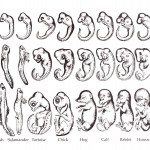
From the first dawn of life, all organic beings are found to resemble each other in descending degrees, so that they can be classed in groups under groups.
Isn't that a good sentence? It's the first of this chapter. There's music in the way the Biblical ring of "From the first dawn of life", falls towards the swallowed repetition of "groups under groups", which itself mirrors and explains the descending degrees of resemblance that gives the sentence its scientific filling.
The next line is just as good: "This classification is evidently not arbitrary like the grouping of the stars in…
Back when I started this, I remarked that one of the reasons I hadn't read the Origin was that I couldn't imagine it being essential to a grasp of contemporary science. Regarding evolution, I think you could still make a case for this. But in other ways, that statement shows that you really shouldn't opine on topics you know nothing about.
Specifically, I'm talking about ecology (by which, just to be clear, I mean the study of the interactions of living things with each other and their environment, rather than 'nature' or 'environmentalism'). It's been said that all European philosophy is a…
When the Origin was published, the idea that species were not fixed entities had been in the air for some time, thanks to Lamarck, Robert Chambers, anonymous author of the best-selling Vestiges of the Natural History of Creation, and Darwin's own grandfather, Erasmus.
But unlike those men, Darwin put all the different pieces together into a coherent whole. How was that? Chapter 11 of the Origin, 'Geographical distribution', gives some hints.
First there's the nurture. In the age of long-haul flights and wildlife documentaries, it's easy to forget how difficult it was to see different…
We left Darwin in a troubled frame of mind. The fossil record seemed to offer little support to his theory (then again, it offered little support to any other theory). By the time we reach the end of chapter 10, 'On the geological succession of organic beings', he's feeling far more chipper:
"[A]ll the chief laws of palaeontology plainly proclaim, as it seems to me, that species have been produced by ordinary generation: old forms having been supplanted by new and improved forms of life, produced by the laws of variation still acting round us, and preserved by Natural Selection."
What…
Thomas Kuhn -- the one philosopher of science that even ignorami like me have heard of -- said that during periods of 'normal science', researchers only take on problems that they know they can solve. 'Paradigm' is an overused word, but it's a measure of the paradigm-shifting nature of the Origin that in much of it, such as in chapter 9 'On the imperfection of the geological record', Darwin flies blind.
This creates almost as much trouble for the reader as it does for Darwin, as we saw in the previous chapter. The less you can explain, the more you need to describe; where Darwin has cracked a…

George Bernard Shaw, according to a comment left on a previous post, thought that many people gave up on reading the Origin because, convinced of Darwin's argument, they wearied of him making his points over and over again.
But I disagree. It's not seeing Darwin restate his case that's tiring. It's seeing him return, like a dog to its vomit, to questions that he admitted in chapters one and two couldn't be answered.
When I read these earlier chapters, I was struck by how skilfully Darwin skirted uncertainties, and even how he used them in his arguments. I thought of giving this a fancy name…
Science is fun. Now, I know that someone telling you a thing is fun is usually a guarantee that it isn't. And I know that people who tell you science is fun usually do so in strained and pleading tones, and expect you to believe them because they have spiky hair and can play the harmonica. But it's true.
To see what I mean, read chapter 6 of the Origin, 'Instinct'. Despite, or because of, having its share of 'are you sure about that?' moments, it's a delight, because it shows Darwin doing the most fun thing in science: mucking about with reality, sometimes called experimentation.
In this…
Up until now, our route into the theory of evolution by natural selection has been all downhill. One thing has led effortlessly to another, with Darwin giving the occasional nudge to steer things in the right direction. Not any more. If it's human interest you're after -- doubt, sweat, anxiety -- then chapter 6 of the Origin, 'Difficulties on Theory', is the one you've been waiting for.
I obviously wasn't going to admit it, but after chapters 4 and 5, I was beginning to fear that we'd peaked with the struggle of chapter 3. But this chapter is full of gems, both in the science, and in the…
To a man with a hammer, said Mark Twain, everything looks like a nail. The better your hammer, I would add, the more nail-like everything looks.
In natural selection, Darwin had crafted one of the best hammers of all time. And in chapter 5 of the origin, 'Laws of Variation', you can hear him umming and aahing about various alternative mechanisms of evolutionary change before deciding that, actually, you know what this needs...hold 'er steady...Thwack!
How about, for example, the "effect of external conditions" -- "food climate &c.". Well, "Gould believes that birds of the same species are…
Mathematicians and physicists speak of a result 'falling out of the equations', implying that if you set things up properly, the rest takes care of itself. Chapter 4 of the Origin, 'Natural Selection', is where evolution falls out of the machinery that Darwin has spent the three previous chapters assembling.
And I hate to say it, but it's a bit of an anticlimax.
In retrospect, it's difficult to see how it could be otherwise. Darwin has manoeuvred us into position so carefully, showing the power of artificial selection, the mutability of species and nature's cutthroat struggle, that we're…
If, so far, you've been finding Mr Darwin's book tough going (it's OK, there's no shame in admitting it), here's what you should do: skip all that flannel about variation, and start here. This is where it gets serious.
Chapter 3 of the Origin, as its opening pages explain, faces in two directions. In chapters one and two, we've established the fact of variation, and the fluidity of living forms -- both in space, as shown by the blurry boundaries between species, and in time, as shown by the effect of artificial selection on domestic species. In the chapter to come, says Darwin, we'll be…
Here's a project for a playful biology grad student with some time on his or her hands. Take chapter 2 of the Origin of Species, 'Variation Under Nature', and modernize the language. Toss in a few figures and some contemporary citations. Give the result a title like 'A routemap for biodiversity research 200 years after Darwin', put your name on it and submit to Trends in Ecology and Evolution. I'm not promising anything, but you might get lucky.
In his first chapter on domestic species, Darwin spent a lot of time worrying about questions that, thanks especially to molecular genetics, we now…
Man, this guy didn't know anything.
I don't mean that as an insult. Darwin, as he admits, knew almost nothing about inheritance, about how variation is produced, or about the origins and history of domesticated plants and animals. You'd think that would be a handicap in using domestication as an analogy for evolution.
And yet, in chapter 1 of the Origin, 'Variation Under Domestication', Darwin uses what little knowledge he has so deftly that nowhere do you feel his conclusions are outstripping his data. This, believe me, is quite a skill, both in a scientist and a writer. What, he asks, is…
Among the small thrills of encountering canonical works for the first time - Homer, say, or the King James Bible, or Star Wars - are the moments when you come across some turn of phrase so well-used it has been worn flat into the surface of everyday speech and think: so that's where that comes from. I'm thinking that the same might be true of the Origin, but in a different way.
For example, what's the first living thing that Darwin names? Turns out it's "the woodpecker, with its feet, tail, beak and tongue so admirably adapted to catch insects under the bark of trees".
This got me thinking…
Hi! My name is John. I've got a PhD in evolutionary biology, and I've spent much of the past decade writing about evolutionary ideas, as applied to everything from literary criticism, to language, to anti-terror policy, and even on occasion to biology. And I've got a confession - I've never read the Origin of Species.
Do I shock you? Good.
I am not proud of this (really, I'm not), but if my professional life has been less stellar than it might have been, it's not for want of reading Darwin. Here's why. Darwin was working at the dawn of biology. He had none of the specialist knowledge and…