

It is nice to see SRI Rice Production, a really important advance in sustainable, small scale grain production getting its due here in this Independent Science News article. Most fascinating, it covers ways in which the SRI model is being adapted to other grains and crops, and its potential utility.
The world record yield for paddy rice production is not held by an agricultural research station or by a large-scale farmer from the United States, but by Sumant Kumar who has a farm of just two hectares in Darveshpura village in the state of Bihar in Northern India. His record yield of 22.4 tons per hectare, from a one-acre plot, was achieved with what is known as the System of Rice Intensification (SRI). To put his achievement in perspective, the average paddy yield worldwide is about 4 tons per hectare. Even with the use of fertilizer, average yields are usually not more than 8 tons.
Sumant Kumar’s success was not a fluke. Four of his neighbors, using SRI methods, and all for the first time, matched or exceeded the previous world record from China, 19 tons per hectare. Moreover, they used only modest amounts of inorganic fertilizer and did not need chemical crop protection.
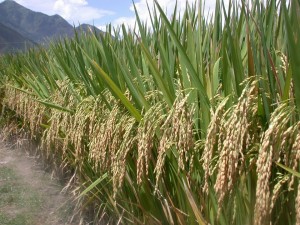 SRI-GROWN RICE IN CHINA
Using SRI methods, smallholding farmers in many countries are starting to get higher yields and greater productivity from their land, labor, seeds, water and capital, with their crops showing more resilience to the hazards of climate change (Thakur et al 2009; Zhao et al 2009).
SRI is labor intensive, but it offers enormous potential for small-scale grain production. In the Global North we tend to dismiss that as a waste of time, but in fact, almost half the world's rice is grown in small scale production - hand cultivation of smaller plots of grains is both PRESENTLY essential to the world's food security and likely to remain so or even become more so as a larger population depends on a smaller land base.
Coincidence.
I just attended a workshop in Tra Vinh Province, Vietnam this week on natural resource stuf and then stumbled on this. My area is trees, but SRI was outlined and we visited a farmer. He liked SRI (and the rice is impressive!), but perhaps partly because he is a seed producer and seller as well as a food producer and these are the people doing best from it overall apparently (perhaps a bit more ready money for labour etc costs).
He said there are difficulties getting the extra labour needed to transplant seedlings, rather than broadcast the seed.
A claim of labour shortages in rural Vietnam is a challenge to easy assumptions! The farmer's children had all left for town in the manner of these places, along with many others, leaving a gap that is hard to fill. If too many want the same people will soon drive the cost of labour up, especially for more marginal farmers. Then again, he wouldn't be a farmer if he didn't have some complaint.
so, i wonder--will wide spacing out perform bio-intensive/raised bed/square foot etc? somebody ought to be trying everything everywhere. make that everybody. sharon, do you think this article will make any difference in how you plant this year?
Sharon -
Someone from Russia has hijacked your email account. Several of us received a spam email from your account last night. It contained a weblink to a Russian site.
I'm posting this here because they may still have access to your email account.