

Nice Nature paper coming out tomorrow by Jay Strader et al

on a pair of flat spectrum ultra-faint radio sources in the core of M22.
The sources are consistent with being ~ 20 solar mass black holes, accreting at a low rate from, well, something.
Maybe...
Best candidates yet in the Milky Way globulars.
M22 has a somewhat unusual structure (massive fluffy core) in a way that several authors have suggested might be a signature of black holes remnants in the cluster, and it is the closest of the dozen or so clusters which are most like that. So easiest to see in M22. At that, it is a nice tour de force by the eVLA in picking up the sources, those suckers are faint!
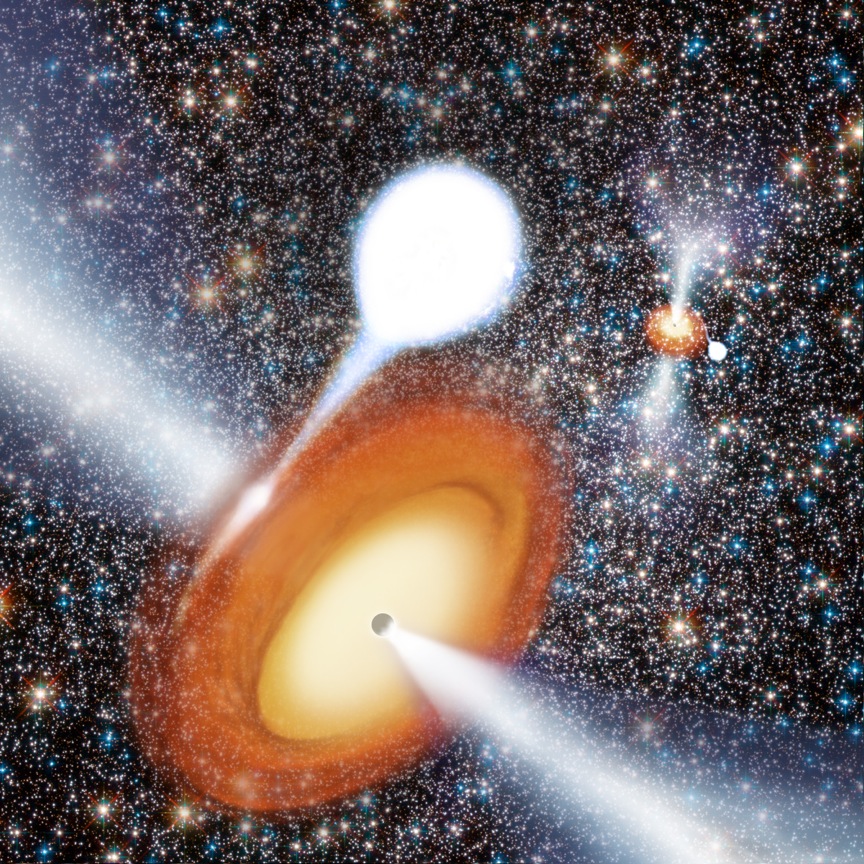
"Simulations have indicated that these black holes would fall toward the center of the cluster, then begin a violent gravitational dance with each other, in which all of them or perhaps all but a single one would be thrown completely out of the cluster.
"There is supposed to be only one survivor possible," said Jay Strader, of Michigan State University and the Harvard-Smithsonian Center for Astrophysics. "Finding two black holes, instead of one, in this globular cluster definitely changes the picture," he said."
To be fair, we did say that there could be 0, 1 OR 2 black holes left at the end, but not quite like this, except with low probability...
Also, if this is the tip of the iceberg for the black hole population, then there ought to be 10-100 black holes in there, which is hard to understand, makes for a dynamically crowded system.
There is an interesting point made in the supplemental information that M22 is unusual in that there is [Fe/H] variation in this cluster, and they suggest that maybe it is the product of the collision of two globulars with different age and composition. If true, it could help in producing such things.
Maybe.
Nice result.
Note that Shri is offering a $100 bet that they aren't black holes:
http://news.sciencemag.org/sciencenow/2012/10/two-black-holes-inhabit-s…
I'd take the bet, but I think they need it for TMT more.
If I were rational, and rich, I'd take the bet and get a win-win.
Black Holes Whence and Whither
A.
Black Holes Whence
http://www.sciencenews.org/view/generic/id/345481/title/Cohabiting_blac…
From
http://universe-life.com/2011/12/13/21st-century-science-whence-and-whi…
http://universe-life.com/2012/09/02/all-the-mass-of-the-universe-formed…
Galactic clusters formed by conglomeration?
No. Galactic clusters formed by Big-Bang's fragments dispersion, evidenced by their Newtonian behavior including their separation acceleration.
The big bang is the shattering of the short-lived singularity mass into fragments that later became galactic clusters. This is inflation. The shattering is the start of movement of the shatters i.e. the start of reconversion of mass into energy, which is mass in motion. This reconversion proceeds at a constant rate since the big bang as the resolution of gravitons, their release from their shatters-clusters, proceeds at constant rate due to their weak specific force due to their small size.
B.
Black Holes Whither
http://www.sciencenews.org/view/generic/id/345421/title/Team_glimpses_b…
From
http://universe-life.com/2011/12/10/eotoe-embarrassingly-obvious-theory…
A commonsensible conjecture is that Universe Contraction is initiated following the Big-Bang event, as released moving gravitons (energy) start reconverting to mass (gravity) and eventually returning to black holes, steadily leading to the re-formation of The Universe Singularity, simultaneously with the inflation and expansion, i.e. that universal expansion and contraction are going on simultaneously.
Conjectured implications are that the Universe is a product of A Single Universal Black Hole with an extremely brief singularity of ALL the gravitons of the universe, which is feasible and possible and mandated because gravitation is a very weak force due to the small size of the gravitons, the primal mass-energy particles of the universe.
This implies also that when all the mass of the presently expanding universe is consumed by the present black holes, expansion will cease and be replaced with empansion back to THE Single Universal Black Hole.
Dov Henis (comments from 22nd century)
http://universe-life.com/