
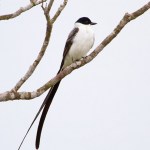

(Inside Science) -- The fork-tailed flycatcher whistles with its wings in two different accents, potentially more evidence this bird is splitting into two species, a new study finds.
Birds are known for the songs they can sing, but dozens of species also use their feathers to generate sounds. For instance, peacocks can rattle their quills together, and the crested pigeon's wings whistle when they fly.
In the new study, researchers investigated fork-tailed flycatchers -- 1-ounce birds found throughout the Americas that resemble black-and-gray swallows. The males sport foot-long scissor-…
Education
 oracknows | October 11, 2017
QEDCon is fast approaching (indeed, I can't believe I have to leave for Manchester tomorrow night), and because my talk there will be about the phenomenon of "integrative medicine," I've been thinking a lot about it. As I put together my slides, I can't help but see my talk evolving to encompass both "integrative" medicine and what I like to refer to as quackademic medicine, but that's not surprising. The two phenomenon are related, and it's hard to determine which has a more pernicious effect on science in medicine.
One aspect of quackademic medicine that I probably don't write about as much…
oracknows | September 29, 2017John Weeks has long been an activist for what is now known as "integrative medicine," earlier known as "complementary and alternative medicine"(CAM). Basically, for many years Mr. Weeks has been at the forefront of encouraging the "integration" of quackery with real medicine and promoting what I like to refer to as "quackademic medicine," a perfect term to describe the increasing encroachment of pseudoscience and quackery in medical academia in the form of—you guessed it—integrative medicine.
Despite his having zero background in scientific research or the design and execution of experiments…
oracknows | September 26, 2017Last week, the University of California, Irvine (UCI) announced that Susan and Henry Samueli were donating $200 million for it to set up a massive new integrative medicine initiative. The plan would basically transform biomedical sciences and medical education at UCI—and not in a good way.
Remember what "integrative medicine" is. What is being "integrated" into medicine is, of course, quackery. Oh, sure, integrative medicine also emphasizes lifestyle modification, such as diet and exercise, but that is part of "conventional medicine" already.
There is no good scientific or medical rationale…
 oracknows | September 19, 2017
It's not infrequently that, whenever I complain about the increasing infiltration of quackery and pseudoscience into medicine, I sometimes lament that skeptics and supporters of science-based medicine are massively outgunned, because we are. Thus, we have the continued growth of what I like to refer to as "quackademic medicine," the infiltration of pseudoscience into medical academia in the form of whole divisions, departments, and institutes dedicated to studying fairy dust like acupuncture, naturopathy, and other "unconventional" treatments that are then "integrated" into medicine. It's not…
 oracknows | August 29, 2017
I've caught a fair amount of flak over my opposition to so-called "right-to-try" laws. Right-to-try laws have proliferated throughout the US like so much kudzu over the last three and a half years, to the point where 37 states now have some version of these profoundly anti-patient laws on the books. At the federal level, three weeks ago the Senate passed a federal version of right-to-try, with the House scheduled to take up the bill when Congress returns from recess next week. Granted, it's watered down and therefore less horrible than the original version, which Senator Ron Johnson (R-WI_…
 oracknows | August 24, 2017
Acupuncture is nothing more than a theatrical placebo.
I wish I could take credit for the term "theatrical placebo" to describe acupuncture, just as I wish I could take credit for coining the term "quackademic medicine" to describe the unfortunately increasing infiltration of quackery into academic medical centers and medical schools and as I wish I could take credit for the term "Tooth Fairy science" to describe doing scientific studies on a phenomenon that has not been proven to exist, but alas I cannot. I can, however, use the terms as I see fit, even if it might annoy some believers in…
 cmonforton | July 26, 2017
My favorite way to capture students’ attention about lead poisoning is to tell them about Dr. Herbert Needleman and his use of children’s baby teeth. In the late 1960's, Needleman recruited school teachers in Chelsea and Somerville, MA to collect their young students’ deciduous teeth when they fell out. It was a non-invasive way----no needlesticks, no bone biopsies---to get data on lead burden in children.
Needleman’s team analyzed the teeth for lead which helped them establish a population distribution of tooth lead levels. (It did not exist up to that time.) In 1972, he published the…
 oracknows | July 17, 2017
There's a good rule of thumb about headlines (other than Betteridge's Law of Headlines) that I use when perusing articles. It's particularly useful for evaluating headlines about medical and science stories. Basically, if a headline says something like, "everything you know about X is/might be/could be wrong" or "everything scientists know about X is/might be/could be wrong," it's a highly reliable indication that much of what is in the article that follows is very likely to be unmitigated, grade-A bullshit. I realize that it might be confirmation bias on my part (I am, after all, a skeptic…
 kkrisberg | July 15, 2017
In 2011, Texas legislators slashed the state’s family planning budget by 67 percent. The justification? To reduce abortions by defunding clinics associated with an abortion provider (read: Planned Parenthood). Now, it turns out Texas legislators actually accomplished the opposite: narrowing access to family planning services only led to more unplanned pregnancies and more abortions.
In a study that will soon be published in the Journal of Health Economics, researcher Analisa Packham found that in the years following the 2011 funding cuts, Texas’ teen birth rate went up by 3.4 percent, which…
 oracknows | July 11, 2017
If any of you are bloggers out there who like to write about studies, have you ever decided that you wanted to write about a study and discovered as you started writing that your university doesn't have access to the journal? Yeah, that happened to me last night. I had wanted to move on from writing about antivaccine nonsense, as it seems that that's all I've been writing about for the last several days (probably because it almost is), but I couldn't because I couldn't count on someone getting me a copy soon enough to be able to write about it last night. So until I get a hold of the paper…
 lborkowski | July 10, 2017
While much public attention is (appropriately) focused on the Senate bill that would shred the Medicaid program, House Freedom Caucus members are pushing a proposal to shred other parts of the social safety net: welfare, or Temporary Assistance for Needy Families (TANF), and food stamps, or Supplemental Nutritional Assistance Program (SNAP). Both the Senate BCRA and the Freedom Caucus budget proposal aim to cut spending on these crucial assistance programs while granting large tax breaks that disproportionately benefit the wealthy.
Representative Jim Jordan (R-Ohio) has put forward a budget…
oracknows | July 7, 2017As I sat down to lay down my daily (or at least week-daily) dose of Insolence last night, my thoughts kept coming back to vaccines. Sure, as I pointed out in yesterday's post, we seemed to have dodged a bullet in that President Trump appears on the verge of appointing someone who is actually competent and pro-vaccine as director of the CDC. Of course, none of that changes the issue that Donald Trump's proposed budget takes a meat axe to public health programs, including vaccines, and that if Republicans succeed in dismantling the Affordable Care Act a large chunk of money going to vaccine…
 oracknows | June 2, 2017
I've discussed several times over the last several years my impression that the media have become in general less tolerant of antivaccine views. At least, the media seem less willing to indulge in "tell both sides" false equivalence. Back when I started blogging, I routinely used to bemoan how news stories about vaccines or autism would almost inevitably include obligatory quotes from antivaxer like J.B. Handley, Jenny McCarthy, and sometimes even Andrew Wakefield. More recently, over the last five years or so, such tropes seem a lot less common. I don't have any solid evidence to back up my…
 oracknows | May 29, 2017
Surprisingly, I made it through an entire three day weekend without posting anything to the blog. Believe it or not, this is a good thing. It means that I actually worked on my grant that's due at the end of the week. Still, a blogger's gotta blog; so I can't just shut down until the end of the week. So, hwere we go.
I've long lamented the creeping infiltration of quackery into medical academia in which modalities once considered quackery, such as acupuncture, reiki, naturopathy, homeopathy, and various other dubious treatments, have found their way into what should be bastions of science-…

 gregladen | May 26, 2017
What, with all the attacks on science and scientist these days, we may not want to be focusing on those times when science goes off the rails and makes a huge mess of things. But, science at its best and scientists at their best, will never shy away from such things.
Dr. Paul Offit just wrote a book called Pandora's Lab: Seven Stories of Science Gone Wrong, which not about an evil black dog that escaped from a box, but rather, seven instances when the march of scientific progress headed off a cliff rather than in the desired direction. People died. Many people died. Other bad things…
kkrisberg | May 23, 2017Last week, researchers officially opened enrollment in the nation’s first decades-long study of lesbian, gay, bisexual, transgender and queer health — an effort they hope will transform our understanding of the health challenges LGBTQ people face and begin narrowing a giant data gap on their physical, mental and social well-being.
“Sexual and gender minorities make up between 2 and 6 percent of the population, however sexual orientation and gender identity are rarely asked about in health studies and they’re not included in fundamental metrics like the Census,” said Juno Obedin-Maliver, one…
oracknows | April 16, 2017From the moment that Donald Trump was unexpectedly elected President, I couldn't help but be concerned about what President Trump would mean for medical science and science in general. I was not alone in my concerns. Of course, now, five months later, we know that such concerns were quite valid. If funding is a primary indicator, then, if anything, my concerns expressed last November were understated. For example, in his first budget, Trump proposed cutting the National Institutes of Health (NIH) budget by 19%, and, then, not content with that, proposed cutting $1.2 billion from this fiscal…
kkrisberg | April 12, 2017To get a clearer sense of just how bad our drug overdose problem has gotten, look no further than this year’s County Health Rankings. The annual report found that after years of declining premature deaths, that rate is on the rise and due primarily to overdose deaths. It means we could be seeing the first generation of American kids with shorter life expectancies than their parents.
“We often think of the opioid crisis either as happening in very rural communities or as an urban issue,” Kate Konkle, Action Center Team director for County Health Rankings & Roadmaps, told me. “But this is…
 oracknows | April 12, 2017
Yesterday, I wrote about the case of Jade Erick, a 30-year-old woman whose death was caused by naturopathic quackery. It's not entirely clear if it was intravenous turmeric that killed her. That's what the press consistently reported. It's more likely that it was intravenous curcumin, which is derived from turmeric. Whatever the case, Erick very rapidly went into cardiac arrest as the infusion began. When first I discussed the Erick case, the identity of the naturopath was unknown because, for whatever reason, the press was not reporting it at the time. But yesterday the naturopath was…