


(blows off the dust since the last entry)
(Life trumped blogging; my first child was born in March)
Just before I went into the parent tunnel, which is awesome by the by, I attended a seminar conducted by Niels Windfeld Lund, General Manager of the World Opera.
Not my usual event. But music's always been a passion for me, and I performed a lot as a kid - lots of trumpet, both the sort of american wind orchestra stuff (seated and marching...yes, a band geek) and some jazz, a little bit of drums. These days I plink around on an acoustic bass, badly, but well enough that I'll be able to sing…
Last month I was on Dr. Kiki's Science Hour. Besides being a lot of fun (despite my technical problems, which were part of my recent move to GNU/Linux and away from Mac!), I also discovered that at least one person I went to high school with is a fan of Dr. Kiki, because he told everyone about the show at my recent high school reunion. Good stuff.
In the show, I did my usual rant about the web being built for documents, not for data. And that got me a great question by email. I wrote a long answer that I decided was a better blog post than anything else. Here goes.
Although I'm familiar with…
I am cribbing significant amounts of this post from a Creative Commons blogpost about tagging the public domain. Attribution is to Diane Peters for the stuff I've incorporated :-)
The big news is that, 18 months since we launched CC0 1.0, our public domain waiver that allows rights holders to place a work as nearly as possible into the public domain, worldwide...it's been a success. CC0 has proven a valuable tool for governments, scientists, data providers, providers of bibliographic data, and many others throughout world. CC0 has been used by the pharmaceutical industry giant GSK as well as…
Dorothea has written a typically good post challenging the role of RDF in the linked data web, and in particular, its necessity as a common data format.
I was struck by how many of her analyses were spot on, though my conclusions are different from hers. But she nails it when she says:
First, HTML was hardly the only part of the web stack necessary to its explosion. TCP/IP, anyone?
I'm on about this all the time. The idea that we are in web-1995-land for data astounds me. I'd be happy if I were to be proven wrong - trust me, thrilled - but I don't see the core base of infrastructure for a…
I've gotten a few emails about the Pepsi-ScienceBlogs tempest. It's clearly taken a toll on ScienceBlogs' credibility. Some of my SciBlings have resigned in protest, and others are taking shots on the topic.
Sponsorship is part of scientific publishing, even in the peer reviewed world. Remember how Merck published an entire fake journal to promote Vioxx? How much money gets spent on reprints that support a company's position, on articles paid for with corporate research funds?
Today's hullaballoo is more honest than either of those. My gut reaction is: calm down, world. This was a miserable…
I tend to want to make posts on Creative Commons related topics at the CC blog, but this is essentially a personal post, and I also want to have it as widely read in our community as possible.
Today is Kaitlin Thaney's last day at CC. She's been working for us on the Science Commons project for a long time - starting part time in mid 2006, full time in early 2007 - and she's been an absolutely essential part of our success over the years.
I first met Kaitlin because she was interning, while finishing at Northeastern, for a joint MIT-Microsoft project called iCampus. She started showing up at…
An old tradition and a new technology have converged to make possible an unprecedented good. The old tradition is the willingness of scientists and scholars to publish the fruits of their research - coming from their brains - in scholarly journals without payment, for the sake of inquiry and knowledge. The problem with this approach is that the brains are not exposed, just the thoughts, and that the brains available have been those physically accessible, such as those at the local university. Thus, those desiring to gain new knowledge through the consumption of peer-reviewed brains have been…
As part of the series of posts reflecting on the move of Science Commons to Creative Commons HQ, I'm writing today on Open Data.
I was inspired to start the series with open data by the remarkable contribution, by GSK, to the public domain of more than 13,000 compounds known to be active against malaria. They were the first large corporation to implement the CC0 tool for making data into open data. CC0 is the culmination of years of work at Creative Commons, and the story's going to require at least two posts to tell...
Opening up data was a founding aspect of the Science Commons project at…
I've kept this blog quiet lately - for a wide range of reasons - but a few questions that have come in have prompted me to start up a new series of posts.
The main reason for the lack of posts around here is that I've been very busy, and for the most part, I've used this blog for a lot of lengthy posts on weighty topics. At least, weighty to me. If you want a more informal channel, you can follow me on twitter, as I prefer tweeting links and midstream thoughts to rapid-fire short blog entries. The joy of a blog like this for me is the chance to explore subjects in greater depth. But it also…
Creative Commons was fortunate enough to be involved in a fascinating workshop last week in New York on Open Hardware. Video is at the link, photos below.
The background is that I met Ayah Bdeir at the Global Entrepreneurship Week festivities in Beirut, and we started talking about her LittleBits project (which is, crudely, like Legos for electrics assembly - even someone as spatially impaired as me could build a microphone or pressure sensor in minutes).
Ayah introduced me to the whole open hardware (OH) world and asked a lot of very good, hard to answer questions about how to use CC in…

The winner in our t-shirt contest. The background to the robot is a 2d barcode that de-references back to creativecommons.org, which I like a lot :-)
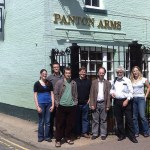
Photo outside the Panton Arms pub in Cambridge, UK, licensed to the public under Creative Commons Attribution-ShareAlike by jwyg (Jonathan Gray).
Today marked the public announcement of a set of principles on how to treat data, from a legal context, in the sciences. Called the Panton Principles, they were negotiated over the summer between myself, Rufus Pollock, Cameron Neylon, and Peter Murray-Rust. If you're too busy to read them directly, here's the gist: publicly funded science data should be in the public domain, full stop.
If you know me and my work, this is nothing new. We have been…
I'll start my final post on the Tech4Society conference by giving thanks to the Ashoka folks for getting me here to be a part of this conference. Most of the time, even in the developing world, I'm surrounded by digital natives, or people who emigrated to the digital nation. It's an enveloping culture, one that can skew the perception of the world to one where everyone worries about things like copyrights and licenses, and whether or not data should be licensed or in the public domain.
There's a big world of entrepreneurs out there just hacking in the real world. First life, if you will.…
Getting ready to head up to Tech4Society's final day. I'm on a panel called the tipping point, about how to scale social entrepreneurial success beyond a local region or state. My instinct is to say "pack your suitcase and start traveling" but that's not very helpful. Even if it's how I have been approaching the problem.
Yesterday I wasn't on a panel. It was a good moment to do some listening. I sat in on a few panels, but was most moved by the trends in Africa session. In other trends panels, the trends were things like "open source" - positive trends. In Africa it was all about how…
I did an interview recently where the author, clearly having done some homework, called out an old quote of mine arguing that ideas aren't like widgets or screws, that they're not industrial objets.
I'd said that a long time ago, inspired by John Perry Barlow's Declaration of Independence of Cyberspace. Here's the money quote: "Your increasingly obsolete information industries would perpetuate themselves by proposing laws, in America and elsewhere, that claim to own speech itself throughout the world. These laws would declare ideas to be another industrial product, no more noble than pig iron…
I'm going to get re-starting blogging here this week, after a crazy few weeks of work at the day job.
In the meantime, here's a few links to stuff I'm doing, reading, and writing.
The team has been busy working on governance and systems for the Sage Commons (the first globally coherent dataset is available - you have to register, but it's open data...).
We've also been busy pushing on the first beta version of the Creative Commons patent tools for the GreenXchange launch in Davos. There is more documentation on GreenXchange in the reading room over at SC.
I contributed an essay to the…
My last posts on why I don't like the open source metaphor for science have generated a lot of good comments, here and in my email, twitter, and in person.
They've forced me to think about what exactly it is about the meme that makes me so uncomfortable, and raised some good objections and points. I'm going to try to chew through a few of them in this post and then ditch the topic for a while, as I've got a lot of complaining to do about publishing and data and those topics have had to take a back seat for a few weeks while I worked this through my system.
On a side note, I actually kinda…
I got a lot of feedback on my last post in which I argued that open source is the wrong metaphor fo science, because it ties us too closely to the artifact that is open source software. The core of my argument remains the same - science is not software, and we shouldn't treat it the way we treat software. But I got a few comments, here on the blog and in email, that are worth looking at.
Here's comment #1.
You cite openwetware and the biobricks registry, but if you look closer, openwetware is a wiki, not a website about open source wetware tech. To my knowledge, other than the people over at…
I was asked in an interview recently about "open source science" and it got me thinking about the ways that, in the "open" communities of practice, we frequently over-simplify the realities of how software like GNU/Linux actually came to be. Open Source refers to a software worldview. It's about software development, not a universal truth that can be easily exported. And it's well worth unpacking the worldview to understand it, and then to look at the realities of open source software as they map - or more frequently do not map - to science.
The foundations of open source software are…
This post was prompted by the combination of three events: a visit with the founder of PubGet, an invitation to keynote at a conference on publishing, and an interview with Bora about the Science Online 2009 conference last January in RTP.
The past year has seen an explosion of talk about the future of the scientific article. It's wonderful to see, even if the results are either depressingly complicated to achieve or depressingly incremental innovation. Both of those results are better than when I got into this - I remember at a conference in Sweden in 2006 hearing a grand high priest of the…