

Mixing Memory tosses a helpful bucket of cold water on the mirror neuron frenzy. The post focuses on the hypothesis that mirror neurons were a crucial ingredient in the development of human language. While I think much of the skepticism is well deserved - mirror neurons remain a mysterious bunch of cells - I think Mixing Memory neglects to mention one important bit of evidence that supports the mirror neuron-language connection.
Specifically, Giacomo Rizzolatti (the godfather of mirror neuron research) has shown that mirror neurons can be activated by fragments of language that are about actions. For example,when we say "golf swing" or "kick the ball," mirror neurons in our motor cortex automatically get excited. Abstract sentences, on the other hand, fail to excite our motor cortex. Of course, this study has little bearing on whether or not mirror neurons are a necessary part of language acquisition. But it does demonstrate that mirror neurons in the motor cortex are uniquely plugged into sentences that are about doing something.
But I think Mixing Memory's post raises an interesting question. Why are mirror neurons so hyped? Why are journalists (like me) so eager to write about this strange group of cells?
My own theory is that mirror neurons are popular because their activity is directly related to what we actually experience. These cells fire whenever we see someone smile, or swing a golf club, or say they are swinging a golf club. Their activity reflects the ordinary events of real life.
On the other hand, just about every other sensory neuron in the brain seems to respond to abstract bits of information. For example, the cells of the V1 in the visual cortex respond to abstract lines and contrasts of light. (The world they inhabit looks just like a Mondrian canvas, and most of us don't live in a world that looks like that.) The V2, V3 and V4 aren't much better. In fact, you have to go to the medial temporal lobe (aka, the V5) before you get cells that respond to complex stimuli, like a smiling face.
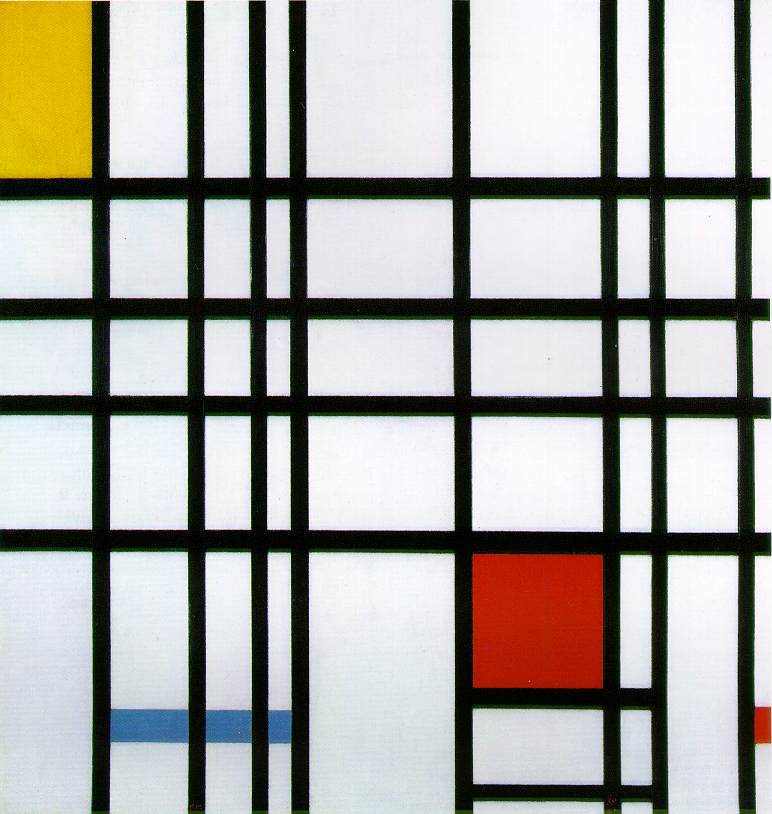
This abstract anatomy reflects the workings of the brain. Behind the glossy cinema of consciousness is a neural army of stagehands, assistant directors, cinematographers, editors, writers, etc., all of whom are content to remain behind the scenes of experience. Our reality, in other words, depends upon a wealth of unconscious processing.
This is fascinating stuff, but after awhile one begins to crave a group of cells that map onto the world we actually know. Mirror neurons ably fill this void. Instead of describing some abstract universe, they are activated by the actions, verbs and facial expressions we continually perform. (Of course, it also doesn't hurt that mirror neurons help to explain sports, porn, autism and movies.) Sure, mirror neurons are overhyped, but it's not everday that we get neuroscientific insight into everyday life.
A couple of questions on mirror neurons. Can your brain get excited by an action if you have never actually physically completed it? If so, how is that possible? And if not then we need another explanation for why porn works for virgins, or obese beer guzzling men like watching baseball, or why anyone but 7 year old girls in tutu's like seeing dance. Also, do blind people have the same neuron-language connection? Does "swing a bat" mean the same thing neuronally to a paralyzed person, a blind person, and a physically normal person? Are our mirror neurons at one point imbedded in some physical activity? Ok, guess that's it for now.
The problem with the Rizzolatti study is that it doesn't look at mirror neurons, it looks at an area where they are thought to be. Of course, we know there are other types of cells related to language and motor programs there as well, so it's not clear which types are being activated.
It helps that they got a good name: "mirror neurons" is much more interesting sounding than "cells of the V1 in the visual cortex"
Different visions from social and cognitive sciences - Situated Cognition, Embodied Cognition, Enactive Approach, Situated Simulation, Covert Imitation - suggest that our conceptual system dynamically produces contextualized representations (simulations) that support grounded action in different situations. This is allowed by a common coding - the motor code - shared by perception, action and concepts.
On one side, the vision of an object immediately activates the appropriate hand shape for using it: seeing a red apple activates a precision grip for grasping and turning. On the other side, thinking an apple produces the simulation of an action related to the apple in a specific context of use.
The common coding also allows the subject for natively recognizing actions done by other selves within the phenomenological contents. Specifically, the subject predicts the outcome of the identified action using the same simulation mechanism described above: seeing someone grasping an apple produces a contextualized simulation of the full course of the action. This covert imitation functions as an automatic action emulator, tracking the behavior of other subjects in real time to generate perceptual predictions.
For a summary of these visions and for understanding the possible role of mirror neurons in it, have a look at the paper "Being-in-the-world-with: Presence Meets Social And Cognitive Neuroscience".