


Stimulating the brain with high frequency electrical noise can supersede the beneficial effects observed from transcranial direct current stimulation, either anodal or cathodal (as well as those observed from sham stimulation), in perceptual learning, as newly reported by Fertonani, Pirully & Miniussi in the Journal of Neuroscience. The authors suggest that transcranial random noise stimulation may work by preventing those neurophysiological homeostatic mechanisms that govern ion channel conductance from rebalancing the changes induced by prolonged practice on this perceptual learning…
In their wonderful Neuroimage article, Braun & Mattia present a comprehensive introduction to the possible neuronal implementations and cognitive sequelae of a particular dynamical phenomenon: the attractor state. In another excellent paper, just recently out in Frontiers, Itskov, Hansel and Tsodyks describe how such attractor dynamics may be insufficient to support working memory processing unless supplemented by rapid synaptic modification - a mechanism which has in fact been described neuroanatomically and previously utilized neurocomputationally to describe cognitive phenomena. To…

If you ever said to yourself, "I wonder whether the human mid- and posterior ventrolateral prefrontal cortex has a homologue in the monkey, and what features of its cytoarchitecture or subcortical connectivity may differentiate it from other regions of PFC" then this post is for you.
Otherwise, move along.
The mid/posterior ventrolateral prefrontal cortex (pars opercularis and pars triangularis, or Brodmann's Areas 44 and 45) is very clearly different, both anatomically and functionally, from its anterior sector (which involves the pars orbitalis, or Brodmann's Area 47). It is also probably…
Suppose - rather reasonably - that soups which taste like garlic have garlic in them. You observe two people eating soup; one of them says to the other, "There is no garlic in this soup." Do you think it's likely that the soup taste like garlic?
If you said yes, then congratulations! You've just committed a logical fallacy (from the premise "if p then q" and "not q," you have inferred p) so absurd that it's only very recently been given a name. But don't feel bad - this absurd inference, known as modus shmollens, can actually be elicited from a majority of adult human subjects when the…
Last month's Frontiers in Psychology contains a fascinating study by Dambacher, HuÌbner, and Schlösser in which the authors demonstrate that the promise of financial reward can actually reduce performance when rewards are given for high accuracy. Counterintuitively, performance (characterized as accuracy per unit time) is actually better increased by financial rewards for response speed in particular.
The authors demonstrated this surprising result using a flanker task. In Dambacher et al's "parity" version of the flanker, subjects had to determine whether the middle character in strings…
Owing to the low signal-to-noise ratio of functional magnetic resonance imaging, it is difficult to get a good estimate of neural activity elicited by task novelty: by the time one has collected enough trials for a good estimate, the task is no longer novel! However, a recent J Neurosci paper from Cole, Bagic, Kass & Schneider circumvents this problem through a clever design. And the design pays off: the results indicate that the widely-hypothesized anterior-to-posterior flow of information through prefrontal cortex may actually be reversed when unpracticed novel tasks need to be…
How do we detect important items in our environment? This crucial capacity has received less attention than one might think, and a number of extremely basic issues remain to be explored. For example, it has long been known that target probability has profound effects on the recruitment of the prefrontal cortex (such that lower-probability targets are associated with greater recruitment of both dorsolateral and ventrolateral prefrontal cortex), it has been unclear whether this pattern arises due to the general probability of the class of "targets" or whether it's more stimulus-specific.
An…
A really excellent PBS CBC (thanks m5) documentary on the surprising cognitive abilities of crows:
Watch the full episode. See more Nature.
See also how crows might be trained to do something a little more lucrative:
This latter video tells a great story, but as John Hawkes has pointed out, there is perhaps some confusion about how successful Josh Klein's more lucrative experiments actually were.
Sometimes, ground-breaking studies don't get the attention they deserve - even from experts in the field. One great example of this is an elegant study by Nieuwenhuis et al. from CABN in 2003; in it, they conclusively demonstrate why a particular event-related potential - the negative-going frontocentral deflection at around 200ms following stimulus onset, aka the "N2" - reflects the detection of response conflict, and not the demand to inhibit a response.
This would seem to be a tough distinction to demonstrate - after all, the demand to inhibit something would be expected to strongly…
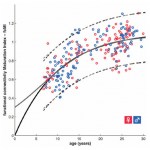
In last week's Science, Dosenbach et al describe a set of sophisticated machine learning techniques they've used to predict age from the way that hemodynamics correlate both within and across various functional networks in the brain. As described over at the BungeLab Blog, and at Neuroskeptic, the classification is amazingly accurate, generalizes easily to two independent data sets with different acquisition parameters, and has some real potential for future use in the diagnosis of developmental disorders - made all the easier since the underlying resting-state functional connectivity data…
With our introduction to paired pulse transcranial magnetic stimulation (ppTMS) out of the way, we now turn to a 2010 PNAS paper by Neubert, Mars, Buch, Olivier & Rushworth in which conditioning TMS is applied to the right inferior frontal gyrus (rIFG) as well as the pre-supplementary motor area (pre-SMA) between 3 and 18ms prior to TMS over the contralateral primary motor cortex (M1). Note that all of these areas are known to interact in exceedingly complex ways based on the task subjects are performing, the intensity of the magnetic stimulation, the relative intensities of the paired…
Yesterday's introduction to paired-pulse transcranial magnetic stimulation elicited an insightful comment from reader "Kix":
As you mention, TMS can be used in order to disrupt or to read out some areas of the brain. I don't see why these functions should be mutually exclusive. For instance, delivering single pulse TMS over the primary motor cortex during movement preparation allows one to guess the direction of the future movement from the size of the motor evoked potential. However, the fact of reading out the prepared response might also disrupt it (Michelet et al. 2010).
I think we…
There's a ton of super-interesting transcranial magnetic stimulation work coming out these days (e.g., here, here, here, here, here, and here) and much of it pertains to a very particular "paired-pulse" form of TMS (ppTMS). Before diving into the new work, I wanted a basic crash course on what we know (and what we don't) about how and why ppTMS works.
If you're not familiar with the basic behavioral effects of TMS, check out this video.
Unfortunately, the crash course I was looking for doesn't exist. So I've made one. Except where noted, the crash course below is largely derived from a…
There are a few fascinating papers to come out recently that I won't have time to cover in detail, but which people may find interesting. References and abstracts after the jump:
Watson & Strayer (2010). Supertaskers: Profiles in extraordinary multitasking ability. Psychon Bull Rev.
Abstract: Theory suggests that driving should be impaired for any motorist who is concurrently talking on a cell phone. But is everybody impaired by this dual-task combination? We tested 200 participants in a high-fidelity driving simulator in both single- and dual-task conditions. The dual task involved…
Two seemingly contradictory trends characterize brain development during childhood and adolescence:
Diffuse to focal: a shift from relatively diffuse recruitment of neural regions to more focal and specific patterns of activity, whether in terms of the number of regions recruited, or the magnitude or spatial extent of that recruitment
Local to distributed: a shift in the way this activity correlates across the brain, from being more locally arranged to showing more long-distance correlations.
In this post I will describe some of the most definitive evidence for each of these developmental…
"What we're seeking is not just one algorithm or one cool new trick - we're seeking a platform technology. In other words, we're not seeking the entirety of a collection of point solutions, what we're seeking is a platform technology on which we can build a wide variety of solutions."
Dharmendra Modha, manager of cognitive computing at IBM Research Almaden, discusses the Systems of Neuromorphic Adaptive Plastic Scalable Electronics ("SyNAPSE") project. Mad scientist eyes are also on display:
Video after the jump:
Hat tip to Dave Jilk for pointing this out. See also his eCortex work.
Decisions can be hard: the conflict you face in any decision can be increased if option A is not that much better than option B, or if option A is newly worse than option B. And then there are are just bad decisions, maybe hard only in retrospect. As illustrated by a 2009 J Neurosci article from Mitchell, Luo, Avny et al it seems that dorsal areas of the prefrontal cortex might help guide us in making tough decisions, whereas a ventrolateral prefrontal area might just alert us only after a bad decision was made.
To show this, they administered a reinforcement learning task to subjects…
Recent work has leveraged increasingly sophisticated computational models of neural processing as a way of predicting the BOLD response on a trial-by-trial basis. The core idea behind much of this work is that reinforcement learning is a good model for the way the brain learns about its environment; the specific idea is that expectations are compared with outcomes so that a "prediction error" can be calculated and minimized through reshaping expectations and behavior. This simple idea leads to exceedingly powerful insights into the way the brain works, with numerous applications to…
Swarming Quadrocopters?
Nanomagnetic remote control of animal behavior.
Blogs are data-mined for personality research.
Vote for method of the year! (My vote is for induced pluripotency)
If you think that the less competent you are, the more competent you think you are, then you are incompetent.Confusion on the Dunning-Kruger effect.
Time on task effects in fMRI research: why you should care.
Spontaneous Eyeblink Rate as an Index of Creativity.
The advantage of being helpless: infants can outperform adults in some ways.
Career Considerations: Center Grants and P-mechanisms from the NIH
Get up…
How can we enhance perception, learning, memory, and cognitive control? Any answer to this question will require a better understanding of the way they are best enhanced: through cognitive change in early development.
But we can't stop there. We also want to know more about the neural substrates that enable and reflect these cognitive transformations across development. Some information is provided by developmental neuroimaging, but even that's not enough, because the real question we have can only be answered via mechanisms ("how"/"why") - quite different than the "what" "where" and "…