


Big news from Eruptions (and me.)
Eruptions has always been an evolving space - it started as a little side project on Wordpress that has grown over the last two-and-a-half years into a community of volcano enthusiasts. The blog has drawn over 2.5 million views and 1.5 million visits since I started it in May of 2008 - which, to me, is mindblowing - and I thank of all your for that. I also thank ScienceBlogs for helping more people find the blog over the last 18 months that I've been lucky to be hosted here.
However, with all things, change is sometimes needed. I'm not going to go into the…
Busy ... so busy! I'll try to have more later today but the next 24 hours for me are super duper busy.
However, I did want to pass along some news that was noticed by the Volcanism Blog that a volcano at Virunga National Park in the Congo erupted overnight. Now, I haven't been able to find much information beyond the single report in the Irish Independent - and that report doesn't even specify what volcano is doing the erupting - Nyamuragira or Nyiragongo. However, we've seen eruptions at the park earlier this year so the volcanoes are almost constantly degassing, so this should be a surprise…
Classes starting today, so I have to be brief:
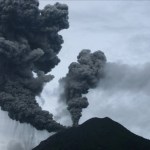
Unique twin ash plumes from Sinabung in Indonesia, erupting on August 29, 2010.
Sinabung
The Indonesian volcano continues to experience explosions, which one last night (well, last night here in Ohio) that prompted an ash advisory for aircraft up to 6,100 m / 20,000 feet, although most reports I've seen pegged the ash column at closer to 2,000 m / ~6,500 feet. Eruptions readers have found a bevy of links for footage and information about the eruption, including a remarkable image gallery from the BBC that shows the volcano exhibiting two ash…
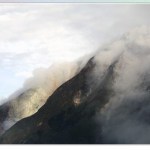
Sinabung on Sumatra erupting on August 29, 2010.
Eruptions readers were quick on the news about the new eruption at Sinabung in Indonesia. There isn't much known about the eruptive history of the volcano - checking out the Global Volcanism Program, the last activity at Sinabung might have been an explosive event in 1881 with persistent fumaroles up until 1912. However, most news sources are quoting 400 years as the last known eruption of the volcano, apparently information from the Indonesian government.
The eruption itself appears to be an ash-rich explosion with ash fall reported up to 30…
Sorry about the lack of posts - I've been not only frantically prepping for class and my Eyja talk, but also I'm somewhat under the weather with an ill-timed sickness, so even though there is stuff to talk about, I haven't really had time/wherewithal to deal with it.
However, expect big things from Eruptions next week!
Drawing of a ship washed inland by the tsunami generated by the August 27, 1883 eruption of Krakatau.
I'll throw a few quick links:
The alert status at Galeras has been dropped back down to "orange" after the non-explosive eruption earlier this week. However, INGEOMINAS warns…
Today was a doubleheader for volcanic eruptions in the news:
Today's explosive eruption from Mt. Etna. Image courtesy of the INGV.
As I briefly mentioned earlier, Galeras in Colombia had an "atypical" eruption - apparently meaning it was non-explosive - that has prompted evacuations and a change in the alert status to "Red" for the volcano. Various news sources don't have a lot of new information yet, but you can check on the report on the INGEOMINAS page (spanish) - and they have links to some of the Galeras news (audio, spanish) from their main page. Some of the latest reports from…
An undated photo of the crater at Galeras.
I am literally out the door, so I will fill this article a little more after my prior academic obligations, but there are reports of an eruption at Galeras in Colombia overnight. 8,000 people living near the volcano have been evacuated as INGEOMINAS moved the alert status at the volcano to "Red". Not much out there on the details of the eruption beyond this intriguing statement:
Diego Gomez from the Pasto Observatory of Vulcanology and Seismology said that due to the atypical, non-explosive eruption, another eruption is imminent.
Galeras the most…
The Doctor fights off a magma creature in Pompeii.
Now, most of the time I talk about why I started this blog, I talk about the eruption of Chaiten in Chile as the catalyst. However, if you look back at my archives, you'll see that one of my first posts was on the Doctor Who episode "The Fires of Pompeii" - so that might also be a good marker to point to on why I started this blog. Why do I bring this up? Well, Pompeii gets mentioned a couple times in the first few seasons of the revived Doctor Who. First off, when the Doctor meets Capt. Jack Harkness (a time-traveling huckster), Capt. Jack…
Finally, a chance to catch up a bit ... !
Yasur erupting in May of 2010.
Some news from the world of volcanoes:
The BBC has a series of videos one the fallout from the Eyjafjallajökull eruption - including a look at the area around the volcano and how the economy has been affected by the eruption. However, things seem pretty quiet at the summit of the Eyjafjallajökull summit where snow can begun to settle without melting - and the Icelandic Met Office appears to think that the eruption is more or less (but not officially) over. And take this press release as you will, but a recent study…

As I've mentioned, I will be giving a talk here at Denison on the Eyjafjallajökull eruption and how the events unfolded on the internet - specifically, I'm interested in the idea of the general public taking an active role in volcano monitoring. So, I have a request from Eruptions readers - and by no means do you have to take part. However, if you are willing, I'd like to know your professional/"day job" and your geologic background - be sure, I will not use your real name or connect your Eruptions pseudonym to any information you send. I am just looking to get a hold on the backgrounds of…
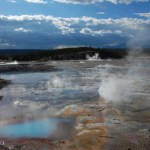
I am back from our trip into the Mountain West - and it was great (see some of the pictures below). We hit Yellowstone, the Grand Tetons, the Tobacco Root Mountains, Glacier and Craters of the Moon - and the weather held out on us just fine.
This week is the last week before classes start here at Denison, so post might be a little sparse this week ... and next week will bring something big to Eruptions, so stay tuned. I'll try to post some news soon as I get caught back up with what has been happening (including all the Katla talk). Special thanks again to Boris Behncke for the great Etna…
The final part of Etna Week, brought to us by guest blogger Dr. Boris Behncke. Check out Part 1 and Part 2 as well!
Etna Volcanic hazards
By guest blogger Dr. Boris Behncke.
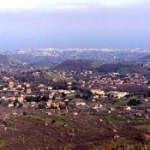
Etna is one of the most active volcanoes on Earth, and a population of nearly one million people dwell on its flanks, many in areas that have been repeatedly invaded by lava flows during the historical period. A few villages have been constructed very close to the vents of eruptions only a few hundred years old.
Top: Residential areas surrounding numerous pyroclastic cones on the lower southeast flank of Etna, seen…
This is Part 2 of 3 from guest blogger Dr. Boris Behncke. Check out Part 1 here.
The current dynamics and activity of Etna
by guest blogger Dr. Boris Behncke
The recent behavior of Etna is characterized by nearly continuous eruptive activity from the summit craters and eruptions from new vents on the flanks at intervals of a few years to decades. Summit eruptions vary from quiet lava emission to mild Strombolian explosions to high-discharge-rate Hawaiian to sub-Plinian style lava and fire fountaining accompanied by the emplacement of fast-moving lava flows; usually the strongest activity…

Etna Week Part 1
Mount Etna - Brief Anatomy of an Exceptional Volcano
By guest blogger Dr. Boris Behncke.
Italy truly deserves to be called "the Cradle of Volcanology" - not only because it hosts virtually all existing types of volcanoes and volcanic rock compositions, and seven of its volcanoes have had confirmed eruptions during the historical period (i.e. the past approximately 2700 years), but also because the earliest surviving eyewitness account of an eruption was written in Italy, the first volcano observatory and the first geothermal power plant were built in Italy, and three…
Italy's Mt. Etna erupting in November 2006.
Well, I am currently off in the wilderness, but that doesn't mean that things aren't still hopping here at Eruptions. We are lucky to have Dr. Boris Behncke of the INGV Catania as that blogger and he brings us a three-part series on Mt. Etna on the island of Silicy. That means this week is Etna Week here on Eruptions, so for all of you chomping at the bit for more information on the Italian volcano, you are going to get it (and then some).
modern-day satellites who can watch that same summit from space.
I think you're all going to love this series…
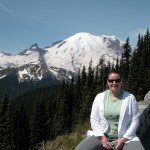
Earlier this summer, we had a chance to ask Sally Kuhn Sennert of the Smithsonian Institution/USGS Global Volcanism Program questions about her job as the main writer of the well-loved Weekly Volcanic Activity Report. Well, now here are the answers!
Sally Kuhn Sennert of the Global Volcanism Program in front of Mt. Rainier, Washington.
Q&A Sally Kuhn Sennert:
Q: Could you describe how you go about putting together the weekly update?
A: If time permits, I would start to gather information on Friday when particular sources post their weekly summaries. The majority of the information…
Alaska's Augustine erupting.
Big volcano news while I'm off in the woods? Post it here!
Well, the summer is rapidly coming to an end - classes start here at Denison on August 30. So, we are trying to squeeze what we can out of the season and to that end, I'll be on one of these things called "vacations" for the next couple weeks. (Oh yeah, and I will be going through Yellowstone, so I'll personally check on those earthquakes, OK?)
That means Eruptions will be operating on the second summer schedule. No new posts until August 23, but some upcoming (automatically posted) articles including the answers to your questions for Sally Kuhn Sennert of the Global Volcanism Program and…
August has been rather quiet for real volcano news, but I did find some more, well, odd news to mention. It is all volcano-related - to an extent - so here we go:
The new volcano-inspired Chivas stadium in Guadalajara, Mexico.
Last year we had the volcano mall in Italy, this year we have the volcano football (that is soccer for us Americans) stadium in Mexico (see above). The stadium in Guadalajara has green, sloping sides that that open to the "crater" that is filled with the pitch and the stands - seems fitting for a city in the middle of the Trans-Mexico Volcanic Belt. No word on what…

Quiet weekend on the whole, volcano-wise, beyond the articles about the latest eruption at Karangetang. So, we'll start this week with a new Mystery Volcano Photo. The last MVP was Tarawera in a shot I took from a road on the back side of the volcano, so that leaves the current standings looking like this:
Standings
Boris Behncke - 4
Don Crain - 4
The Bobs - 3
gijs - 2
volcanista - 1
Lockwood - 1
Elizabeth - 1
Ralph - 1
Anne - 1
Cam - 1
gg - 1
Damon Hynes - 1
Marco - 1
Doug C. - 1
Diane - 1
Stephen - 1
MK, Alberta - 1
Kultsi - 1
Henrik - 1
Zane - 1
Now, here is the new one. Good luck!
Click…