



After a semi-hiatus due to various distractions, I'm about to restart blogging in earnest again over at the new home of Genetic Future on Wired Science.
Please update your RSS feed: my new one is here. And a reminder: you can always keep track of new posts here as well as other nuggets of genomics goodness by following me on Twitter.
Finally, farewell to my ScienceBlogs colleagues, and especially to Erin Johnson for her hard work in holding the place together.
See you over at Wired!
In the last century infant mortality has declined precipitously in the Western world, thanks in large part to the development of antibiotics and vaccination. Yet as the suffering and death from infectious disease has reduced, the burden from genetic disease has become proportionately greater: currently around 20% of all infant deaths in developed countries are a result of inherited Mendelian (single-gene) disorders.
What can be done to reduce this burden? Increasingly sophisticated methods for detecting disease in embryos during pregnancy will help, and these have recently taken another step…
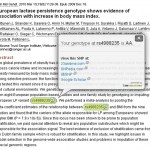
Software company 5AM Solutions has just launched a neat little FireFox plug-in for customers of consumer genomics company 23andMe.
The idea is very simple:
Download your raw data from 23andMe (or use one of the files from me or my colleagues at Genomes Unzipped);
Install the plug-in from here and point it to your 23andMe data;
Browse to a website discussing one of the genetic variants included on the 23andMe chip, and you'll see highlights around the rsID of any variant on the page (rsIDs are unique codes assigned by dbSNP to most of the common variants targeted by…
As part of his Gene Week celebration over at Forbes, Matthew Herper has a provocative post titled "Why you can't have your $1000 genome". In this post I'll explain why, while Herper's pessimism is absolutely justified for genomes produced in a medical setting, I'm confident that I'll be obtaining my own near-$1000 genome in the not-too-distant future.
Matt's underlying argument is that while sequencing costs will continue to drop, obtaining a complete genome sequence that is sufficiently accurate for medical interpretation will require additional expenses (increased sequence coverage to…

Late last week I stumbled across a press release with an attention-grabbing headline ("The Causes of Common Diseases are Not Genetic Concludes a New Analysis") linking to a lengthy blog post at the Bioscience Resource Project, a website devoted to food and agriculture. The post, written by two plant geneticists, plays a tune that will be familiar to anyone who has encountered the rhetoric of GeneWatch UK: basically, modern genomics is pure hype perpetuated by scientists seeking grant money and corporations seeking to absolve themselves of responsibility for environmental disasters. …
A reminder to anyone who reads my other blog Genomes Unzipped that we have a reader survey underway there now, which includes some questions about genetic testing experiences and attitudes towards genetics. We're closing the survey to responses this weekend, so if you're an Unzipped reader but haven't had a chance to fill in the survey, please do so now.
Update 30/11/10: 23andMe has extended their 80% discount until Christmas, without a need for a discount code.
Personal genomics company 23andMe has made some fairly major announcements this week: a brand new chip, a new product strategy (including a monthly subscription fee), and yet another discount push. What do these changes mean for existing and new customers?
The new chip
23andMe's new v3 chip is a substantial improvement over the v2 chip that most current customers were run on (the v2 was introduced back in September 2008). Firstly, the v3 chip includes nearly double the…

Back in June I launched a new blog, Genomes Unzipped, together with a group of colleagues and friends with expertise in various areas of genetics. At the time I made a rather cryptic comment about "planning much bigger things for the site over the next few months".
Today I announced what I meant by that: from today, all of the 12 members of Genomes Unzipped - including my wife and I - will be releasing their own results from a variety of genetic tests, online, for anyone to access. Initially those results consist of data from one company (23andMe) for all 12 members; deCODEme for one…
Over at Genomes Unzipped, my esteemed colleague Carl Anderson has his first ever blog post: an exploration of the various ways in which the effects of genetic variants on disease risk can vary from person to person.
This potential variation has been the cause of much angst among critics of the direct-to-consumer genetic testing industry. However, as Carl notes, DTC testing companies generally do a pretty good job of conveying the uncertainty associated with one source of variation (differences in population background), and can't really be blamed for not accounting for the effects of…
In my second big piece of news for the day, I'm pleased to announce that Genetic Future will shortly be moving to a the brand new Wired Science Blogs network.
While the network was announced today there will be a brief hiatus before I get started in my new home, due to the time constraints imposed by my first big announcement today. However once the move is complete I'll be back to delivering the same slices of genetics and personal genomics goodness that you've been getting here at ScienceBlogs (or at least, that you were getting before my recent exposure to the mind-shattering…

For those who haven't already heard via Twitter or other means, there's a good reason I've been so quiet the past few weeks. My first collaborative genetic experiment with my wife - for which I presented some promising preliminary data back in February - finally generated results on August 28th:
Figure 1: Tobias MacArthur
We're still getting the hang of interpreting the results, but overall the outcome seems overwhelmingly positive. Further replication will be required to confirm our initial findings, of course.
I also have another major announcement due later today - stay tuned.
The recent Government Accountability Office report into the direct-to-consumer genetic testing industry certainly made a splash: it took centre stage at a Congressional hearing on the industry, and garnered media headlines about "bogus" results being generated by testing companies.
As I noted at the time of its release, the report is an obscenely one-sided affair: it's transparently framed as an attack piece rather than a balanced analysis of the state of the industry. That's a real shame, because the information collected by the GAO could so easily have been used to provide valuable insight…
More huge news in the sequencing industry, following on from the public share offer from Pacific Biosciences - relative newcomer to the field, Ion Torrent, has just been bought by Life Technologies for an impressive US$375 million in cash and stock, with an option to increase by a further US$350 million if "certain technical and time-based milestones" are met by the end of 2012.
Ion Torrent made a splash with its launch at this year's Advances in Genome Biology and Technology meeting in February (here's my coverage from the meeting). The company has developed a sequencing technology…
The long-awaited public stock offer from third-generation sequencing technology company Pacific Biosciences has finally arrived (here's the SEC filing, and coverage from Matthew Herper and GenomeWeb).
PacBio has already raised almost US$400 million in venture capital, and aims to increase this by up to US$200 million from its share offering. The sheer scale of these figures gives you a sense of just how much money is being thrown around in the race towards ever cheaper, faster and more accurate DNA sequencing machines. Of course, whether investors will decide to throw more money in PacBio's…
In my previous post I quoted from Mary Carmichael's excellent interview with two officials from the FDA, Alberto Gutierrez and Elizabeth Mansfield (part of her fantastic week-long DNA dilemma series, which you should read in full if you haven't already). There are numerous nuggets of gold tucked away in this interview that warrant further analysis, and I wanted to highlight a few in more detail. For a more complete dissection I'd recommend Keith Grimaldi's post commenting on the whole interview.
I wanted to focus on two crucial tidbits unearthed by Carmichael: the attitude of the FDA towards…
Two days ago I reported a rumour that the FDA might have convinced genotyping chip provider Illumina to stop providing its products to direct-to-consumer genetic testing companies - a move that would effectively prevent these companies from being able to operate.
The rumour seemed plausible at the time, based on two pieces of evidence. Firstly, a letter sent to Illumina by the FDA in June warned the company that the use of its chips by personal genomics companies appeared to violate FDA regulations:
Although Illumina, Inc. has received FDA clearance or approval for several of its devices,…
Following up on the rumours I posted about yesterday regarding a potential bid by the FDA to choke of direct-to-consumer genetic testing companies' supply of genotyping chips, I received the following statement by email from 23andMe's PR firm:
23andMe is engaged in an ongoing process with the FDA.
23andMe understands that Illumina is also engaged in such a process.
23andMe has no reason to believe there will be an interruption in the supply of Illumina chips at this time.
I understand we'll have some more clarity on this issue from the FDA tomorrow.
Update 14:35 EDT 04/08/10: I just received a phone call from a 23andMe representative indicating that these rumours are not true; more details to follow once I have a written statement.
Update 17:26 EDT 04/08/10: Here is the written statement from 23andMe's PR firm:
We will continue to work with Illumina as our discussion with the FDA continues.
I've requested further clarification.
Update 17:59 EDT 04/08/10: I've received a (slightly) longer written statement from 23andMe clarifying that they have "no reason to believe there will be an interruption in the supply of Illumina chips…
The whole idea of actually paying to read mainstream news online is rather alien to me, having grown up immersed in a world of free content readily available via Google News. Indeed, I can't help but see free news as some kind of inviolable human right.
Thus when the Times recently set up a paywall blocking free access to all of its online content (including its blogs), I was faced with a serious dilemma: there are only a few mainstream science journalists in the world who write sensibly about genetics, and my favourite example (Mark Henderson) was now locked away behind a web-form requiring…
This week was pretty hectic, so there were plenty of useful or interesting links from the personal genomics world that I didn't have time to write about in detail. Feel free to share your own suggestions in the comments.
Responses to the Congress/FDA crack-downAs all of you will be aware, the big news this week revolved around the debate over the regulatory future of the direct-to-consumer (DTC) genetic testing industry, following a brutal Congressional hearing into the industry last Thursday that featured a scathing report by the US Government Accountability Office.
Over at Genomes Unzipped…