



This is my last post at Scienceblogs.com.
In the future I will be blogging at Greg Laden's blog, located at its original home at gregladen.com.
I have a feeling that Scienceblogs will not last long without me. What do you think?
:)
But seriously, I'll be talking about the story of the current status and development of this blog and scienceblogs.com with Mike Haubrich on our podcast Ikonokast. We recorded the conversation today, and will post it in a day or two.
Please go HERE to continue this conversation.
That is all. Thank you very much.
In every area of life, but especially in the overlapping realms of technology, science, and health, misunderstanding how things work can be widespread, and that misunderstanding can lead to problems.
In the area of voting, the main problem seems to be the expenditure of great amounts of outrage and concern over things that are not real. At the same time this happens, things that are real matter a great deal.
I'll give you one example. Remember the special election for the Congressional Representative for Georgia's 6th district, earlier this year? Several media outlets reported "voting…

... which I've posted on before ... there are new developments, summarized at Inside Climate News:
Invoking the Racketeer Influenced and Corrupt Organizations Act, or RICO, a federal conspiracy law devised to ensnare mobsters, the suit accuses the organizations, as well as several green campaigners individually and numerous unidentified "co-conspirators," of running what amounts to a giant racket.
"Maximizing donations, not saving the environment, is Greenpeace's true objective," the complaint says. "Its campaigns are consistently based on sensational misinformation untethered to facts or…
from a major non profit, click through the the X Blog to read the press release.
William Wehrum is a lawyer and once, apparently, worked for the EPA. Trump is trying to appoint him to be assistant administrator for air and radiation. This is a reasonably important job that concerns many aspects of the environment.
Watch:
https://twitter.com/SenJeffMerkley/status/915704243335700481
The Republicans have already said they love this guy. Of course they do.
There is a The War on Science going on, and in Washington, the Republicans are winning it. They are winning it in over 30 states. When they have finished winning it, that is the end of civilization at least in this…

Solar gardens in the state have just reached the 100 megawatt milestone.
This is actually something of a disappointment because a few years ago, Xcel, the main energy company involved in this, projected that we'd be at 200 megawatts by some time last year. On the other hand there are close to 180 new projects in design and construction phase. A current, revised estimate suggests that the statewide solar garden production will reach that 200 megawatt goal.
Currently, Minnesota plants are produce about 15,000 megawatts of electricity. So, the solar garden electricity is only 1% of our…

Witness the overall demise of fossil fuel pipelines, thanks in part to the hard work of amazing activists, and in part to the fact that the value of these pipelines is dropping fast, which in turn, can be attributed in no small part to the hard work of amazing activists. And now, the latest:
From The Globe and Mail:
TransCanada scraps controversial Energy East Pipeline project
TransCanada Corp. has pulled the plug on its controversial $15.7-billion Energy East Pipeline proposal, after slowing oil sands growth and heightened environmental scrutiny raised doubts about the viability of the…
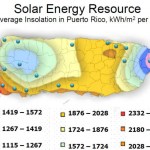
Puerto Rico can become the first significant size polity to rebuild itself from the ground up to be totally Carbon free. Or at least, that seems like a good idea. If only the US Government wasn't so anti-Puerto Rico, owing to the president being, well, Trump.
Anyway, there is now a pile of money and effort pouring int Puerto Rico and this can be used in part to give Puerto Rico sigificantly more economic and energy security in its future, if only energy-smart decisions are made now. So let's see what Get Energy Smart Now blog has to say about this!
Puerto Rico’s electricity system, prior to…

The Trump Administration, in the person of Interior Secretary Zinke, tried to eliminate Obama-era limitations on greenhouse gas emissions from the petroleum industry. The Administration tried to use the "Administrative Procedure Act to turn off provisions intended to reduce how much natural gas petroleum drillers could vent or burn on public or tribal lands. This would have been administered via the BLM. The federal government was sued by California, New Mexico, and various environmental groups, and yesterday, the court ruled in favor of the environment.
This is the second loss for Trump…

You will remember Clement as the whistle blower at the Department of the Interior who was harassed for showing how climate change affects communities in Alaska. He was removed from his job by Fake Interior Secretory Zinke and given a new job removing staples from paperwork or something similar. Zinke similarly reassigned several others at around the same time. The inspector general has been investigating this but nothing has come of that yet.
Clement hung on for a long time but today he left his position. According to the Washington Post:
“Keeping my voice is more important than keeping…
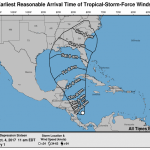
Update Thursday AM
As expected, Nate emerged as a named storm over night. The storm is now interacting withland in Central America and is therefore having trouble getting organized. And, as expected given the uncertainty this causes, the forecasts are unclear on future intensity. The most recent National Hurricane Center projection has Nate Maxing out as a much weaker storm than yesterday's projection suggested. And, the center of the expected path of the storm has shifted west and is now centered roughly on New Orleans.
After leaving Central America, Nate is expected to pass just over the…

Two science books cheap (Kindle version, two bucks):
The Male Brain: A Breakthrough Understanding of How Men and Boys Think
Dr. Louann Brizendine, the founder of the first clinic in the country to study gender differences in brain, behavior, and hormones, turns her attention to the male brain, showing how, through every phase of life, the "male reality" is fundamentally different from the female one. Exploring the latest breakthroughs in male psychology and neurology with her trademark accessibility and candor, she reveals that the male brain:
-is a lean, mean, problem-solving machine. Faced…

OK, maybe that's a bit extreme, but some kids take longer than others ...
But seriously, this is a heartwarming and touching story of science reaching into childhood and yanking some poor unsuspecting kid into the world of ... academia...
From Once Teased For Her Love Of Bugs, 8-Year-Old Co-Authors Scientific Paper.
REVIEWER THREE
Sophia was a bug loving 8 year old (reminds me of my neighbor) who's mother put her in touch with the Entomological Society of Canada, and this eventually led to Sophia's collaboration on a paper that was recently published.
The paper, published in the Annals of…

Sorry for the inconvenience, this post has been moved HERE.


to lighten up your day a bit:
OK, sorry, maybe that was depressing. Sorry.

Visiting Arkansas, hanging around briefly with some people in the Real Estate business, I found a lot of hatred of Mexicans, whom they unimaginatively referred to as "spics" but making it clear they were talking about Mexicans, not some other spics. Sitting with a group of people talking about racism in an urban neighborhood in near Minneapolis, I found zero mention of dislike between whites per se and blacks per se. But Poles and Tibetans, they were very much disliked by people who were mostly but not all white. Years ago I remember being shocked by a fellow anthropologist who expressed a…

Sorry, the contents of this post have been moved to THIS NEW LOCATION. Please click through! Thanks.

Today, Donald Trump told Puerto Rico that they dodged a bullet, that the hurricane that hit them was not a real catastrophe, that only a couple of people died, that he, Trump, is doing a great job, but would Puerto Rico please try to spend less money on fixing things up.
https://twitter.com/CNNPolitics/status/915249263520690177
Well, I'm certainly glad that problem is managed. Great work!
Oh wait ...
Is it too early to lighten the mood a bit?
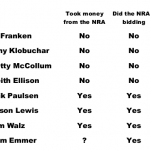
First a word about our lovely press. If I hear one more reporter grovel and squirm about how we don't really want to hurt the NRA or take away any gun rights or do anything unreasonable, no, no, we just want to assume there is a solution to the carnage that does not inconvenience any of the gun loving yahoos that watch our networks .... then I'm going to I just don't know what. Reporters: Please leave open the possibility that a double digit percentage of Americans don't care one whit how much restrictions there ends up being on guns. We just want the insanity to end, and if that means…