

I have always felt that sea level rise would be quicker and higher than my colleagues in climate science have suggested. My reasoning for that is simple. Sea level rise has in the past not followed overall climate change in a perfectly simple manner such that the present era has lower sea levels than it should. When this was noticed in the mid 20th century up through the 1970s, in the form of high wave cut benches along various rocky shore lines, the explanations usually invoked moving land masses, such as a continent buoying upwards as it eroded, so the same sea level would cut benches that were higher and higher the farther back in time you go. And, that probably happens to some extent. But it turns out that the amount of ice trapped in continental glaciers in the northern and southern hemispheres is probably more than it "should" be given current conditions.
(I should note that paleontologist colleagues that I've discussed this with tend to think similarly.)
This is not hard to imagine. I can offer a very over-simplifed meteorological model to help see how this may be the case. (We've discussed this before on this blog.) The equator gets more sun than the rest of the planet per unit surface area because the earth is a ball. This extra energy sets up a giant rotating donut shaped mass of air on each side of the "equator" (not the exact equator) which involves air moving upwards, then moving away from the equator, then cooling and dropping down and then getting sucked back into the vortex-like rotating donut again. (On the way up the air lost much of it's moisture; thus, tropical rainforests.)
This giant rotating donut sets up a counter-rotating donut away from the equator both to the north and the south. This secondary donut has the property of having much dryer air, so instead of lots of rain forming along it's circular length, you get dryer conditions along its circular length. Go look at a map of the world. Find all of the southern arid regions. Note that they line up east-west wise with each other. Now find all the northern arid regions. Same thing. (There are some exceptions, ignore them. Later, for extra credit, you can work out explanations for them.) At first you might think that these arid bands that encircle the earth are at different distances from the poles, but that is because the map you are looking at cuts off the south pole, most likely. Look at the latitudes themselves; both the northern and southern hemispheres have a dry band in the same position in relation to the equator.
North and south of this band, another rotating donut exists, although at this point the donut is very much a theory that occasionally manifests itself because as you get farther from the poles this whole donut thing breaks down. And then there is potentially another donut thing, maybe more like a fritter at this point, around the poles.
Remember last winter, when it was really really cold some places and stayed warm some places, thus causing great confusion? The US was warm and Europe was cold. Well, that is a falsehood. What really happened, is that in the Northern Hemisphere, there was a stark break between warmish and cold air, and all those whingy European cities ("oh, it's so cold here") are north of that division, and all those drippy American cities ("hey, were's our damn snow!") are south of that division. What happened that year is that the donuts got their ducks in a row more than usual for a little while, and made a sharper distinction between bands around the earth.
Think about it this way: Imagine that there were no ocean currents, and that all these air-donuts were very stable. If you let "air coloring" (like food coloring but for air) into the atmosphere at various points from the equator towards the poles, and got in a space ship and went really far out and looked back at the earth, it would look like those big planets with the bands around them (i.e., Jupiter or Saturn). Sort of. The Earth, in fact, has bands. It is just that the primary visible tings in the bands are water vapor (white) and dust (light brown), and the bands are poorly organized except along the equator. This, and the fact that the bands are not well organized makes it difficult to find them. But they are there.
This picture shows how the donuts operate in cross section:
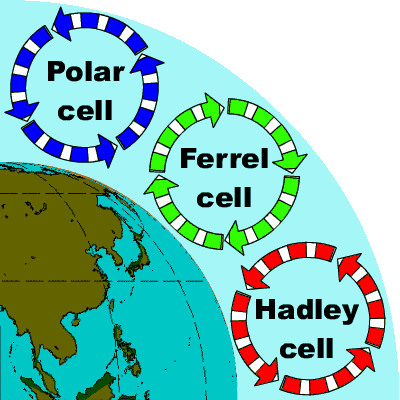
The giant twisting donuts that encircle the earth have names. The spaces between them are often "jet streams." Again, this is a very simplified ideal model. Lots of other things matter.
And here is a picture of the earth that kinda shows the bands, if you kinda squint and look closely:
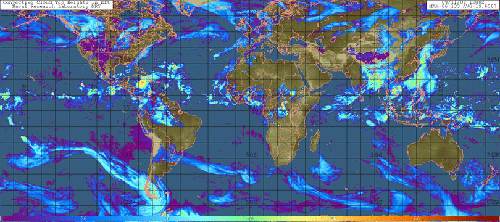
See the bands? You can see the two giant rotating donuts mushing together along the equator, then north and south of this a more empty area, than north and south of that more clouds. The fact that the bands are not crystal clear on this cherry picked image reminds us that there are many different things involved in determining climate and weather.
Most of the year-round ice on the planet is in the farthest zones to the north and to the south. If for a period of time, the giant rotating donut thing completely went away everywhere except at the equator (where it can't go away) the gradient of heat from equator to pole would be smooth, and during the summer in a given hemisphere, it may be quite warm far from the equator. If, on the other hand, the heat is trapped in well formed rotating donut configurations, or for some other reason heat does not get to the distal regions of the planet, then the farthest zones will be relatively cold.
That first scenario appears to be what was happening during the last interglacial, when there was less Carbon in the atmosphere than today, but sea levels were higher. At present, however, the distal regions seem to be cooler than they should be.
However, it appears that global warming is taking care of that. The donuts (and other atmospheric circulation features) are doing something different, or the ocean is storing and moving heat around differently, or both. We may be shifting from a certain pattern whereby the topics were very tropical and the polar regions were very polar, through a period of a lot of crazy changes back and forth, to a period where the polar region will very quicly warm up.
And big whopping amounts of ice melt and sea levels go up.
If this is true, then we should expect some much larger than generally predicted melting of continental glacial ice. And, in fact, we are seeing that across the arctic over the last few years, and right now, especailly in Greenland.
For several days this month, Greenland's surface ice cover melted over a larger area than at any time in more than 30 years of satellite observations. Nearly the entire ice cover of Greenland, from its thin, low-lying coastal edges to its 2-mile-thick (3.2-kilometer) center, experienced some degree of melting at its surface, according to measurements from three independent satellites analyzed by NASA and university scientists.
On average in the summer, about half of the surface of Greenland's ice sheet naturally melts. At high elevations, most of that melt water quickly refreezes in place. Near the coast, some of the melt water is retained by the ice sheet, and the rest is lost to the ocean. But this year the extent of ice melting at or near the surface jumped dramatically. According to satellite data, an estimated 97 percent of the ice sheet surface thawed at some point in mid-July.
Just to be clear, according to this report from NASA, about twice the normal area has experienced melting. Measurements of the effects of volume are not yet completed. We don't know what the total amount of Greenland Ice Sheet will be added to the ocean this summer, but it is likely to be very much more than predicted.
This extreme melt event coincided with an unusually strong ridge of warm air, or a heat dome, over Greenland. The ridge was one of a series that has dominated Greenland's weather since the end of May. "Each successive ridge has been stronger than the previous one," said Mote. This latest heat dome started to move over Greenland on July 8, and then parked itself over the ice sheet about three days later. By July 16, it had begun to dissipate.
Where does the heat in these "heat domes" come from? Well, the sun shining on everywhere, but mostly the climatological equator.
This sort of widespread melting in Greenland seems to come along now and then, almost periodically, possibly in cycles of a century and a half or so. Therefore, we will be able to watch the Climate Change Denialists claim that this is totally normal variation. However, as we have discussed many times, the short and medium term climate "cycles" (or, sometimes, just "variation") occur all the time but on a substrate of physical properties of the air and ocean. The air has more and more CO2 in it, and thus can retain more of the sun's energy for longer, and the ocean is slowly heating up, so over time it takes less heat out of the air (all else being equal) and replenishes atmospheric heat when it drops.
Some have estimated that the Greenland Ice sheet can mostly melt off if there is enough Carbon in the atmosphere. If it did, sea levels would go up about 6 or 7 meters. During the last inter-glacial, sea levels were not THAT much higher than they are now, but they were close. Between the Antarctic and Greenland, there's plenty of ice to convert to sea. I am concerned that melting conditions in Greenland could cause a lot of that ice to become sea water in a much shorter period of time than current, in my view conservative, predictions suggest. If something similar happens in the Antarctic ... a wider and more even spread of warmth in the Southern Hemisphere most years ... than there would be more than enough melt-water to produce surprising and catastrophic results.
From an even more simplistic view - there's a hell of a lot of energy coming from somewhere to melt all that ice. If it's coming from the oceans or land then there should be a concomitant decrease in land or water temperatures (with water it's a bit tricky because the cooling will be somewhere in that body of water, but with land it must be at the surface of the solid formation). If the energy is coming predominantly from the air. then as the ice sheets wane, the disappearance should accelerate and there should also be a more extreme range of air temperatures through the seasons. The relatively few people living near the poles are screwed - not that living at such latitudes has ever been easy. There are quite a few glaciers of course which are not at polar latitudes, and we expect the same sort of thing - accelerated disappearance and more extreme air temperatures in those regions.
"There are quite a few glaciers of course which are not at polar latitudes"
That was true at one time. Other than the Tibetan glaciers, most other glacial fields are rapidly melting.
Glacier Nationa Park went from 150 glaciers at the beginning of the 20th century to about 25 now, and many have melted in the last couple of years.
Here's an interesting test of the models: The prevailing model predicts that the last of Glacier's glaciers will be gone by 2030. Good luck with that!
Greg, you do a pretty good job with the Hadley cell, but you kind of handwave around the rest of it. In fact, the jet stream is a very robust feature as well,. You won't get much further at this level without getting into geostrophic flow and the thermal wind law.
I do agree with you that things can shift in a big way, but that big way is exactly those exceptional regions you leave as an exercise. The exact favored wobbles of the main features can in fact change. These changes may be small on the globe but they are huge on the ground. Whence weird seasons.
And Greenland is having a weird season now. I don't know if you've ever lived in a snowy place though. A little surface melt is a long way from substantial runoff. The water will mostly soak into the ice pack, compressing it a little.
Nature has never forced the ice sheets as hard as we are doing now, and it's hard to predict how exactly they will fail or how long it will take. But these are huge things, and they won't melt like a popsicle on a hot sidewalk overnight.
The worst case for the first meter seems longer than 50 years. Maybe 100, maybe 200; the general consensus is weakly around a century. After that, though, coastlines that aren't steep are going to be a big mess for a very long time.
But it won't be this year or next.
Michael, yes this is very much oversimplified. Not hand-waving. At least in the academic area I'm from hand-waving implies adding things that are not there. I've simply written a few-hundred words blog post rather than a textbook on meteorology!
I've never really lived any place snowy... just upstate New York and Minnesota. No glaciers. Well, in the ADK's there was permanent ice but that is probably gone now.
Nature has never forced the ice sheets as hard as we are doing now, and it’s hard to predict how exactly they will fail or how long it will take. But these are huge things, and they won’t melt like a popsicle on a hot sidewalk overnight.
No, they won't. What I'm saying here, though, is different. The models thus far have been outpaced on arctic melting for the last several years. The current models may allow for but don't well accommodate Eemian sea levels. To put it a slightly different way (though I do say this above but I probably didn't highlight it sufficiently): There is too much ice right now, if we take the Eemian as a standard (which we could do just as well as take the present); this combined with melting outpacing the models leads me to suggest that the transfer of H2O from glacial ice to oceanic liquid could be much faster than otherwise predicted (the alternative to "30 years" for some value is not "Tomorrow" though) and possibly even shift metastatically.
The problem with ice sheets melting is that liquid water is denser than ice, so the pressure at the bottom of a column of water is higher than at the bottom of a column of ice at the same depth.
What this means is that water on the top of an ice sheet can propagate down to the bottom as liquid water. When that liquid encounters ice that is below the freezing point the liquid freezes and deposits its heat of fusion warming that ice up to the melting point. At the melting point, ice has essentially zero strength.
The only thing that keeps the bottom of the ice sheet frozen is the geothermal heat being conducted away through the ice sheet and dissipated into space during winter. Heat flow only occurs when there is a temperature gradient. If the temperature gradient in the ice sheet goes to zero (because it is all at the melting point), the heat flow goes to zero too and the ice at the bottom melts due to geothermal heat.
Km thick ice sheets don't melt like an ice cube. When they get too warm, they fail catastrophically and flow into the sea like a river. This is a highly non-linear process that once it starts cannot be stopped.
Some of earlier altimeter data of Greenland showed the ice cap to be getting thicker. The gravity data now shows that it is losing mass. What might have happened (but the data is too sparse to be sure), is that the ice sheet got thicker because it got warmer in depth via thermal expansion.
At present CO2 levels (~400 ppm), the Greenland ice sheet is unstable and will melt. That is not something that any knowledgeable ice sheet modeler disputes. The only issue is over the timing.
When Greenland does melt, sea level will go up ~7 meters. What is the value of the real estate that will be flooded when that happens? If we could stave off that melting for one year by spending the equivalent of the net present value of one years continued use of that property every year, it would be cost-neutral to do so. Right now it would probably take less than one year's NPV. If we wait long enough, the cost to prevent Greenland from melting will increase beyond the point where it is even possible.
Can anyone let me know how sea level rise per unit rise in global average temperature is calculated?
Re: ice sheets, recent article in _Geology_ (June, 2012) suggests that the last time CO2 levels were this high (w/out human inputs) was in the Pliocene ca. 3 Ma. Authors estimated equilibrium sea levels were ~ 22 m higher then, than at present. That would require melting all of Greenland, most of the WAIS, and a bit of the EAIS, they figured. "We" would appear to be in a bit of a disequilibrium situation ...
Grahams: See Scott's comment and my commentary in the post about the Eemian.
CO2 is probably pretty closely related to global temperatures, all else being equal, but the distribution of heat can determine sea level (really, glacial ice mass at the poles) in a way that varies by a few meters, at least with a given global average temperature. Putting this another way, the average global temperature can be the same during two eras, but the average temperature in temperate and arctic regions can be a couple of degrees different C. Thus, the same CO2 produces a range of sea levels.
Over the full range of sea level changes (hundreds of feet) CO2 will correlate pretty well. But when we speak of 10, 20, 30 feet (less than 10% of the total range of variation during the last million years)...well, that is, I think, the expected variation due to other causes (i.e., the exact nature of the distribution of heat north-southwise).