

In last night’s debate, Mitt Romney said this:
“Syria is Iran’s only ally in the Arab world. It’s their route to the sea.”
This is not the first time Romney has said this. In March, he said, “Maybe one of the few bright spots in the Middle East developments in the last year has been the rising of the people in Syria against Assad. Obviously, as you know, Syria is Iran’s only Arab ally in the region. Syria is the route that allows Iran to supply Hezbollah with weapons in Lebanon. Syria is Iran’s route to the sea …” When he said that in March, the Washington Post called him on it, but apparently his campaign ignored the correction.
Romney’s assertion that Iran is landlocked is wrong at several levels, but even the fact checkers and press are ignoring the truly alarming reason why this wrongness must be taken into account when considering Mitt Romney’s ability to manage US foreign policy. I’ll get to that in a moment. But first, a bit of factual context.
Here is a map of Iran, courtesy of the CIA:
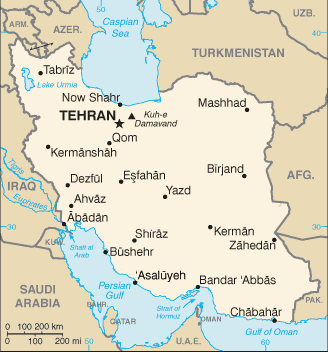
Map of Iran showing that about half of the country's borders are along a sea.
You can’t see it on the map, but that unnamed country in the upper left near Tabriz is Turkey. So, Iran is bordered to the west by Turkey and Iraq. Syria is elsewhere. If Syria is a “route to the sea” for Iran in the usual sense, then it is really Iraq + Syria, or Turkey + Syria that is the route to the sea. And, in fact, Iran does communicate with the Mediterranean sea to the west via various routes. Romney appears to have been correct that Iran sends arms to Lebanon via overland routes, and Lebanon is indeed on the Mediterranean Sea. Anyway, back to the map, that big blue blob to the north is the Caspian Sea, which is not connected to the ocean, so that is not “the sea” in the sense people usually mean it. But, the two conjoined big blue blobs to the south, bottom, of the map are the Persian Gulf and the Gulf of Oman which is contiguous, really part of, the Indian Ocean and the Arabian Sea.
Iran has 2440 kilometers of coastal border in the south. An additional 740 kilometers is Caspian sea. These coastal regions are major areas of settlement, history, trade and transport. In some ways, Iran is all about the sea.
OK, look at the map again. To the east (right) of Iran are Afghanistan and Pakistan. See how Pakistan is also on the sea? Afghanistan, in contrast, is landlocked. and, just so you know, the former USSR bordered Afghanistan to the north. This will all become important in a moment.
Iran is the modern country that represents the core of what was once “Persia.” Iran is, essentially, Persia, although there were times past when the Persian Empire was much bigger than present day Iran. This is important to Romney’s ignorance of the local geography because even a rudimentary understanding of place and history should serve to remind us that Persia = Iran and Persia is the place with the Persian Gulf, and there was this war called the Gulf War, and that Gulf was the Persian Gulf. So, in this sense, Romney’s gaffe was roughly analogous to, say, a presidential candidate back during the Viet Nam war thinking that Laos was North Viet Nam’s route to the sea, and not knowing what the Gulf of Tonkin was.
But that’s not the main reason to be concerned.
Persia, by the way, is not Arabia. Arabs are people who live in or near Arabia (the Arabian Peninsula) or who have spread from that region across North Africa or various places in West Asia, or who adopted Arab culture during historical periods. Persians never really got into that. Iranians are ethnically and historically distinct from Iraqis or people in or near Saudia Arabia. The primary language in the traditional Arab lands is, wait for it, Arabic. In Iraq, which is arguably Arab, the primary language is Arabic. (The second most common language there is the language of the Kurds, who live in a region that was divided among various modern countries, so they are ethnically distinct). But in Iran, former Persia, the primary language is … Persian! Arabic is in the top ten of the many languages used in this historically rich crossroads region, but probably not in the top five. Arab people in Iran are a minority, and for the most part are a repressed minority living in a few enclaves. The point is this: Iran is ethnically, historically, and culturally distinct from the rest of the “Middle East” and this distinction is earmarked, underscored, related to, and largely caused by this whole “Persian” thing … Persian culture, Persian Empire, Persian language, Persian Gulf. Which is an arm of the sea.
It concerns me that Romney conflates the diversity of this important region. Does that matter? Does getting people’s ethnicity, culture, language, and history wrong matter? I think that if you ask the diplomats on the ground they would slap you upside the head for even asking such a dumb question.
But that’s not the main reason to be concerned!
Remember how Afghanistan and Pakistan are next to Iran, to the right? Afghanistan is where Osama bin Laden (no relation) originally hid out, US forces cornering him in the early days of the war, neighboring Pakistan is where he was killed by special forces units sent in by President Obama (no relation). Why was Osama bin Laden in Afghanistan to begin with? He’s from Saudi Arabia, why was he not there? The US has very little military and intelligence presence in the most populous Islamic nation in the world, which is all covered with Jungle, why not hide out there? He was in Afghanistan because Afghanistan was his second, adopted home, because Osama bin Laden was a freedom fighter there, working with the Mujahideen there, which in turn was a resistant movement fighting against the Soviet Union, which had invaded Afghanistan in late 1979.
Why did the Soviet Union invade Afghanistan and fight a ten year long war there, which happened to spawn a resistance movement supported by the United States under the Reagan Administration, which ultimately led to the rise of the radical Al-Qaeda led by resistance fighter Osama bin Laden? It is extremely complicated and there are many levels at which to consider this, but one overarching theme that has influenced Russia and Soviet policy in the region is this: Pre-Soviet Russia and the USSR lacked sufficient routes to the sea that were winter-free and with good access to the Indian and Pacific oceans. The history of Russia and the USSR can be partly written in reference to this one thing. Having said that, it isn’t just the route to the sea thing, but also influence and control in the whole South Asia region. The point is, that for hundreds of years, Russian and Soviet diplomatic and military activities have involved poking around in, occasionally invading bits of, and working out deals with all of the nations to the south and along or near either the Indian Ocean or a sea that leads to the Indian Ocean. This is still going on (remember the invasion of Georgia a few years ago?).
So here’s the thing. Long term, over centuries. Russian and Soviet mucking around along this southern frontier has been a key factor in all military, economic, and political considerations of the region. Most countries bordering the Indian Ocean directly or indirectly have received some kind of attention from the Russians or Soviets, and this has been of great concern to the rest of the world. One of the most significant events of the last half of the last century was the ten year long war in Afghanistan. Had that war ended in Afghanistan becoming part of the USSR, or a good ally, then guess what would have happened next.
Iran would today be Russia’s “Route to the Sea” in the south.
And the struggle to determine that outcome gave birth to modern geopolitics in the region, to Osama bin Laden and Al Qaeda, to the dicy situation in Pakistan, and to the radical faction of the global Islamic movement that people like Mitt Romney like to scare us all with.
Yet, he seems to know nothing about it, because if he had even a middle schooler’s level knowledge of history and geography of the region it would be utterly impossible to not know that Iran is a key coastal country of southern Asia, and that this geographical position is key in Iran’s role in geopolitics of the present and last centuries.
And this guy wants to be president.
Don't make the mistake of calling a Iranian Persian an Arab. You will be picking your head out of your ass. It is a much older culture, and they are very proud of it.
Bin Laden was killed in Pakistan, which detracts from that whole paragraph. And wasn't Iran bordered by the USSR in now Turkmenistan, not to mention through the caspian sea. I just don't follow here, if anything you'd think that the Soviets were trying to bypass Iran by taking Afghanistan and eventually Pakistan.
You goofed! Osama Bin Laden was in *Pakistan* when he was killed. Everyone assumed he was in Afghanistan, but he was in Pakistan, perhaps living in that house for years. Did you not notice that the raid that killed him sparked a diplomatic incident with *Pakistan*?
Nice rant though, apart from that detail...
Excellent post as usual Greg. Just a note, Iran has 5440 km of LAND borders, not total borders.
https://en.wikipedia.org/wiki/Geography_of_Iran
I believe Osama bin Laden was killed in Pakistan
http://tinyurl.com/4yb7ugl
Thank you for the helpful corrections. Yes, I know he was killed in Pakistan. That sentence started out much longer (yet correct) and in shortening it I deleted an entire country. Good thing I don't work for the State Department.
Interesting and well argued post over all. There is, however, an important factual error. You say,
"Afghanistan is where Osama bin Laden (no relation) was killed by special forces units sent in by President Obama (no relation)."
Osama bin Laden was killed in the city of Abbottabad which is in Pakistan. His compound was near a Pakistani military base and academy. That is why President Obama said in the debate last night that the operation might not have been a success if we had asked Pakistan for permission as Romney had suggested in the 2008 debates.
As much as I dislike Romney, he is not wrong about Syria. Iran has a pipeline deal with Iraq and trucks can pass from Iran to Syria through Iraq so it is a channel to get past the blockade.
Robert: Yes, that has been acknowledged. Syria is Iran's route to Lebanon (see post) and there are all sorts of routes of communication and material, including oil, water, truck routes, etc. across the entire region that might surprise people. But Syria is not "Iran's route to the sea" since Iran sits on the sea. As I think I tried to make clear, the whole "route to the sea" think is a widely known classic trope in the region, to anyone who has not been studying the geography of Planet Kolob.
Re: “remember the invasion of Georgia a few years ago?”
Quite irrelevant. Joseph Stalin was a school boy from Georgia. The hullabaloo with Russia was that radical Georgian nationalists attacked and tried to expel ethnic Russians living in the northern border area. Russia came to their defense. It had nothing to do with geopolitics, much less a warm-water port.
That said, it is amazing that Mitt could repeat his misinformation to so many supposedly well educated audiences without protest. Certainly in all that time someone in his campaign looked at a map or remembered geography lessons. When Mitt said it on TV, I jump out of my seat and asked if I had really heard him. “Syria is Iran’s route to the sea.” It surely must have been a slip of the tongue. But no, Romney said exactly the same falsehood, and it is a falsehood after 3 repetitions, at least five times before. Romney either does not know anything about geography, or he is willfully inventing a false geographic narrative to back other political objectives. If he can misrepresent the facts of geography and get away with it, he will feel free to misrepresent anything.
It is increasingly clear that US objectives in Syria are not freedom and democracy, but rather to punish Iran, kill some Arabs to satisfy public opinion, and support Netanyahu policy as accepted by Congress. However, Syrian rebels are undisciplined and all across the map ideologically. Their victory can only mean butchery. The sane course is a negotiated settlement, as defended by Russia and China [and no matter how bad we think they are]. Romney’s use of evidential falsehoods to back what is plainly a war narrative is unpardonable. We have walked that path before.
I think my daughter, who was literally blasted out of her bed when the first mortars fell, would not consider the Russian incursion irrelevant, but I suppose that is personal.
The Ossetian issue, which is the key underlying framework for the invasion, is very much a matter of regional geopolitics and Russia's concern for communication (in the victorian sense) across South Asia, i.e. pipelines, land routes, etc. That was certainly not the most important event in decades, but it was recent and I'm hoping here to jog some memories of the relationship between that event and the last Presidential election.
I too am torn between the "ignorance" and the "willful ignorance" explanation for Romney wanting Iran to be land locked.
This is no gaffe. This is not a case of Romney being ignorant of geography, it's a case of the so-called "fact checkers" being ignorant of the trade routes now being used as a result of sanctions.
Romney was speaking in the context of the debate topic on foreign policy and the sanctions restricting the finances and trade of Iran. Although Iran is indeed located on the seacoast of the Indian Ocean and the Persian Gulf, the international trade sanctions have restricted and impeded its ability to transport armaments and other goods through its own seaports. To defeat these trade sanctions, Iran has resorted to using its air transportation to transport goods through an air corridor in Iraqi airspace into Syria and its seaports, such as Latakia.
fyi... Iran-Iraq-Syrian pipeline deal from last year is indeed the route to the Med Sea and easier distribution of the nat gas to the EU. The current plan is Iran to Damascus and then on through Lebanon to the Med Sea. Can't say for certain this is what Romney is referring to, but other than arms, this would be the most plausible reason he keeps saying it.
Also, in saying 'route to the sea' it is not suggesting that the two countries are bordering each other, nor is it suggesting other countries are not involved. It is simply trying to tie the two countries together to show a common interest.
I think Daniel, above, is correct in thinking that the Soviet Union wanted to reach the Indian Ocean via Pakistan. Recall that Iran under the Shah was a US ally, and I suspect there would have been no great trust between the ayatollahs and the Soviet regime. Turkey, being part of NATO, blocked access from the Black Sea to the Mediterranean via the Dardanelles.
My memory is a bit hazy, but wasn't there a Soviet client regime in Afghanistan, and the 1979 invasion was at least partly to shore up that regime?
Yes, there could be some smuggling into Iran via Syria. But that's more logistically involved than small boats crossing the Persian Gulf/Gulf of Oman. The latter involves two fewer land border crossings than unloading a boat in Syria (which does have a Mediterranean coast) and trucking it over to Iran. Much of Iran's southern coast is rugged terrain well suited to smuggling operations.
Maybe Romney got Iran and Syria confused with Afghanistan and Pakistan—Pakistan being landlocked Afghanistan's route to the sea. (Well, one of them; the other is Iran.)
If the man is too stupid to read a map, he's too stupid to be the Commander in Chief. End of discussion.
A few point, that might, or might not, change the context of the overall situation:
Both Iran and Russia have long dreamed of pipelines that would ship their petroleum resources, gas and/or oil, to energy short Europe through the Mediterranean. The invasion of Georgia was, to some extent, part of this but I think the main thing was that Russia is loath to have states that are too independent next to them.
Access to the Pacific by Russia might be much less an issue in the future as the ice melts due to AGW.
The start of the Iranian nuclear program can be traced back to their first nuclear reactor, built by GE and given to Iran by the US. The present dilemma is a direct result of the Atoms for Peace program.
Iranian suspicion of US motives and means goes back to the CIA engineered coup and replacement of a popular Iranian leader, who was making slightly pro-Soviet noises, with a leader who would be more pro-US. This was also seen by the CIA as a blocking maneuver to keep the USSR away from the Indian Ocean.
The Mujaheddin was losing in Afghanistan before the US backed them and ginned up religious fundamentalist sentiment as a tactic to bring fighters to Afghanistan. OBL was influenced by the CIA inspired and organized Muslim fundamentalists front and he became a US proxy by joining this moment. Once the Soviets moved out the US left the monster they had created intact and undirected. Al-Qeada was a result of this organization being potent and desiring other missions but undirected.
The Iranian regime, alarmed by both a fundamentalist Sunni and Arab force north of their border, was quite cooperative with the US invasion of Afghanistan. Persians and Arabs are quite different in culture and temperament as are Shea and Sunni Muslims.
By rights, common interests, if it wasn't for historic reasons for well founded Iranian suspicions of the US and differences over the nuclear program, both of which the US needs to take some responsibility, the Iranians would be active and direct allies of our efforts in Afghanistan. In the unlikely event of US-Iranain cooperation many of the strategic and logistical problems in and around Afghanistan would disappear. Iran would be a route from the sea for US supplies and forces.
This would also make us much less dependent upon Pakistani good will. Without US funding and strategic support Pakistan would be more open to settling the Kashmir situation and settling the issues with India. If the Indians were less worried about Pakistan they would be a much stronger counterweight to China. There is also the fact that the obvious counterweight to Arab nationalism is Persian nationalism.
The overall point of those last few bits is to point out that while there is no obvious up side to conflict with Iran there are obvious and real benefits to working together.
Of course none of this matters to Romney because as flawed a tool as he is his mission is both simple and clear: Do and say whatever is necessary to advance the political ambitions of the GOP. US economic soundness, the prosperity of the citizenry, and world peace, are secondary to this goal. As Noquest said, he only needs sufficient digits to hold a pen.
Obviously a lot of people commenting on this thread would have done better than Mr. Romney in the debate.
Thank you for this informative piece.
For anyone trying to make hay out of this, the great news is that unlike Obama, Rmney knows here are only 50 states!
Also, Syria is Iran's route to Club Med.
Perhaps Romney will realize that Iran has a coastline if Iran gets sufficiently upset and blockades the Strait of Hormuz. As I read your piece, I thought this was going to be your main concern.
Your next column should discuss whether using "gaff" is a gaffe or not.
When I heard Romney say Iran needed a route to the sea, I assumed he was taking a western-centric view of the world, saying the Mediterranean was the only sea that "counted" in that region.
It is really kind of foolish to challenge Romney's intelligence. The guy saved Bain Consulting from collapse. He is obviously very smart and has great practical sense. Much smarter than Obama who has no intellectual achievements to his credit.
The problem with Romney is not that he is dumb. The problems are that he may increase conflict with countries like Russia and that he will oppose necessary taxes on the super-rich.