

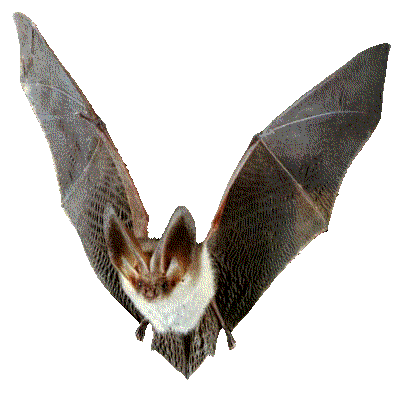
Okay guys, if you had a choice between having a big brain or big .. er, testes .. which would you choose?
A recent scientific paper reveals that as sexual selection pressures increase in promiscuous bat species, males evolve larger testes and smaller brains. But in bat species where females remain faithful, males had comparatively smaller testes and larger brains. Conversely, male sexual behavior had absolutely no effect on either brain or testes size.
Because brains and testis are the most metabolically expensive tissues to grow and maintain, the balance between their relative sizes represents an evolutionary trade-off, especially in species that have very tight energy budgets, such as bats. This energetic conflict between brains and balls caused Scott Pitnick from Syracuse University in New York and two colleagues, Kate Jones from Columbia University, also in New York, and Gerald Wilkinson from the University of Maryland, to look at how bats solve these evolutionary challenges.
In their paper, the researchers tested two hypotheses; first, that testes size increases as female promiscuity increases because larger testes produce more sperm and second, that as testis mass increases, brains become smaller due to the subsequent decrease of energy available for growing and maintaining a larger brain.
To test these hypotheses, Pitnick, Jones and Wilkinson compared brain dimensions and testis mass to the social and mating systems for 334 species of bats. Due to their small body size and their correspondingly high metabolic requirements necessary to meet the demands of flight, bats have a severely restricted energy budget and so they provide an excellent model system for studying this evolutionary balancing act. Additionally, even though bats are the second most species-rich mammalian group after rodents, they are well-known, so the researchers were able to access and analyze a tremendous amount of taxonomic data collected throughout the decades.
"In species with promiscuous females, the males are competing to fertilize her eggs and so need to produce a lot of sperm," Pitnick said. "And this may be especially true in some species of bats where the females store sperm for several months."
"If female bats mate with more than one male, a sperm competition begins," Pitnick elaborated. "The male who ejaculates the greatest number of sperm wins the game, and hence many bats have evolved outrageously big testes."
This relationship between testis size and mating system has already been demonstrated in primates. However, even the largest primate testes (in the promiscuous crab-eating macaque) were only 0.75% of total body mass, whereas the largest testes found in bats were an astonishing 8.4% of total body mass (in the Rafinesque's big-eared bat). Wow! If that was the case for humans, assuming that the average man weighs 160 pounds, the average guy would have balls that weigh almost thirteen-and-a-half pounds (and none of his pants would fit, either)!
As predicted by this study, brain size in these bats also varied with testis mass and mating system: as testis mass increased, brain size decreased. This study also showed that in the more monogamous bat species, average male brain size was about 2.6% of body weight, whereas in promiscuous species, average male brain size shrank to only 1.9%.
Surprisingly, the relationship between mating system and brain size has received little attention from researchers, says Pitnick, who teaches evolution and population biology and researches topics such as sexual selection and sexual conflict.
"Because they live on an energetic knife-edge, bats may not be able to evolutionarily afford both big testes and big brains," concluded Pitnick.
This paper [PDF] was published online in the top-tier peer-reviewed journal, Proceedings of the Royal Society of London B.
Thanks for the tip, Ian.
.
Oh, goody, this new blog move is going to be about sex. so, why are the majority of human males so hung up on penis size rather than testes size? Well, I know the answer to that question, but had to ask.
a penis has a practical use, but it also serves as a sexual ornament.
Um... does this mean that the next time my girlfriend makes a crack about men being stupid I can blame it on her being a slut?
Ok, I admit that there is a correlation bettween brain size and intelligence. But my question is: Is this applicable for all animal species?
Is there a measurement for synapses of neurons in the brain?
I dont know if the results will be the same if the measuremt is made for the number of synapses instead of brain size.
Just Guessing
I actually think pough makes a good point. The women are choosing to be promiscuous, as you mention "male sexual behavior had absolutely no effect on either brain or testes size". Females are choosing (lots of) the males with big balls over (single) males with brains. The interesting question is why female behavior has evolved to make this the case. What environmental pressure produces promiscuous females?
And how can we introduce more of this behavior in humans? :-)
So recent research I read in either SCIENCE or NATURE showed that female humans respond more favorably to agressive, "bad" behavior in males (did I get that right? I kind of skimmed the article). Seems to track with more testosterone and less thinking (the latter on both sides of the gender gap). I did not see "Crazy/Beautiful," but the trailer suggested that wild, blue-collar males will make the upper-class blonds swoon. Back to nature, etc., etc. What's a geeky bat or guy to do?
pough; you could say that, but Miss Manners would be horrified by your word choice, as would your girlfriend.
Jose; you raise a good point. brain size is roughly correlated with intelligence, but there are plenty of exceptions to this rule across taxa and also between genders within a given species. for example, the average bird is more intelligent than the average human, yet their brains are demonstrably smaller. i suspect that the relationship between testes mass and brain size is not as tightly correlated for all species as for bats (if i am not mistaken, bats' restricted energy budget is the reason they were selected as the model system for this study).
to answer your question, it is possible to measure synapse number for specific regions of the brain (they do it in birdsong research), but i am not sure how easy it is to do for a whole brain, or if it is even possible to do for a whole brain using current technology.
Will; very good question. i cannot answer that for bats. as for humans, many "first world" countries are living out a great social experiment that has already shown that women do become more promiscuous when they are (1) freed from the obligation and stigma of unwanted/unplanned pregnancies, combined with (2) greater educational and (3) greater employment opportunities such that they can support themselves and any offspring that they do choose to have without having to rely solely on the (potentially absent) father.
Biosparite; okay, so most females respond to risk taking males, but who ends up fathering their offspring? appearances can be deceiving (DNA is not). also, keep in mind that the "females prefer jerky guys" scenario is not universally true. for example, let's take a look at the white-throated sparrow. there are two color "morphs" in this species, the "white morph" and the "tan morph", and each morph also has clearly identifiable physiological and behavioral differences. the white morph males and females are more aggressive, sing more, have more testosterone (both males and females), and are generally very outgoing birds, while the tan morph birds are more subdued. which males do the females of this species prefer? they all want to set up housekeeping with the "nice guy" tan morph males, but only the white morph females are "tough enough" to muscle out the more passive tan morph females when competing for a mate. so the tan morph females are then stuck with what is left, the philandering and generally neglectful white morph males!
Single tan morph male ISO white morph female nonsmoker; has no nestlings, likes to sing and call in the birdbath, loves romantic dinners at the feeder, ready to gather twigs and set up nestkeeping.
My comment about humans was (mostly) toungue in cheek.
You point out various factors in modern (first world) culture that seem to have produced more promiscuous females. These factors suggest that whenever women have more cotrol over their reproductive/lifestyle choices (ability to selectively continue with a pregancy even after impregnation, ability to live independently w/o male or family assistance) they are more likely to entertain multiple sexual partners, much like men historically have. Does this suggest that over the next few generations as female social power overtakes males (just look at college enrollments) women will actually become the more sexually voracious?
More interestingly how does this behaviour develop outside of "cultured" species. Why are some female bat species more promiscuous than others? Do those females have more control of their reproductive options?
Also, does your response to Biosparite suggest that the "opposites attract" hypothesis might have some basis in fact? Attractive quiet girls end up with obnoxious males and aggressive females end up with passive males? It would explain my parents. ;-)
Biosparite: brilliant!
I think the real question is unanswered (at least by the summary above): Which is the cause and which is effect?
Do males grow big brains (and concomitantly small testes) because females are loyal? Or is it the other way around: smart males induce loyalty in otherwise promiscuous females.
And dumb but well-endowed males turn innocent virgins into lusty sluts.
Sincerely,
Mr. Large
Bah. Miss Manners can calculate the body mass ratio of my testes.
I wonder if religious conservatives would use these observations to encourage the banning of sex-before-marriage and other "promiscuous" behavior with the excuse that they will be trying to construct a more "intelligent" human species.
I am going to add your blog in my links, I think it is wonderful.
biosparite; hilarious! this white morph female loved your ad.
Will; haven't women already become more sexually voracious?
the reasons underlying the development of different mating systems (monogamy, polygamy and promiscuity) in birds at least, are multifacted and complicated. basically, they depend upon allocation and quality of those resources necessary for successful reproduction, i.e.; food, territory, nest sites, etc.
actually, all female white-throated sparrows prefer the tan morph males when given the choice. the tan morph males are a limited resource in this case, so this sets up a competition between the females for this particular limited resource. the more aggressive white morph females win the competition, leaving the more passive tan morph females with the left overs, those obnoxious white morph males.
Mr. er, Large; you started off asking interesting questions, but had a poor finish. it's just like a man to think that males are in complete control of the evolutionary trajectory of a species.
Pough; i think that such calculations require the use of a very sharp knife!
Dr. Marco; thanks for your kind words. to answer your speculation, i don't think that religious wingnuts are interested in "creating" a more intelligent human species since that would be an admission that evolution really does occur. besides, thoughtfulness and religiosity are antithetical.
GrrlScientist: Discussing humans above I meant that women have been on the rise socially in Western cultures for less than a century and the progress is increasing rapidly. As I mention women have already overtaken men in college enrollment (55% to 45% last I heard), suggesting that in the near future (one more generation) women make overtake men in social power in Western culture. And if social power relates to promiscuity in humans than we can expect women to become much more so in the future, possibly matching men.
Of course, this conjecture assumes conservatives can't pull women back through vigorous legal (Roe) and social (family values) responses.
Hugh: As GrrlScientist mentions the women being promiscuousis the cause and the small balls is the effect. The quesiton is what evolutionary pressure produces the promiscuous female. I think we have some idea what pressures produce it in humans, but in less social/cultural species I'm curious what the research would show.
I haven't anything in the bat testes discussion that mentioned female brain size - are their brains also small in species with large-testes males? A significant divergence in gender intelligence could be interesting, and might affect behavioral strategies.