


Fossilized mosasaur skull (source linked from image).
Mosasaurs are marine reptiles, not dinosaurs.
But the reason I show this fossil here will (hopefully) become more obvious after you read the story.
A 2 kilometer-long treasure trove of fossilized bones, teeth and claws from dinosaurs and ancient reptiles was recently unearthed on the Chatham Islands, approximately 850 kilometers (530 miles) east of New Zealand (see map, below), proving that dinosaurs also inhabited South Pacific islands.
Jeffrey Stilwell, a US-born fellow in palaeontology at Melbourne's Monash University, said he accidentally discovered the fossilized foot, finger and spinal bones of carnivorous dinosaurs when he visited the Chatham Islands in 2003.
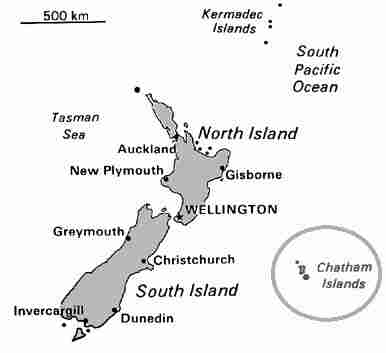 "It's really a unique type of sediment deposit in that the bone-rich horizons extend for at least 2km of wave-cut platform and cliff exposures," said Stilwell of his find.
"Prior to our discoveries, only a few isolated examples of dinosaur fossils had been found in the northern part of New Zealand," Stilwell noted. After his 2003 discovery, Stilwell and his colleagues returned to the site last month, thanks to a grant from the National Geographic Society, to search for more bones in the same area.
Stilwell's fossil discoveries are still being studied but already, he and his colleagues have identified three kinds of carnivorous dinosaurs, three kinds of herbivorous dinosaurs, one kind of flying reptile and several marine reptiles, such as mosasaurs (pictured, top) and elasmosaurs.
These fossils were the first discovery outside the New Zealand mainland in the southwest Pacific, although some fossils had been previously found along the Antarctic peninsula. This area has yielded more dinosaur fossils than have been unearthed in all of New Zealand in the last 25 years.
One of the few previous finds of a dinosaur anywhere on New Zealand was a single bone found by amateur palaeontologist, Joan Wiffen, at the Mangahouanga Stream site in Hawkes Bay. Later, Wiffen and her helpers returned and collected enough bones to identify a new species of mosasaur.
Prior to this, the Chatham Islands were well-known as the world's best source of fossilized shark's teeth.
The data were recently published in the peer-reviewed journal, Palaeogeography, Palaeoclimatology, Palaeoecology.
Thanks, Christine!
At last, a major fossil story on LTSL. It has been "looked for like rain . . ." (Sylvia Plath).
Grrlscientist, do you know if these islands were islands back then or were they part of a larger landmass? If they were islands is there enough evidence yet to consider how the dinosuars (not the marine reptiles which could obviously get to islands) got there.
Also have they found any hobbit, orc or oliphant fossils in New Zealand yet?
Canuck Rob,
The Chatams have been bobbing up and down for millions of years - I think i's widely accepted that they last surfaced about 4 million years ago - long enough that lots of reptiles/insects/birds have chatams sub species which are of interest of in terms of molecualr evolution/ecology (but nothing to do with your question)
In fact the chatams are part of the larger NZ continental shelf (we're bigger than we look you know) and as such where part of Gondwanaland up untill ~85 million years ago
Cool! But what's the age of the fossils on the Chathams? I should probably just go read the article...
The fossils are more like 65 million years old - right on the K/T boundary and after NZ split from Gondwanaland which is pretty cool
Thanks. See on this also here.