

 Birds, bees, bats, butterflies and other species that pollinate North American plant life are steadily vanishing, according to a study released recently by the National Research Council. This "demonstrably downward" trend could damage dozens of commercially important crops, scientists warned, since three-quarters of all flowering plants depend on pollinators for fertilization.
Domesticated honeybees, which pollinate more than 90 commercial crops in the United States, have declined by 30 percent in the last 20 years. In fact, U.S. farmers had to import honeybees last year for the first time since 1922, underscoring the extent of the problem.
A number of factors have reduced pollinators' numbers in recent decades, the researchers said. Introduced parasites such as the varroa mite have hurt the honeybee population, and pesticides have also taken a toll. Bats, which carry pollen to a variety of crops, have declined as vandalism and development have destroyed some of their key cave roosts.
"Despite its apparent lack of marquee appeal, a decline in pollinator populations is one form of global change that actually has credible potential to alter the shape and structure of terrestrial ecosystems," said May R. Berenbaum, an entomologist at the University of Illinois.
Animal pollinators fertilize more than 187,500 flowering plants worldwide.
Cited story.
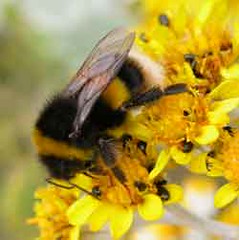
Image: Bumblebee, Bombus terrestris (source).
.
Another endangered species: pink plastic flamingos
"Don't it always seem to go, you don't know what you've got 'till it's gone...."
Actually native pollinators would more than pick up the slack if farmers did not poison them and wipe out their local habitat. I recommend THE FORGOTTEN POLLINATORS by Stephen Buckman, et al., for more details. Also see the January 2006 issue of AUDUBON MAGAZINE for plans for constructing native-bee nesting boxes, but be sure to vary the size of the holes from 1/16 to 5/16 of an inch to accommodate the different sizes of wood-nesting bees in your area. Some of them are TINY, and they select holes that are a snug fit. They use beetle holes in tree trunks and other natural openings, but you can bring substantial numbers to your neighborhood with nesting boxes. Unlike European and now Africanized bees(both, by the way, are invasive exotics), native wood-nesters are not irascible in the vicinity of their nests. They will not sting unless you do something really obnoxious like grabbing them. Some of them are beautifully colored, too. Over the weekend I was watching a metallic-green, diminutive bee nectaring at a weedy native aster at the W. 11th St. Park in Houston. Another cool thing about native bees: they are FAST at pollination since they are solitary, and, therefore, are in a race against time to stock their nest hole with wads of pollen and nectar to provision the cells in which they lay their eggs. Since they do not have help, they have to move along.
Bee populations can be especially at risk from population crashes because of the hymenopteran complementary sex determination system. If the ensuing bottleneck reduces genetic diversity and increases homozygosity at the sex determination locus, many of the fertilized eggs in that population will develop into sterile diploid males instead of fertile females. Amro Zayed and Laurence Packer at York University have done quite a bit of research on this system.
Most people who are neither biologists nor insect-watchers are very surprised to learn that solitary bees not only exist, but are important pollinators that are unlikely to be aggressive towards humans. I worked on solitary cavity-nesting wasps for some years, and had lots of teaching moments.
BTW, folks in the Tucson area can see a wonderful nesting-box exhibit at the Arizona-Sonora Desert Museum. When I've visited there, the boxes have been full of beautiful cavity-nesting solitary bees and wasps.
Julie,
Do you know r know of Margrit McIntosh at the Univ. of arizona? She did graduate work in tucson studing cactus bees that happened to be ground-nesting in a vacant lot adjacent ot her apartment. I tried to lure her to Houston several years ago to make a presentation to a group I belonged to about her work but was unable to spring loose travel expenses for her. Her account of the bees she studied can be found on the Web and is very entertaining. I understand from Fish & Wildlife people here in Texas that TX native bees seem to be doing well. During the NABA butterfly count on the Katy Prairie NW of Houston this past Labor Day, I enjoyed allowing sweat bees to lap up the same from my skin during a very warm day chasing butterflies with close-focus binoculars and digital cameras. I once rescued a tiny native bee from a water droplet on a leaf. Somehow the bee had gotten its abdomen stuck inside the droplet and was unable to overcome surface tension to extricate itself. I enjoyed watching the bee stand on my finger afterwards and buzz its wings in order to dry them off.