

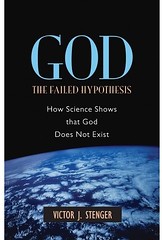
 At first glance, I thought this book was too slim to accomplish its stated goal, but I was wrong. In God: The Failed Hypothesis (Amherst, NY: Prometheus Books, 2007), Victor J. Stenger critically examines both empirical data and scientific models for the existence of a supreme, transcendant being -- God -- and finds them to be inadequate.
Stenger begins by defining God according to the Judeo-Christian-Islamic scriptures and asserting that the existence of God is a hypothesis that can be tested scientifically. Thus, as with all hypotheses, this allows us to make predictions of what we should expect if the God Hypothesis is either confirmed or refuted.
In each of the ten chapters, the author focuses on particular scientific evidence against the existence of God, clearly laying out the details of each argument. Several chapters were especially interesting to me, for example; chapter seven, which asks, Do our values come from God? Repeatedly throughout history, the religions of the world assumed the grand role as arbiters of human behavior. Their leaders continually bemoan the moral decay that they claim to see in society, stubbornly insisting that they can tell the rest of us what is right and wrong because they have a special pipeline to the mind of God, who ultimately defines right and wrong. But after relating his observations of how people -- including believers -- actually behave, the author comes to the conclusion that "God cannot be the source of commonly accepted human morals and values. If he were, then we would expect to see evidence in the superior moral behavior of believers compared to nonbelievers. If you deny that any discrepancy exists between the behavior of believers and what is taught in their scriptures, the empirical fact is that nonbelievers show themselves to be no less virtuous provides strong evidence that morals and values come from humanity itself. Observable human and societal behaviors look just as they can be expected to look if there is no God." (p 210).
Another interesting chapter examines the problem of evil and maintains that;
- If God exists, then the attributes of God are consistent with the existence of evil
- The attributes of God are not consistent with evil
- Therefore, God does not and cannot exist
In this chapter Stenger argues that unnecessary suffering in the world is inconsistent with a god who is omniscient, omnipotent, and omnibenevolent. Of course, evil might solely come from the devil, but this implies that god is not omniscient, omnipotent, or omnibenevolent (the 3Os). The author also observes that "[i]mmediately after the September 11, 2001, tragedy, many (though by no means all) of the Christian clergy blamed it on the devil and not God. This implies that either the devil is an equally powerful, autonomous separate God, which is no longer a monotheism, or a part of God himself, which is no longer omnibenevolence." (p. 223) As a result, this is not consistent with the the traditional omnipotent, omnipresent and omnibenevolent Judeo-Christian-Islamic God hypothesis being tested.
The last chapter of the book investigates life in a godless universe and asks why many of us cannot find meaning in our lives without having it handed down from above? Stenger observes that, as social animals, we find pleasure in the society of others, and that we empathize with others' suffering. As a result, we have built up a vast civilization and we have a wide range of important activities in which we can participate -- working to reduce avoidable suffering being only one of them. But what about spiritual comfort and inspiration, you ask? The author notes that spiritual comfort and inspiration are the purpose for art, music literature and science, as well as family, work and recreation. Further, he adds, religious "comfort" is not all that it is cracked up to be; psychologists report that highly religious protestants exhibit more symptoms of obsessive-compulsive disorder than do the less religious and nonreligious. Additionally, life everlasting carries with it the persistent dread that one might spend eternity somewhere other than in the bosom of God.
After each chapter, there is a section filled with references and notes, and the end of the book had a detailed bibliography and index, making it easy for the reader to follow up on particular points. Logically structured, meticulously argued and readable, this book is a unique and powerful critique of the existence of the traditional omnipotent, omnipresent and omnibenevolent Judeo-Christian-Islamic God. Relying on converging evidence from physics, astronomy, philosophy and biology, Stenger has written a masterful argument in support of reason.
.
- Log in to post comments
I am looking forwards to reading the book very soon.
Does Stenger review the solutions (or "solutions"?) to the problem of evil?
Bob
Stenger recognizes that the "problem of evil" has consumed many theological and philosophical texts, but basically, he reviews the problem of evil and concludes that, because there is avoidable, unnecessary suffering -- "evil" -- in the world, this is incompatible with god (as defined by the judeo-christian-islamic scriptures) so therefore, god cannot exist.
Christians believe in a god that is actually just a really big human. That's not unexpected since christianity, far from being "Judeo-," is actually Greco-Roman. Those were both cultures whose religions made their gods nothing more than bigger humans (not to mention the other similarities, like polytheism and stories of gods who mate with humans to produce god-like beings). If you remove the cultural bias when talking about a deity, there is actually no reason to suppose that such a being would resemble humans in any respect. If there were actualy a deity, I think it might well not even possess what we call consciousness.
"avoidable, unnecessary suffering -- "evil" -- in the world, this is incompatible with god." So basically he says "the problem of evil has been written about a lot and rather than deal with the issues I'll just assume the hypothesis." Very scientific. (BTW, if you actually read the Roe v. Wade decision they use the same logic - there is disagreement among scientists, clergy, philosophers about whether a fetus is a human life and the Court will not attempt to answer that question but will assume the answer is no)
It is not surprising that one can use science to "disprove" God since science is based on a closed system which by its nature denies the existence of God. Science and Christianity work from two distinct sets of assumptions each which effectively denies the assumptions of the other. I wish more people on both sides would grapple with this. Any effort to 'prove' the assumptions isn't going to work.
It looks like Stenger offers nothing new to the question of God. He dresses old arguments (believers are bad too, the problem of evil) in 'scientific' garb. Too bad.
actually, lee, he does not say that. do you even read before your knee jerks?
Thanks, GrrlSci. Re evil: I'm not sure the actual scriptures in question posit an omniscient, omnipresent, and omnibenevolent god -- that seems to be a later theological add-on. (Sean Carroll at Cosmic Variance had a great post a while back on something like this, I think.) Does Stenger provide evidence against what may be a more popular belief, in a well-meaning but not fully competent supernatural being (i.e. the kind that "grieves with you")? Not sure what that evidence could be.
Lee -- to the extent that a religion makes statements about what is or is not the case, it is susceptible to being confirmed or disconfirmed by available evidence (the degree of confirmation or disconfirmation depending on the weight of said evidence). Put up or shut up.
I was a bit disappointed by the frequency with which Stenger refers to his previous books. He does this dozens of times. For example, about the PEAR studies: he handled this in a previous book, so he jsut dismisses them in a line. So in some respects this latest book is more like an update than a complete argument.
I was most interested in his views on cosmology; "first causes" and "fine-tuning". However, he didn't go into a lot of detailed math, so I don't have a way of checking on his assertions.
Anyway, the prose is quite readable.
So basically he says "the problem of evil has been written about a lot by some of the best and brightest minds in history and all they could come up is...well, a big zero, thus, this hypothesis has repeatedly failed to get confirmed".
"It is not surprising that one can use science to "disprove" God since science is based on a closed system which by its nature denies the existence of God. Science and Christianity work from two distinct sets of assumptions each which effectively denies the assumptions of the other. I wish more people on both sides would grapple with this. Any effort to 'prove' the assumptions isn't going to work."
Actually, science course-corrects in the face of sufficient evidence. Lamarckism was quite popular in the scientific community until Darwin described his theory of natural selection. The earth-centered universe was the Ptolemaic model for many centuries before Copernicus (who later retracted, leaving it to Galileo some time later) suggested the Earth was not the center of the universe. And the less said about alchemy, the better. Science is not always right the first time (or the second or the third), and there is the distinct possibility that Stenger may not be right. But to claim that science cannot prove or disprove God because it doesn't take God as a given (which is the more proper phrasing) is fallacious. (And I'm not getting fresh with you ;-)
Besides, if an intelligent being created nature, wouldn't there be some pretty good naturalistic indicators of their handiwork?
Stenger vastly oversimplifies the "problem of evil" if he's saying that since evil and unnecessary suffering exist, an all-powerful benevolent God must not. That assumes that God's idea of benevolence is that we should never suffer. But many writers have posited that God may allow suffering and evil to exist because it is beneficial for us in the bigger scheme of things - it is necessary for growth and learning. Also because it is an inextricably linked to giving us free will. You have to let your kids screw up if you really want them to learn.
#11(Robb) -
But does that mean he will allow them to die to prove a point? It seems to me that any deity we fancy to be a father figure should at least act like one and not want (or allow) his children to die needlessly just to prove a point to the others.
The book sounds really pretty juvenile. It's not like the problem of evil is something that nobody's thought about before. This is not to say Stenger is wrong, but it doesn't sound like he's found anything new to say.
As usual, the scientific arguments against belief target only the most naive forms of religion. Any sophisticated believer can retreat into mysterianism and apophatic theology and render all of Stenger's arguments irrelevant.
God exists! without God Civilization cannot exist
=================================================
God is collective conscience of society. God is not an external entity, but within each of us. God is that part of our psyche (mind) that prompts us to do "good deeds" that are socially acceptable, and prompts us to keep away from "bad deeds" that are socially un-acceptable. Collective conscience evolves from the individual conscience.
Without "collective conscience" civilized society cannot exist, markets cannot exist, trade cannot exist..... without collective conscience why trade? why not snatch something from others, isn't it?
Those of you seeking definition/concept of God in Bible: The definition of God appears only in one sentence! it is where Moses speaks to God, asks who are you? the definition is the answer, if you missed it, you missed the whole concept of living God in Bible..... the definition of God is exactly same in Hindu Bhagavat Gita (story of child floating in the river appears in both Krishna and Moses stories). The concept of God is similar in all other religions also....
http://mapsofwar.com/ind/history-of-religion.html
To understand the "concept" of God you need to read the scriptures of different religions yourself http://www.sacred-texts.com/ don't blindly believe what religious high priests "interpret" as God!
Anon said: words! words! words!
1. Evil exists
2. Evil acts are commited by humans
3. Therefore humans are evil
Now go on to explain how anything good cannot be the result of human activity alone, because humans are evil and therefore completely incapable of anything good. Thus, invoke some other explanatory hypothesis for anything you value positively. Proceed to explain in anonymous blog comments how anyone who does not agree with you just doesn't "get it" and should read more fairy tales in a serious manner. Please don't forget to use as many exclamation marks as you feel are appropriate (hint: the more the merrier!!!).
mtraven said: Any sophisticated believer can retreat into mysterianism and apophatic theology and render all of Stenger's arguments irrelevant.
If I have a complex and self-consistent view of the social interactions and history of dragons, elves, and faeries, that I really really believe in, can I render all the arguments about the non-existence of such beings irrelevant by describing to my debate opponents the events of the last great treaty meeting between the king of the Forest of Light and the Skylord Dralangathalan? In other words, please explain how the term "sophisticated believer" is not an oxymoron.
I have not seen the book, but it seems like it's impossible to rule out any god at all, at least with what we know now. I think a decent case can be made that the Abrahamic god is impossible (most succinctly stated as "Your God is too small for my Universe") but there is a small gap where, to the best of our knowledge, there might be a loosely-attached Deist creator with little or no direct involvement.
That said, I'm becoming more and more certain that I'm an atheist, but I don't really think atheism is fully supportable intellectually -- for lack of better knowledge, one is kind of stuck with agnosticism.
I suppose if I were to redefine God as "goodwill" or "quantum probability", I might have difficulty denying their existence. I would also have difficulty saying that this "God" really does anything. But is this really the Creator God anymore? The one that people have died and killed others for? Is this the God of Abraham? Is this Zeus or any of the pantheon of Gods? No. Playing semantic squirming games does not invalidate the point made.
Mark:
Now, why would you want to call that a deity? I think the minimum requirements for anything to be considered a deity should be that 1) it's a person & 2) it has magical powers. If it doesn't possess these two qualities, just call it something else.
They render their own arguments irrelevant in the process.
But they don't -- that's the whole point. Mysterianism is inappropriate for science but perfectly appropriate for religion. I guess a true mystic isn't going to bother with "arguments" though.
For a reply about "sophisticated believers", see this comment on Pharyngula and subsequent comments of mine in that thread.
Thanks for the interesting read and discussion! Great post!
Whenever people reach scientifically into the human brain's operation to justify faith, I am amused to see the assumptions made from the connectors between these two.
While scientific tests are not designed to be deep or wide enough to capture currently known spaces in the brain for faith - it might be useful to look more to new measuring rubrics so that we begin to discuss offerings each has to converse with the other.
For instance, faith is more a matter of intelligence within the intrapersonal domain, and less an intelligence located in the logical-mathmatical domain. This fact creates new opportunities for discussing links between science and faith in ways that value and benfit both - without a need to deminish one or outlaw either.
#12 AtheistAcolyte:
If there is a God and He/She/It is omnipotent etc etc then it is not valid to assume that we can know what His/Her/Its thoughts or motivations are, or how He/She/It "should act". What seems like a pointless undeserved death from the POV of this vale of tears might not seem that way in the context of an afterlife. It's not logical to presume that we'd be in any position to assess the moralilty or benevolence of the actions or inaction of a God. This is the whole point of the Book of Job: God says "Oh yeah? What would you know about it?"
There's some presumption and prejudice in certain statements in this thread to the effect that religious people are incapable of clear thinking and logic. That may be true of certain fundamentalist bible-thumpers but is not a fair statement in the larger scheme of things. World-class philosophers and theologists and yes, scientists have for centuries been addressing the same questions that Stenger does and (it would seem ? I havent read Stenger) at a more deserving level of depth. There are any number of concepts of God that are logical and consistent with the observable world, though admittedly not the God of the Old Testament when interpreted literally. There have been many attempts to prove or disprove God?s existence on the basis of testable hypothesis; IMHO it can?t be done and is a pointless exercise. I see it as exactly analogous to attempting to prove or disprove the statement: ?Human life has purpose and meaning?; it is a belief, not something subject to resolution by the scientific method. It is wrong to assume that people who hold this belief are illogical.
#21 (Robb) -
Here's my problem with the whole "We can't assume to know God's thoughts or motivations" line: How, then, can we know any god is acting in accordance with a divine plan? How can we know that any god isn't making this stuff up as they go along? Even further, how then can we assume that any god is "good"? Isn't that assuming something about the thoughts and motivations of that god? If you were to counter that God is good because he told us so in the Bible, I could counter-argue that a malevolent or otherwise non-omnibenevolent being could make the same claim just as easily. Should you declare that God is defined by "good", I would ask you, "If your God came to you tonight and told you to sacrifice your child, would you do it?" If you said no, then you would have an independent moral basis telling you that God is ordering you to do something wrong. If you said yes, I would applaud your devotion to your God and then call Child Services immediately. If you said you would go through with it, banking on it being a test a la Abraham and Isaac, I'd say that the only way a god would know if you were faking or not is if you actually held the full intention to carry it out, at which point, again, I would have to call Child Services.
Metaphysical shell games aside, a belief in a god is one of the greatest tragedies of human evolution. We have been granted fantastically improbable lives in this fantastically improbable world, and yet these same lives are cheapened by the idea that we were always meant to be. How boring it must be, to look at a tree and see a creator's hand instead of the result of some 12 billion-plus years of universal existence.
I actually think that we can no more prove the nonexistence of a god any more than we can prove its existence (a la Descartes), and such an analysis is completely beside the point. Religion is all about faith, which by definition means belief in something that can't be proven. What I find ironic about the 'fundies' who try to get creationism etc. taught in schools is that such efforts just indicate how little real faith these people actually have, that they need to pretend that their views are supported by science.
The interesting question to me is, where does faith come from given that there is no evidence for a supreme being out there? I discuss that a bit in a post at my site, in reference to the recent Times magazine article about faith and evolution:
http://www.biotunes.org/bioblog/2007/03/atheism-next-evolutionary-step…
There may well be a white-bearded, muscular and impressive-looking guy somewhere in the cosmos, with first name God, and we can not really disprove that...but what usually I find myself reacting to is when someone pretends to speak on behalf of that potential entity. The problem is one of usurpation of rights by claimed proxy.
In the Stanford alumni magazine I received today there is a quite funny juxtaposition:
a) a couple of letters to the editor adopt a very sarcastic tone to attack a liberal evangelical leader because what she says is different from the literal "truth" one can read in the Bible.
b) there is a wonderful article on how kids who believe they are oh so smart from Day 1 have trouble learning and sometimes making mistakes, because that-in their view- would show they are no so smart. Other kids, instead, simply try new things, enjoy the process of facing and often overcoming challenges, and of course over time they become more sucessful than the "smart" kids who know it all from Day 1.
http://www.stanfordalumni.org/news/magazine/2007/marapr/features/dweck…
"People with performance goals, she reasoned, think intelligence is fixed from birth. People with learning goals have a growth mind-set about intelligence, believing it can be developed. (Among themselves, psychologists call the growth mind-set an "incremental theory," and use the term "entity theory" for the fixed mind-set.) The model was nearly complete (see diagram)."
You can guess who may be seen to represent religion and who science :-)
#23 - AtheistAcolyte
"How can we know any god is acting in accordance with a divine plan/ that any god is 'good'"?
Well, granted you can't, and it's possible that God is flawed, evil, or insane. But I think one can assume that if God is the creator of the universe, and us, and if the universe seems to be sane, "fair" (i.e. has consistent rules) and constructively supportive of human life, then God would seem to be on our side, which would be considered "good". We can't know God's exact thoughts and motivations, but we can trust them because His creation is self-evidently "good" - i.e. works for us.
If something purporting to be God came to me and commanded me to sacrifice my child, I would not do it. Because (1) I would have no way of verifying whether it was God commanding me or some other entity or emergent schizophrenia; (2) I consider it morally wrong to kill my child, or for anyone to give me such a command; (3) if God gave me free will then my expectation is that I'm supposed to use it according to my moral sense; and (4) if that really is God and He really does want me to commit infanticide, then God is nuts and the universe is insane and we're all in deep doodoo. However, I'm not going to lose much sleep worrying about such a possibility.
For the same reason, like Alvaro, I think it is entirely reasonable to completely ignore anyone who claims to have personal communication with God or to know His mind. In the absence of any evidence as to which if any of the 100,000 prophets from 5,000 religious sects really have a hotline to God we each have to discern on our own.
"a belief in a god is one of the greatest tragedies of human evolution."
You state that as if it were self-evident - but *why* is it a tragedy? Because religion is "responsible" for war, repression, etc? Well, science is "responsible" for the A-bomb at Hiroshima. Because it makes people intellectually fuzzy? Well, Isaac Newton believed in God.
"these lives are cheapened by the idea that we were always meant to be."
I surmise that you mean something like:
belief in God equates to belief in predeterminism;
belief in God equates to a lack of curiosity, skepticism, intellectual rigor w/r/t the natural world or the humanities, and to being opposed to progress, innovation, and liberal ideals;
belief in God results in shirking responsibility for personal moral discernment and for honestly and fairly addressing difficult, morally ambiguous dilemas.
I fully agree that contemporary conservative Christianity in the U.S. and fundamentalists of all stripes do use religion as a cover for these cop-out behaviors. But I disagree that this behavior is an implicit result of believing in God per se.
First read the comment #14, Story of Abraham is simple, first born child sacrifice was social "custom" "law" before Abraham, he changed it. Note that the "collective conscience" (voice of God, or God) of not sacrificing first born children came from the "individual conscience" of Abraham. The people who's names get listed in religious scriptures are the Individuals who contribute to the evolution of the "collective conscience" of the society.
If you study the story of Moses it is similar. Moses liberated the slaves who where living under the laws of Pharaoh's. When they were liberated and moved out into the desert suddenly there is no laws to govern these liberated people, fights and disputes becomes common among the people. As the leader of the group it is Moses responsibility to make some laws, so that society can exit peacefully. That is exactly what he did. Collective conscience is a necessity of civil society / civilization.
Collective conscience can reach out and alleviate sufferings of people in distress that's when God becomes real.
Do you think slavery is abolished at the time of Abraham Lincoln? You are wrong, if slavery means stealing work/wealth of people without paying them full compensation....... That is exactly what the currency racket (Fed, Banks, people who control them) are doing...... they are stealing your work/wealth by printing fake currency!
Today world is going through a distress period, about 7% of the people on earth control 80% of it's resources/wealth, this is making life miserable for 93% of people in the world. This means that someone is manipulating trade in their own favor to usurp wealth. We are all selling and buying goods and services with currency then what's the problem? The problem is the "fiat currency" system, the currency notes that are issued without redemption obligation. Essentially what this means is currency issuer will buy your goods/services and give you a currency note but then if you give the currency back and want to buy goods/services from currency issuer, they are not obliged to give you anything back. In fact the Federal Reserve Bank does not have anything that has "value" (value means something that will sustain life) in reserve, all they have is some Gold bars, you cannot eat it, nor can you use it to grow food the primary requirement to sustain life, so gold bars are just a token, which again needs redemption to realize "value", one token (paper currency) cannot be backed by another token(gold) isn't it? the whole system is a "BIG SCAM". Oops! this means people who control "fiat currency" racket can easily become rich isn't it? The reality is "YES" and it is happening, that is how 7% of the people control/own 80% of the resources/wealth.
It is time for collective conscience of people (God) to step in and alleviate the suffering of the people in distress. It is time for religious organizations around the world to wake up and fight the "fiat currency" problem by starting their own Banks that will issue *real* currency notes with redemption obligation. Let us make God a reality!
#26 (Robb) -
I suppose we could assume that IF God created the universe and IF the universe SEEMS to be "sane" (whatever that means) and IF the universe SEEMS to be "fair" and IF the universe SEEMS to constructively support human life, then God would SEEM to be on our side. I, however, do not accept any of those propositions and even IF I did, there would be 4 SEEMS and one big IF between me and trusting God.
You mentioned your personal moral sense and your inability to tell between God and another entity or a hallucination. This is very telling. Yet you assume that you received your free will from God, or that God created the universe or what have you. How are you sure that entity which gave you free will or created the universe was God? It could have been something else, couldn't it have been? Did someone give you your moral sense or did you develop it on your own?
If I stated it as if it were self-evident, I apologize. I meant it only as my opinion on the matter. I'm sure someone else finds another aspect of existence the "greatest tragedy". And I know that science has provided the means of some acts I would call great injustices, such as eugenics and nuclear weaponry. However, I would point out that science is knowledge-based and ethically neutral in all respects. It's only when men are involved that the ethics become hazy. The horrors of Hiroshima do not negate the physics of the atomic nucleus.
You may make the argument for religion likewise, that men are the evil force behind all of religion's evils. The difference is that religion is NOT ethically neutral in all respects; in fact, it strives to be ethically non-neutral at all times. As Sam Harris put it, "The discomfort induced in mathematics by Godel does not make the doctrine of Mormonism even slightly more plausible."
I don't think I have a problem with religious moderates who are somehow able to compartmentalize their minds and not need to reconcile their religion with their science, except that they provide the groundwork for the fundamentalists to do their work. I don't advocate throwing the baby out with the bath water, but I would advocate throwing the bath water out with the baby's urine.
#27 (Anon) -
Wow. I see the words, but all I read is "blahblahblahI'MNOTGETTINGENOUGHATTENTIONblahblahblah"
Until we can agree on a definition of God as the first premise we can never reach a satisfactory conclusion.
I would like to propose:
It (not He) would be an omnicient, omnipotent, omnipresent (essence, force, power, etc.) without human gender, characteristics and emotions that has no need for prayers of praise or supplication.
After we agree upon what we are talking about, then the discussion can begin.
Having asked myself these same questions as a child and young adult without assistance, I wish that the author had allow himself to read other books that think openly, such as William James' Varieties of Religious Experience, Faith and Morals, and Ghost Hunters by Deborah Blum about James and the origons of the Physical Research Society. We may ask if science really closes the door so fast; and study Maoism, communism, Naziism and the faith that 'freed'the animal experiences. Note that Bertrand Russell wrote that ..."however passionately men struggle for power, it isn't power that is thought good in moments of reflective meditation. This is proved by the characters of the men whom mankind have thought most nearly divine." Power, 250p.
Until we can agree on a definition of God as the first premise we can never reach a satisfactory conclusion.
I would like to propose:
It (not He) would be an omnicient, omnipotent, omnipresent (essence, force, power, etc.) without human gender, characteristics and emotions that has no need for prayers of praise or supplication.