

tags: researchblogging.org, women in science, feminism, gender disparity, academia, career

Image: East Bay AWIS.

An article was published in today's issue of Science that explores the reasons that female scientists are not achieving that elusive Principle Investigator (PI) status that is generally thought to be the epitome of success in academe. In short, this article argues that family responsibilities hold women back; women sacrifice their own career aspirations to care for children or elderly parents, and they also are more likely to sacrifice their career in favor of their spouse's career.
According to the survey data, which were collected from 1300 postdocs employed at the National Institutes of Health (NIH) in Bethesda, Maryland and published in the 29 October issue of EMBO, more than 70% of male scientists are focused on becoming a PI, whereas the same can be said for only 50% of female scientists. Not surprisingly, marital status affected women's career aspirations far more than men's: married women with children are less likely to focus on being a PI as their ultimate goal;
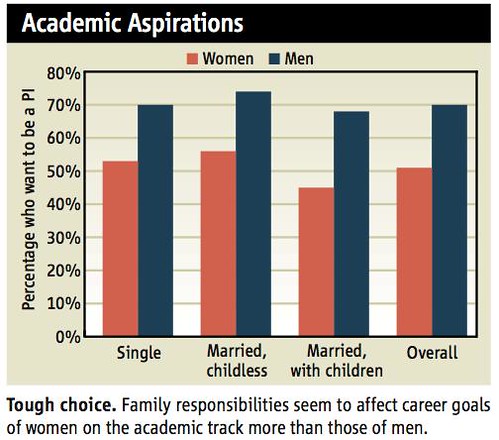
But most interesting, to me, was the finding that men were much more confident than women that they would achieve their goal to become a PI; 59% versus only 40% (data not shown). In this article, the author claims that this gender discrepancy in confidence was due to the fact that women are more likely to sacrifice their careers for their families. However, I wonder if this discrepancy is really due to another reason: women recognize that they are less likely to achieve their academic goals regardless of what they do, so they (rationally) decide to sacrifice their career aspirations for their families instead.
The barely discernable difference in career aspirations between single women and married but childless women, seems to lend support to my own hypothesis. Further, in my own experience, I know a fair number of female scientists, sensing that their career aspirations were likely to be fruitless, had children instead of devoting themselves to decades of career frustration and rejection.
In the article, the author argues that this male-female discrepancy suggests that academic institutions should be more supportive of female scientists by providing "family friendly solutions"; access to affordable childcare facilities, allowing female PIs to work part-time without penalty when they are caring for family members, and providing supplemental funding to hire qualified spouses to work on separate or related research projects.
I agree with the author's conclusions, but I think that being supportive of women in science goes beyond simply providing "family-friendly solutions"; in my experience, female scientists are routinely isolated socially and their experience and skills are either denigraded or completely dismissed by their male counterparts, especially by their PIs, who should be their most ardent supporters. Worse, women often are led to believe their work is less than stellar, and so they typically isolate themselves and their feelings of inadequacy from their colleagues. I think employment in the sciences will even out between the genders after these more subtle issues are recognized and dealt with productively.
Source
Yudhijit Bhattacharjee. Postdoc Survey Finds Gender Split on Family Issues. Science 318:897 (9 November 2007). [PDF] (figure).
*raises hand* I went through the entire pre-tenure faculty thing - grant proposals, publishing, grant proposals, publishing, rinse and repeat. I didn't get tenure. I got a new job, and had a kid... but it isn't the kid that kept me from the more prestigious job.
Men too. I married a woman with bipolar disorder about three years pre-tenure. Tenure denied. Don't know if beacause "they" sensed a potential problem. She's much better now, and we're still happily married, but I'm doing something COMPLETELY different, and loving it.
wow, andy, bipolar disorder really resonates with me. anyway, i am curious to know .. what are you doing now? has your scientific training and experience helped you in this other career?
I took the daddy track... actually ran a daycare for several years, while teaching college in evenings. Now? My kids are ready for college, they are fantastic, wonderful people, and I would not trade that for anything...
...good, because I have lost at least tens of thousands of dollars because of my choices. I could have paid for their college educations with what I gained by being such a big part of their earlier education. It is a lousy choice to have to make.
Hello!
This is very interesting; is resonates with a piece in the Guardian (in the UK) a few months ago, looking at the pay gap between men and women, particualrly in the higher income brackets. Bascially women suss out that the social cost of asking for moneny is greater than the fiancial gain.
I then extrapolated into looking at that and a lack of supply of female candidates standing for parliament, in my own blog:
http://jochristiesmith.blogspot.com/2007/08/apprently-its-not-women-tha…
However, I think your take on the lack of senior female scientists (we have exactly the same problem in the UK)is very similar; fundamentally we are all trying to achieve something..whether getting more pay, PI status or selection as a candidate in a hostile environment. Our decision not to proceed or to focus on bringing up our families is as much down to a rational assessment of our ability to suceed in that hostile environemnt as anything else.