

tags: caecilian, amphibian, parental care, flesh-eating amphibians, behavior, evolution, streaming video
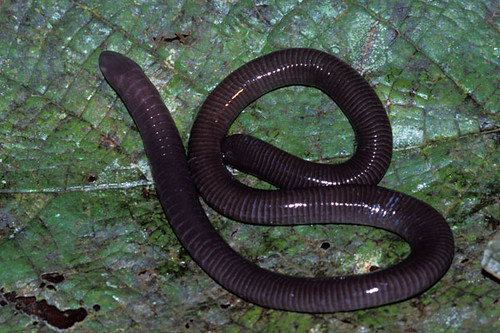
The Purple Caecilian, Gymnopis multiplicata,
is native to Costa Rica, South America.
Image: WildHerps.com
What is that peculiar creature in the above image? Did you guess that it is a worm? Many people do, never realizing that there are strange subterranean vertebrates that resemble worms, but are actually amphibians. So far, only 114 species of these creatures, known as caecilians [seh SEE lee ans], have been identified, but because they rarely come to the surface of the earth, the lives, habits, populations and precise species numbers remain mysterious to this very day.
BBC photographers working on a new program, Life in Cold Blood, were filming a female caecilian with her offspring. They document that, besides protecting their offspring, the female allows her young to feed off her body, by peeling her skin off and eating it.
Interestingly, young caecilians have evolved specialized teeth for tearing and removing their mother's skin.
To capture this never-before-filmed behavior, the camera crew constructed a set that resembles the shallow, humid underground chambers that caecilians typically occupy. Nevertheless, the crew experienced difficulties in filming this behavior because young caecilians only ate their mother's special nutrient-rich skin once every three days, and the entire event only lasted approximately ten minutes in total. [streaming: 2:07]. Below is a YouTube video, although not as good as the BBC video [0:33];
Caecilians, like all amphibians, have moist and soft skin. They also have two sets of teeth that they use to catch their prey (worms) and to burrow through the soil. As you saw in the linked video, caecilians have tiny eyes, and further, their eyesight is poor.
Caecilians are subterranean animals that can dig burrows that are as deep as five feet. They are found in the tropics, and the adults live solitary lives, except during breeding season. How males and females locate each other is currently unclear.
Source
BBCNews (story, film)
Dare I say it - go and here for a lot more on the same.
I'm glad I'm not the only one to make a post on that. I'm also glad I'm not the only one to be unable to directly post the video because of the BBC's refusal to allow people to copy their videos... Something that many Brits (of which I am not one) complain as they're taxpayer supported.
Anyway, it's pretty cool. I recommend watching it, wholeheartedly.
why didn't you take screen shots of the video to describe to us on our blog? I don't have mediarealplayer, that's why it would have convenient to me. Plus, you wouldn't have to depend on the video as much in your post.
please take screen shots of the flesh eating.
i tried to take screen shots but they didn't turn out. i went back and found a YouTube video of baby caecilians feeding, but it isn't very good, unfortunately. but this is the best i could do.
Darren Naish also mentioned this in a post earlier this year,
http://richarddawkins.net/forum/memberlist.php?mode=viewprofile&u=9333
You have to scroll down to the part headed "Viviparity, dermatotrophy and matrotrophy" for the part about skin eating.
By the way, am I the only person in Britain to think the BBC is actually underfunded?
oops, I'm an idiot. In think in my last post I may have accidentally posted the URL of my richarddawkins.net viewer profile (which I tend to put as my URL when posting comments) instead of the article by Darren Naish which I was referring to.
I probably shouldn't post things before my morning mug of tea in future.
The correct link is here http://scienceblogs.com/tetrapodzoology/2008/01/surreal_caecilians_part…
Grrl, could you edit my first post so it doesn't look like I made that mistake? Please?
I was bitten by a frog once.
Thats what happens when you try to teach an animal with poor eyesight to take food from your hand.
I wonder about the real human Cecilia who inspired the name.
No, no, both come independently from Latin caecus "blind".
More on caecilians can be found in the archives of last month at Tetrapod Zoology.
I found a caecilian or a very closely related animal in Lawyers Canyon, Idaho. As far as I know this creature is not supposed to exist there, but I swear it does. I just read that they live underground so I don't know my chances of ever seeing one there again. I saw it about 9 years ago. My family owns the ground. It is the natural bourder of Idaho county and Lewis county.
Thanks for helping to ID this. Had one on our front terrace last night.Not scaled like a snake. Segmenting not right for a worm. I was stumped. 15 inches long. Costa Rica is in Central America.
Thanks again, Jim