

tags: Alex And Me: A 30-Year Adventure, Alex & Me: Lessons from a Little Bird with a Big Heart, ethology, cognition, learning, parrots, Irene Pepperberg, book review
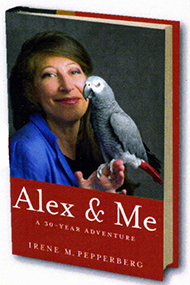 As a scientist, parrot researcher, aviculturist and parrot companion, I have met Irene Pepperberg several times, at both scientific meetings and also at avicultural meetings, and I have followed her research closely (but quietly) for most of my life. So, when Seed Media, which houses all of ScienceBlogs, asked me if I wanted to read and review Pepperberg's upcoming book, Alex & Me: Lessons from a Little Bird with a Big Heart (NYC: Collins; 2008), I couldn't respond quickly enough: Oh. My. God. YES! YES! YES! my email screamed. Instead of patiently waiting for this coveted book to arrive in snailmail, I went to the Seed offices the next day to collect it in person. I already knew I would open the book and start reading, miss half a dozen train stops, become temporarily disoriented on the subway system in the far distant lands of either Brooklyn or Queens, straighten myself out, and arrive home in time to finish devouring this book in the middle of a sticky NYC night -- all in the span of hours. I could hardly wait!
Well, it turns out that this advance reading copy was NOT the actual book itself, but just a booklet, a glimpse of the real thing, containing proofs of the first two chapters of the book, printed on cheap paper. Bummer. So I spent some time socializing over beers with the good people at Seed before I went home and started reading. My initial disappointment with the small size of the booklet quickly vanished because, despite the errors that will no doubt be corrected before the finished book is released on 28 October 2008, I was already captivated by Irene's introduction to her life with Alex.
Before I say any more, I want to let you know that I might be especially vulnerable to Irene's story because I lost two parrots while I was in the hospital. You might recall that I lost one of my beloved yellow-bibbed lories that I raised from a newborn chick, a chick that closely resembled a fluffy white dandelion seed head and could sit comfortably on a quarter. But I also lost my African grey "gift" parrot, Zazu -- a death that nearly killed me, and which I am mentioning publically for the first time, more than a year and a half later. (In fact, I am still seeking a second African grey parrot to help fill that aching empty space that the loss of Zazu left in my soul).
So, knowing about my own experience, would it surprise you to learn that hot tears of despair and abandonment sprang into my eyes as I read about Irene's reaction to the loss of her colleague, teacher, and companion, Alex? I'll let you be the judge, because here's where my own tears started;
Most of the press stories emphasized Alex's scientific importance. His verbal, math, and cognitive skills. The fact that he helped transform our understanding of the mental abilities of animals. But for me, in these early days without Alex, the story was an emotional one.
In the days and weeks following Alex's death I was roiled by multiple tsunamis of surprise, around me and within me. My mind was desperately churning, "What's to become of the lab? What's to become of the research? What's to become of everything we've created? What's to become of me?"
[ .. ] The sense of loss, grief, and desertion that tore at my heart and soul viscerally at the passing of my one-pound colleague and companion of three decades was of a degree and intensity I had never anticipated, nor could have imagined. A huge torrent of love and caring that had been assiduously kept in check burst through, and the liberated flood of emotions swept all reason before it. I had never felt such pain nor shed more tears. And hope never to again.
Now, I said that a great torrent of emotions "had been assiduously kept in check" for three decades, as if by some third party I'd hired to do the job, some outside contractor, Emotion Controllers Corp. But I had become so good at implementing my plan of emotional distance that this profound torrent of feelings that was the subterranean currency between Alex and me lay out of sight, invisible even to me, beyond the rugged mountains of the cause of scientific objectivity.
[Irene Pepperberg, Alex And Me: A 30-Year Adventure (working title), advanced reading copy, pp 6-7].
I am sitting here in my coffee shop as I transcribe Irene's words for you, and already tears are streaming down my face -- again!
Anyway, even though there is plenty of editorial and production work remaining before this book is released to the public, I can already assure you that it promises to resonate with you intellectually and emotionally, and it will teach you so much about what it is really like to be a scientist, as well as a person whose heart was stolen by a "mere bird brain." Better yet, some of the funds earned by this book will support Irene's still-struggling but very worthy research program with her two other one-pound junior colleagues, African grey parrots, Griffin and Wart.
- Log in to post comments
I lost a peach-faced lovebird last yr. and in no way anticipated the volume of grief that would result from the death of that palm-sized ball of feathers and energy (have owned birds off-and-on for 30 yrs. but none more closely-bonded to me than that one). "Tsunamis" of emotion is indeed an apt description; and no doubt that much more intense when the relationship involves 30 yrs. as in Irene's case. Looking forward to her book, even though yes, it will mean grieving all over again...
Tsunamis of emotion indeed. I lost my "birdie soul-mate," my citron cockatoo, in January. I've lost plenty of pets before, including some of my parrots, and I never expected the shock or extreme loss that has engulfed me since. It's so intense, I sometimes wonder if I'll ever be able to bond with any bird that I don't already have while at the same time longing for another cockatoo. There's just something about them that my grey or amazon can't match.
Thanks for this post! I can't wait to read the whole book--I preordered it from The Alex Foundation (TAF) as soon as I heard about it. I've had the privilege of meeting Dr. Pepperberg twice at TAF fundraisers and am inspired by her work, her dedication, and her compassion.
Suggestion: if folks want to order through alexfoundation.org, sales will help support Dr. P's ongoing research with Griffin and Wart, Alex's junior colleagues.
I've never had a parrot, but this makes me want to read the book really bad! Too bad October is far away. I hope you will post an update when you get to read the whole thing.
Looks to be VERY interesting reading.
I know the feeling,these feathered beings have a way of stealing your heart.
...and so sorry to hear about the loss of yours GS.