

tags: explicit atheism, godlessness, religion, theism, rational living, freethinking, philosophy
All children are born Atheists; they have no idea of God.
~ Baron d'Holbach, 1772.
Living the Scientific Life (Scientist, Interrupted) was recently added to the Atheist Blogroll. You can see the atheist doohickey on my left sidebar, which looks like this;

The Atheist Blogroll is a community building service provided free of charge to atheist bloggers from around the world. As a new member, I was invited to write a little blurb (blurp?) about this on my blog as a sort of announcement, so I decided I would write about how I grew up to atheism as a reasoned and reasonable way to live, even though I was (like many of you, I suppose) inculcated into the belief that there is a god from the moment I was born.
I was regularly lied to from the day I was born, although it took me awhile to realize it. What was this lie? I was told there was a god who both cared about me and wanted me to fear him, or else he would strike me dead with a Lightning Bolt from the Heavens. Because I was a small child who was inexperienced in the ways of the world, I believed this lie. At first.
Of course, it didn't take long for me to notice little inconsistencies that made me wonder about the truthfulness of this assertion. For example, even though I learned it was a sin to take the lord's name in vain, my father in particular, enjoyed telling god to damn certain people to hell for doing things he didn't like such as cutting him off in traffic or bothering him about lunch while he was trying to read the newspaper on Sunday afternoons after church. Being barbequed alive seemed a terrible fate for such minor offenses, but I was a mere kid and had to be repeatedly reminded that all sins were equally terrible in god's eyes, that bothering someone while he was reading the newspaper was the same as subjecting someone to extended physical and mental torture and rape before finally murdering that person by eating them alive.
Since I initially believed this lie wholeheartedly, whenever I heard the pronouncement, "goddamn you to hell!", I held my breath expectantly and sat waaay back, hoping the ensuing Lightning Bolt from the Heavens would not singe my eyebrows. It never did, because oddly, it never materialized.
Hrm.
One day, I made this same pronouncement after discovering a sibling had committed the sin of theft against me, and then committed the sin of lying about it to me when caught in the act. At the time, I had no words or phrases in my limited verbal arsenal to adequately express my anger at the crime and at being lied to about this crime. Well, okay, there was that one .. little .. phrase ..
"Goddamn you to hell!" I loudly proclaimed as I had been taught throughout my childhood. Wow, I suddenly was transformed from an invisible and pliable child into a real person with individual thoughts to be reckoned with. My mouth had uttered the worst phrase I knew in response to the worst crimes I thought could ever befall me. So I had taken the name of the lord in vain, and it felt damned good. Liberating. Powerful. I could kill with words.
Except for one minor detail: god never fried my errant sibling just as god never fried me all those times I had been damned to hell. But the fallout generated by uttering this one oft-heard phrase was absolutely spectacular. I might have been a sweet little three- or four-year-old (although the parents would tell you otherwise), but my parents nearly killed me, and I mean they really nearly killed me. So I learned a very valuable lesson regarding the power of words: mere words control people's behaviors and beliefs and thoughts. Mastering and controlling words was a mechanism for mastering and controlling .. people. Thus, words are to be employed with great care. I also noticed something else.
Lies are comprised of words.
After this event, while nursing my aching and battered body, I decided to wholeheartedly throw myself into solving the Mystery of the Newspaper: I was going to learn how to read and use words if it killed me.
And so I learned. I was reading before I entered school, which made the assigned reading material insultingly simplistic and ridiculous, but also made me keenly aware of all the wonderful reading material out there, beginning with newspapers and including my parents' bookshelves, of all places.
Apparently bored by the domestic life (probably our only shared opinion), my mother had joined a book club that sent a leather-bound classic volume with gilted-edged pages each month and it was these books that I first began to read. As a horse-lover, I immediately jumped on the opportunity to read John Steinbeck's The Red Pony. The death of Jody's pony, Gabilan, left me bereft, but ultimately undaunted. After I finished that book, it didn't take long before I stumbled across another intriguing leather-bound gold-plated book, On the Origin of Species by Charles Darwin, so I read that, too.
That book was so readable, even for a mere kid, and the logic was so pristine that it transformed my thinking at all levels. I grew up in a rural farming community, so many of the examples that Darwin used to illustrate his points were familiar. Through his words, his logic, his cautious and carefully-worded arguments, the world was revealed as a vibrant and mysterious place, but despite its seeming chaos, the world was still logical and understandable: it was governed by rules, even though those rules might not be obvious to humans. Inspired, I began asking questions, lots of questions, of the adults around me. Of course, I was ignored, but it wasn't long before I asked the preacher what was the purpose of god since we evolved. Woops.
After being told that I was a stupid little girl who should remain silent until I "knew something" (the precise word used was "shaddup"), I realized that I would never be taken seriously until I had a serious education. Fortunately, a neighbor man who was in college at the time told me about his experiences and adventures, and I was intrigued. I immediately knew academics was my calling, and science was my inner passion, and that university was where I needed to be.
Because I loved horses and knew them well, I subconsciously began developing the conceptual framework of my grad school education while I was still in grade school: I began reading everything I could get my hands on about the evolution of horses and oddly, the genetics of breeding racehorses. So serious was my interest that, by the time I was twelve, I purchased a very expensive equine medicine and surgery textbook because the libraries didn't have anything on the topic. I still have that book.
During this same time more or less, I also wanted to clarify a few points of personal confusion about religion, so I began to seriously read and think about it, specifically, about the presumed existence of god and how that doesn't appear to solve any problems but rather seems to cause more of them. In short, god was inconsistent with everything I had learned in school: god made no sense whatsoever. As a product of a religious grade school and junior high school education (looking back, I now think it was a fundamentalist religious school), I had been trained to memorize large portions of The Bible. My rapid recall and accuracy made me one of the "stars" of the school (I was often told that it was too bad these natural abilities were wasted on a mere girl who could never become a theologian). So I was frequently encouraged to argue with nonbelievers and heretics -- people who also happened to be my neighbors and their kids (my friends) whose sincerely held religious beliefs were different from mine.
This often vicious conflict between different religions made no sense to me then since they all were about god, and focused upon god and dictating how god's followers were supposed to behave in public. What was there to argue about? And worse, why were some of "god's children" condemmed to eternal damnation when others weren't? Wasn't god big and powerful enough to transcend all human definitions and parameters?
Hrm.
During the course of memorizing vast passages of The Bible, the internal conflicts throughout The Bible became so annoyingly obvious and numerous that they were impossible to ignore, so I asked questions. Lots of questions. For example, if The Bible truly was the divine inspired word of god, then why are there so many mistakes in it? I was once again told to remain silent until I "knew something", so I began reading extensively about this topic as well.
I was eleven or twelve when I first read about the exploits of Madalyn Murray O'Hair -- "America's most hated woman" -- and it was then when I realized I was not alone with my doubts. [Later, in college, thanks to my amazing education in the humantities, I learned that Diagoras, Epicurus, Critias, Leonardo da Vinci, Sigmund Freud, Karl Marx, Friedrich Engels, and Julian Baggini (just to name a few famous thinkers and philosophers throughout history) had similar thoughts on religious matters.] Despite assertions to the contrary from the authority figures around me, I learned that I was very sane to recognize that there are many interesting parallels between god and Santa Claus the tooth fairy and that only crazy people believed in the supernatural. I began to suspect that both Santa Claus the tooth fairy and god were convenient lies used by authority figures to manipulate and shame those who were vulnerable to believing such rhetoric because of their lack of education, social status, or their unwillingness to challenge established paradigms and social structures by thinking carefully about the world around them.
So by the time I was fifteen, I learned that god is a blatant lie; that religion is a social construct used by the powerful and the wealthy to control the finances, sexualities and destinies of others (especially women); and that words have tremendous transformative power that profoundly affect one's thoughts, ethics and worldview. I also learned that reading is a powerful way to learn more about the world and to interact with others who, throughout all written history, also thought about these issues in great depth and in doing so, challenged the establishments of their day.
As my thinking and worldview evolved and matured, I realize I learned a few important lessons between birth and the age of fifteen, but the most important lesson is also the most fundamental: it is unethical to lie to children because we will grow up one day and in doing so, we will learn the truth. Further, we will never forget that those in power over us -- parents, preachers, politicians -- held us in such low esteem when we were weak or vulnerable that they thought it was acceptable to lie to us.
- Log in to post comments
Well said.
Terrific post!
You put a lot more effort into uncovering the lie and you managed to do it earlier (relatively speaking) than I did.
Unfortunately it takes work to learn the difference between reality and superstition and courage to accept it, qualities believers lack.
So I wouldn't hold my breath waiting for the rest of the world to catch up.
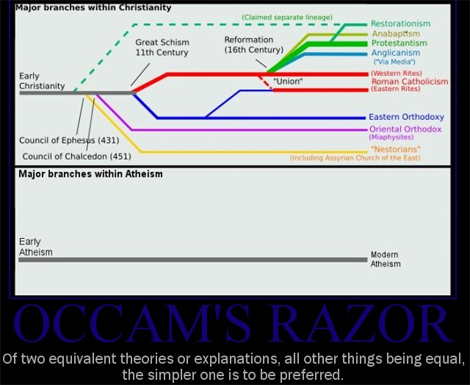
Since atheism and group conformism are rather badly at odds, shouldn't there actually be a little tiny branch for every atheist who has ever lived in the lower half of that diagram?
Beautiful post.
This sounds like good reading for my step-daughter. While she is pretty safe at home, there are summer camps and peers.
Well, that'll teach gawd-fearing parents not to leave copies of corrupting leather-'n'-gold books around where innocent little grrls could be debauched by reading them!
Your conclusions regarding God are reasonable given the evidence you've considered, but there is more to the story.
There is a God who loves and respects you, and who uses love instead of lies to accomplish His purposes and to win human hearts. Part of that respect is honoring your choice not to believe in Him even though He would prefer that you know His love. I believe God is the also the creator of the geological and biological processes, including speciation, which we find so fascinating. I'd be happy to discuss this more with you if you'd like.
indeed. books are evil, but the ability to read is even eviler, and evilest of all is the ability for a mere girl to have the time available to think and question -- if all girls became pregnant at the age of menarche, well, society would solve half of their problems by allowing the other half to force us females to become broodmares, diaperwashers and nosewipers!
Awesome post.
It's funny that "Hell" is a bad word in English. Here in France, almost all bad words relate to sex. I guess this says something about our respective cultures.
Hi, GrrlScientist:
I enjoyed reading your,
"I began to suspect that both Santa Claus and god were convenient lies used by authority figures to manipulate and shame those who were vulnerable to believing such lies because of their lack of education, social status, or their unwillingness to challenge established paradigms and social structures by thinking carefully about the world around them."
Please note that my legal name is Santa Claus. I'm a volunteer advocate for the 2 million children in the U.S. annually who are abused, neglected, exploited, abandoned, homeless, and institutionalized through no fault of their own.
Perhaps, as soon as I publish them, you'll find time to read THE SANTA DIET (a complete diet for physical, emotional, and spiritual health), SANTA CLAUS (A Monk's Life), and THE LOVE VERSUS FEAR PARADIGM.
Meanwhile, I wish you and your beloved parrots and S.P. lories especially blessed lives.
Santa :-)}
I congratulate you from Bangladesh.
books are evil...
But that book in particular! (No, not Steinbeck's...)
Clearly, you've uncovered the root of all the problems in your whole life.
Why couldn't your mother have hid OOS under a stack of De Sade and D.H. Lawrence and K. Marx and commentaries on the Necronomicon, to protect you from its unwholesome emanations? Such careless parenting will not be permitted in the Republic of Gilead...
if all girls became pregnant at the age of menarche, well, society would solve half of their problems by allowing the other half to force us females to become broodmares, diaperwashers and nosewipers!
Sounds good to me, as long as we set a few aside to become supermodels.
On the topic at hand: I seem to be missing the gene for religion--I never believed, even as a small child. I didn't think people were lying, though--I just assumed they were insane. Not sure if that's better or worse.
Five-star post. Thanks.
Hey grrl.
check your netscape mailbox, (if you want to see what i wrote to you)
1 .jpg = 1K .txt
very nice post. you sound like you were a much cleverer kid than any of the kids i knew at that age.
You seemed to have been raised by people who inadvertently quoted Vonnegut: "Shut up, he explained." It's great that you have persevered.
My daughter has a t-shirt that proclaims "It's fun to use knowledge for evil!" Perhaps you're the author?
So really... "Blah Blah Blah, horrible religious childhood, the truth shall set ye free, except it won't teach you the correct definition of the word lie, which requires intention to deceive..."
p.s. I sympathise about your parents telling you incurably stupid things like 'he would strike [you] dead with a Lightning Bolt from the Heavens', it must be a pain to be brought up by morons.
Dear Godless Scumbag, Carnival of the Godless has arrived, and you're in it. Burn in hell.
http://www.kieranbennett.com/2008/08/03/carnival-of-the-godless-97/
Thank you, perfectly told and meaningful. And the conclusion is bulletproof.
Question for you Grrlscientist, you say "it is unethical to lie to children because we will grow up one day and in doing so, we will learn the truth". I agree. The question is, should you lie to children about Father Christmas?
For context, quote from my old blog:
I said something that seemed rather foolish at lunchtime yesterday. The table was discussing how they had to lie to kids about how Santa Claus gets into the house to deliver his goodies, and I innocently inquired "why don't you just tell them the truth, that Santa doesn't exist and that you and other relatives buy their presents". This little suggestion was met with a combination of indignation and incredulity. Even the thought seemed indefensible heresy, it would spoil the magic of christmas, and other equal bullshit.
Well said. My only comment apart from flattery is that part of the problem is that there are some of these people who don't believe what they're saying is a lie. If only 'they' were all cynical atheists-in-disguise, trying to use our innate inclination towards superstitious tendencies against us, then the whole thing would be much easier to deal with. Unfortunately...