

tags: Tiktaalik rosea, sarcopterygian, fishibian, fishapods, transitional fossil, evolution, vertebrate terrestriality, vertebrate evolution
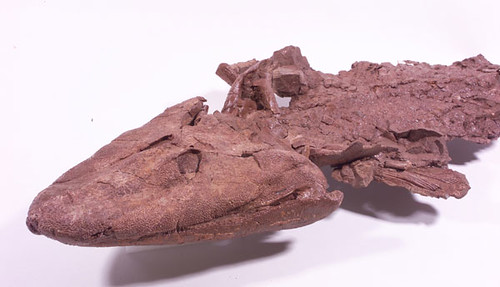
A new study on the internal anatomy of the skull of the extraordinary fish, Tiktaalik roseae, which lived 375 million years ago, provides more evidence of how vertebrate life transitioned from water to land. The head showed changes from more primitive fish that helped adapt to the new feeding and breathing conditions presented by a terrestrial environment, scientists said.
Image: Ted Daeschler, Academy of Natural Sciences [larger view].

A paper was just published that documents another study of the remarkable transitional fossil, Tiktaalik roseae, detailing how this new "fishapod" or "fishibian" (tetrapodomorph fish) continues to provide evolutionary insights to scientists. In this case, the cranium of T. roseae, a fossil sarcopterygian fish that lived 375 million years ago, provides evidence for the intermediate steps by which terrestrial animals evolved from aquatic fishes.
Meticulous studies of the internal structure of the cranium from several fossil fishapods, T. roseae, reveal the step-wise process that morphological changes followed as terrestriality evolved in tetrapods.
T. roseae was originally discovered on Canada's Ellesmere Island, 600 miles above the Arctic Circle, in 2004. It was a large aquatic predator, measuring between 3 and 9 feet long, with sharp teeth and a flattened head that resembles that of a crocodile. It is thought that this animal inhabited the mudflats of freshwater flood plains in a subtropical environment.
At the time of its discovery, the underside of Tiktaalik's skull was fully encased in rock. But several fossil preparators cleaned the rock away using a needle over a period of several years, revealing the internal structure of the skull (figure 1);
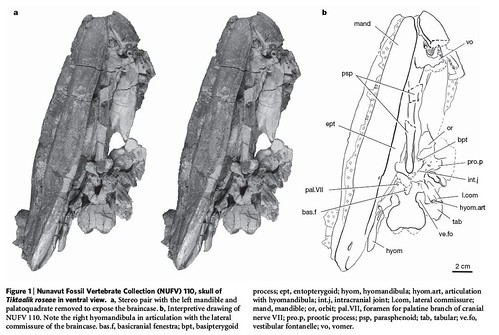
"The braincase, palate and gill arch skeleton of Tiktaalik have been revealed in great detail," reports Jason Downs, a research fellow at the Academy of Natural Sciences who is the lead author of the study. "By revealing new details of the pattern of change in this part of the skeleton, we see that cranial features once associated with land-living animals were first adaptations for life in shallow water."
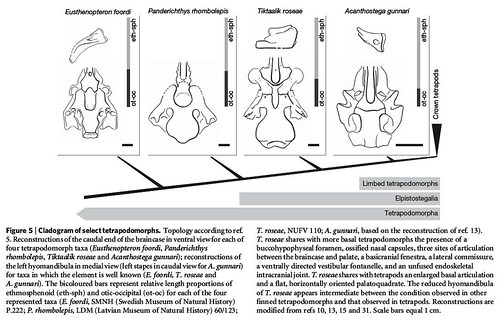
According to Downs and his colleagues, the cranium of Tiktaalik has features that are intermediary between the primitive transitional fish, Panderichthys rhombolepis, and the transitional tetrapod, Acanthostega gunnari.
Even though these morphological features reveal Tiktaalik to be more fish-like than amphibian-like, this fossil animal fits into the morphological gap between more primitive and more derived fishapods. One of the most intriguing findings was the reduction in size of the hyomandibular bone that, in fish, joins the braincase, palate and gills and is associated with underwater feeding and respiration. In more primitive fish, the hyomandibula is large and shaped like a boomerang, but in Tiktaalik, this bone is very small, no bigger than a human thumb.
"This could indicate that these animals, in shallow-water settings, were already beginning to rely less on gill respiration," Downs said.
In the transition from water to land, the hyomandibula gradually lost its original functions and later gained a role in hearing. In humans and other animals that posess a middle ear, the hyomandibula, or stapes, is one of the tiny bones involved in sound conduction.
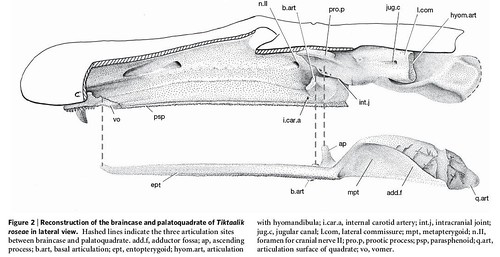
But Tiktaalik also shares several structural similarities with its close relatives, P. rhombolepis and A. gunnari. For example, the entopterygoid bone in T. roseae is horizontal and shallow as it is in the other fishapods (figure 2);
Another interesting morphological change was documented for the neck bones, which suggests that the neck was more flexible in the fishapods than in fishes (figure 3);

This increased flexibility gave Tiktaalik an advantage over less-flexible species because they could move their heads without reorienting the whole front end of their bodies, as fishes must do.
"When feeding, fish orient themselves by swimming, which is fine in deep water, but not for an animal whose body is relatively fixed, as on the bottom of shallow water or on land," reports Neil Shubin, an evolutionary biologist at the University of Chicago and the Field Museum and co-author of the paper. "Then a flexible neck is important."
Combined with its sturdier front limbs, this flexible neck could have allowed Tiktaalik to leave the water for short periods of time.
"It's not to say that Tiktaalik itself is a terrestrial animal. It spent most of its time in water, for sure," Downs pointed out.
Earlier work on Tiktaalik also indicated that its head wasn't fused to its shoulders. In fact, Tiktaalik has the first known flexible neck.
Based on this study, these morphological data indicate that significant changes to the braincase occurred relatively late in the evolutionary transition to the tetrapods and further, the general cranial dimensions of tetrapods were first attained in the fishapods. Additionally, the observed changes in the shape of the head appear to be related to the reduction and reorientation of the hyomandibular bone. With the loss of the gill elements, head mobility increased in T. roseae relative to other fishapods. The evolutionary relationships between these animals based on cranial morphology are summarized in a cladogram (figure 5);
So these data provide a clearer picture of the sequence of events that occurred as primitive fishes gave rise to terrestrial tetrapods.

"The new study reminds us that the gradual transition from aquatic to terrestrial lifestyles required much more than the evolution of limbs," concluded Edward Daeschler, a co-author on the paper.
Sources:
Jason P. Downs, Edward B. Daeschler, Farish A. Jenkins, Neil H. Shubin (2008). The cranial endoskeleton of Tiktaalik roseae Nature, 455 (7215), 925-929 DOI: 10.1038/nature07189.
Official Tiktaalik website.
NYTimes (quotes).
David Marjanovic.
- Log in to post comments
Tres cool.
Very interesting pictures there. Its incredible how these animals change over time.
Hi, no need to post this comment - it's just a request for the blogger Grrlscientist, or whoever has the power to revise this post...
Since you have posted large files of the figures from this paper, would it be possible to source the illustrator like you sourced Ted for the photo of Tiktaalik, under each figure? Not that the illustrations are likely to get picked up further on the web, but you never know. The figs I'm referring to (numbered figs 1, 2, 3, and 5 from the Nature paper) are by Kalliopi Monoyios. If you wouldn't mind mentioning that, I'd really appreciate the shout-out.
Thanks for your help.
Best,
Kalliopi
Is it possible that you have found a species related to other species? it appears you have assumed evolution in your interpretation of proof of evolution. A good theory assumes a null-hypothesis then uses accurate scientifically gained information/data to disprove the null-hypothesis. there is no information presented that proves evolution was involved in the formation of this "transitional" fossil. I used to be a hard core evolutionist until I realized that the theory of evolution was used to interpret all the information available to prove the theory of evolution. Not good science. The best theory I have seen as to the reason there are so many fossils of extinct species is: that species can and do become extinct. Why do people suspend their reason when it comes to wanting to prove evolution? I can answer that since I wanted evolution to be true at one time in my life. I didn't want there to be a god who had expectations of me. I wanted to live my life without moral or spiritual limitations. If I could find a way to convince myself that I was merely random chance and was not intended, I would be free to indulge myself in any sort of behavior I wanted without fear of concequences. Evolution seemed to be the best "theory" to provide that for me. Unfortunately I am a very logical man and once I saw the circular logic of evolution, I began to look for more real evidence for the theory. Everywhere I turn it seems the real scientific evidence is pointing to another process of how I came into existence. I read both the "evolutionary" science and "creation" science articles so I am not a "right-wing" nut job, only a thoughtful-rational observer of the different conclusions people come to based on the evidence we have available.
Is it possible that you have found a species related to other species?
Given the scientific name Tiktaalik roseae, the fossil is estimated to be 385 million years old. Evolutionists looking for possible candidates for their tales of a transition from water to land are putting the fossil forward as an intermediate form by distorting its âmosaicâ features.
There are three well-preserved fossil specimens of Tiktaalik roseae. Some 3 meters long, the creature exhibits various mosaic characteristics. (Mosaic life forms contain features belonging to different groups of life forms.) As in fish, it has fins and scales. Features such as its flat head, mobile neck and relatively powerful rib structure are found in terrestrial animals. The creature, whose name is derived from the Inuit language Inuktitut and means âa large, shallow-water fish,â also has bones in its pectoral fins. Evolutionists distort these mosaic properties according to their own preconceptions and maintain that the animal is a transitional form between fish and terrestrial life forms.
Mosaic life forms, however, are very far from being the intermediate forms required by the theory of evolution. The present-day Platypus that lives in Australia, for instance, is a mosaic creature that possesses mammalian, reptilian and avian features at one and the same time. But nothing about it constitutes any evidence for the theory of evolution. Mosaic life forms are not what evolutionists need to find in order to back up their claims; they need to find âintermediate forms,â which would have to be with deficient, only half-formed and not fully functional organs. Yet every one of the organs possessed by mosaic creatures is complete and flawless. They have no semi-developed organs, and there are no fossil series that can be proposed as evidence that they evolved from some other life forms.
The theory of evolution hypothesizes that a process based on random mutations, in other words on chance, took place. According to this claim, the millions of living species on Earth must have evolved from a vast number of intermediate forms, all subjected to chance mutations, and as a result had deformed, abnormal structures, and the fossils of these so-called intermediate forms should have been found. To put it another way, the fossil record should be overflowing with the remains of life forms that can only be described as freaks of nature. However, this is known not to be the case. When species emerge, they do so suddenly, with all their distinguishing features fully developed, and with no series of freaks among them. In his 1999 book Fossils and Evolution, Tom Kemp, curator of Zoological Collections at the Oxford University Museum, describes the position as follows:
In virtually all cases a new taxon appears for the first time in the fossil record with most definitive features already present, and practically no known stem-group forms. (Tom Kemp, Fossils and Evolution, Oxford University, Oxford University Press, 1999, p. 246)
Evolutionists attempt to give the impression that fossils actually support the idea of evolution. Yet the âmissing linkâ concept is one that has been invented solely in the light of the needs of the theory of evolution and has no counterpart in the fossil record itself. The lack of fossil links alleged to connect species to one another has been known ever since Darwinâs time. Excavations by paleontologists since Darwinâs day have also failed to resolve this situation, which represents such a grave impasse for the theory of evolution and, on the contrary, have further confirmed the absence of any missing links among living groups.
E. R. Leach, author of the book Rethinking Anthropology, wrote this in his article in Nature:
Missing links in the sequence of fossil evidence were a worry to Darwin. He felt sure they would eventually turn up, but they are still missing and seem likely to remain so. (E. R. Leach; Nature, 293: 19, 1981)
A. S. Romer, one of the most eminent paleontologists of his time, said this on the subject:
"Links" are missing just where we most fervently desire them [to point to a transition between species] and it is all too probable that many "links" will continue to be missing. (A. S. Romer, in Genetics, Paleontology and Evolution, 1963, p. 114)
David B. Kitts, professor of geology and the history of science at the University of Oklahoma admits the absence of the intermediate forms required by the theory of evolution:
Evolution requires intermediate forms between species and paleontology does not provide them. (David B. Kitts, "Paleontology and Evolutionary Theory," Evolution, Vol. 28, September 1974, p. 467)
The picture that emerges from the fossil record is completely compatible with creation. The record reveals that living things appeared suddenly and lived for long periods of time without undergoing any change at all. These facts can clearly be seen in an evaluation of evolutionâs fossil impasse by the American paleontologist R. Wesson in his 1991 book Beyond Natural Selection. Stating that the gaps in the record are real, Wesson goes on to say that the absence of a record of any evolutionary branching is quite phenomenal. Species are usually static for long periods. Species and genera never show evolution into new species or genera but are replaced by another, and change is usually abrupt. (R. Wesson, Beyond Natural Selection, MIT Press, Cambridge, MA, 1991, p. 45)
Some 250,000 fossil species have been collected to date, and there is absolutely no trace of intermediate forms in any of them. Evolutionists are behaving irrationally and unscientifically by ignoring this and embarking on campaigns of missing link propaganda.
The Error of Biological Inference from Skeletal Remains
When the bodies of vertebrates are fossilized, they generally leave no remains behind apart from bones. However, bones leave traces of only a very limited part of vertebrate biology, about 1%. When evolutionists begin interpreting the fossil remains of an organism, most of the information about its biology has been lost. Evolutionists, with almost no information concerning the organismâs soft tissue biology âfillâ the gap in their knowledge according to the demands of the theory of evolution, which they have adopted as a dogma long beforehand.
The intermediate form claims that evolutionists produce solely by looking at bones is no more than vague conjecture. In his book Evolution: A Theory in Crisis, the molecular biologist Michael Denton makes the situation very clear:
Because soft biology of extinct groups can never be known with any certainty then obviously the status of even the most convincing intermediates is bound to be insecure. (Michael Denton, Evolution: A Theory in Crisis, Burnett Books: London, 1985, p. 180)
Even the most convincing appearing intermediate forms for evolutionists can subsequently let them down very badly. One excellent example of this is the Coelacanth phenomenon.
Sensational reports show that evolutionists have learned nothing from the Coelacanth phenomenon
As with the latest fossil Tiktaalik roseae, the Coelacanth is a fish that evolutionists once fondly imagined to be a missing link in the transition from water to land. Evolutionists examined 400-million-year-old fossil Coelacanths, which was once believed to be extinct, and drew a number of evolutionary conclusions from the remains. For example, they maintained that the bony structures in its fins were feet that helped the animal walk across the sea floor, and they also claimed that it possessed primitive lungs. The important point here is this: All these assumptions were made in the absence of any information about the Coelacanthâs soft tissue biology.
The erroneous nature of producing evolutionary fantasies in the absence of any information about the animalâs soft tissues emerged following an important discovery in 1938. A living Coelacanth was caught, showing that it was not, as had previously been thought, an extinct life form at all. Furthermore, many more living specimens were caught in subsequent years. Evolutionists immediately set about examining the fishâs anatomy and way of moving in its natural environment, and saw that the missing link assumptions they had ascribed to it were completely incorrect. The fish, which they had assumed to live in shallow waters and to move by crawling over the seabed, actually lived at depths of around 180 meters, and they also observed that its fins never made contact with the seabed at all. The structure they imagined to be an evolving lung turned out to be a fat-filled swim bladder that had nothing to do with respiration whatsoever.
The realization that the Coelacanth, which had once seemed such a convincing-looking intermediate form for evolutionists, was just an ordinary species of fish clearly shows that the intermediate form claim being made about this latest fossil is also based entirely on uncertainties and speculation, because it, too, is based on imaginative interpretation of soft tissues from the fossilized remains of an extinct life form. In short, the ongoing propaganda through the media is based on nothing more than the exaggeration of scientifically vague information in the light of evolutionist dreams.
Tiktaalik is a mosaic life form which is no evidence for evolution!
It has many times been demonstrated with countless pieces of evidence that Tiktaalik Roseae is not an intermediate form and that the evolutionist speculation around it is impossible. It has been proved that the creature is a MOSAIC form with perfect, complex characteristics and no intermediate characteristics whatsoever. Despite this, however, Tiktaalik continues to be the most popular vehicle for evolutionist propaganda(this blog makes an other example of it). Because fictitious intermediate forms are all Darwinists have to hide behind. Since Tiktaalik Roseae is an extinct, mosaic form, Darwinists must think that it will be a simple matter to use it to deceive people, which is why they keep bringing it up. But they are mistaken. It is intermediate forms, not mosaic organisms, that evolutionists need to find to support their claims.
Great research! I wonder if this species is closely related to the fish that have walked out of the water a few years back in Florida. The newer fish reportedly had small legs that allowed them to actually walk on land.