

tags: new species, Papua New Guinea, Zoology, Biodiversity
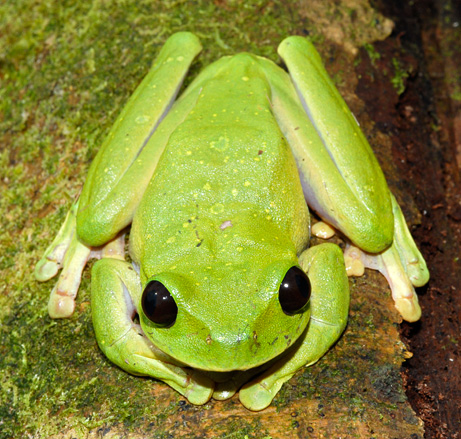
A large brilliant green tree frog, Nyctimystes species, with enormous eyes, was discovered by scientists next to a clear-running mountain river.
Image: Steve Richards/Conservation International.
A brilliant green tree tree frog with giant black eyes, tentatively classified as a Nyctimystes species, is one of 56 new species of animals discovered during a 2008 expedition to the remote island of Papua New Guinea.
This species of frog is specially adapted to its habitat of rushing freshwater rivers: females lay their eggs underneath river stones, and tadpoles have mouths that suction onto slippery rock surfaces.
Another new frog species, Litoria species (below), found in the protected Kaijende highlands, is also nicely adapted to its rushing river home: its mating call is loud and ringing so it can be heard above rushing mountain streams.
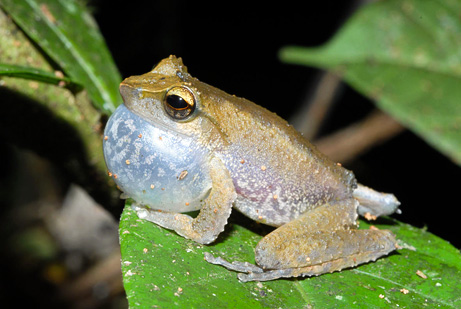
The loudmouthed Litoria species of frog found in Papua New Guinea.
Image: Steve Richards/Conservation International.
These large forests are home to the Hewa people, whose "intimate knowledge and stewardship" of the forest has kept the land and wildlife pristine, according to research by William Thomas, an anthropologist at Montclair State University in New Jersey.
But these discoveries are just the beginning. Papua New Guinea, an island I've been fascinated by since childhood, is a remote "lost world" filled with peculiar animals, plants and peoples that have never been seen by modern scientists.
"If you're finding things that are that big and that spectacular that are new, that's really an indication that there's a lot out there that we don't know about," said expedition leader Steve Richards. "It never ceases to amaze me the spectacular things that are turning up from that island."
The 2008 expedition consisted of scientists from Conservation International, the University of British Columbia in Canada and Montclair State University in New Jersey, as well as local scientists from Papua New Guinea. This international team documented more than 600 species of amphibians, mammals, birds, reptiles, plants, and invertebrates.
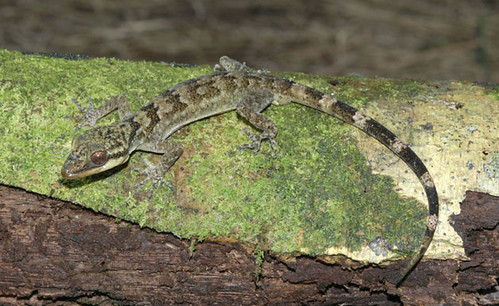
The Cyrtodactylus bent-toed gecko is another species believed to be new to science [larger view].
Image: Steve Richards/Conservation International
A unique Cyrtodactylus bent-toed gecko is yet another species that is new to science (above) and the team also discovered 3 new genera and roughly 50 new species of jumping spiders on this expedition (below);

This jumping spider, Orthus species, is one of 50 potentially new spider species found [larger view].
Image: Steve Richards/Conservation International
The new jumping spiders represent "strikingly distinctive evolutionary lineages that had been unknown before, with a group that is already very distinctive on the evolutionary tree of jumping spiders," stated spider expert, Wayne Maddison of the University of British Columbia.
Conservation International plans to conduct three more expeditions to Papua New Guinea in 2009, in the hopes of turning up even more new animals.
"Most of us live in urban worlds where we think everything's totally well known," said Bruce Beehler of Conservation International. "It's a little bit of a reminder, just a wake up call, that we really need to know our world better so we can manage it better."
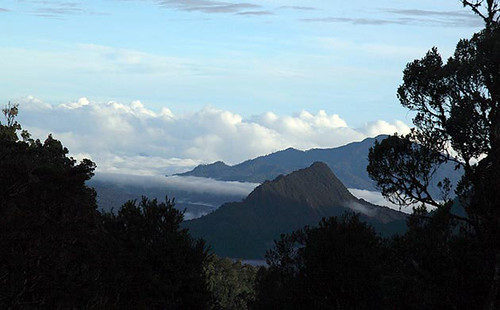
The dense forests of unexplored Kaijende highlands and Hewa wilderness in Papua New Guinea, an island north of Australia [larger view].
Photograph: Dr. Bruce Beehler/Conservation International.
Source:
Wow these are some cool photos. I really like the small green jumping spider, and your landscape photo, but all of them are amazing. Thanks for sharing. Anna :)
Hey, that spider's just posing for the camera. Undiscovered, pah! It's just been waiting for its moment in the limelight.
That's one glittery looking spider! Wonder if it's in cahoots with those Twilight vampires...
Thanks for posting about this
Love the pictures! It's simply amazing what this Earth has to offer us..
If i encountered these new species I think it would be fun to step on these new species and hear them go "squish".
Totally with you there mc. I stepped on a troll the other day and you shoulda heard it !pop!
So how did they figure out which tadpoles went with which frogs? I suppose they most have raised them up. It would keep the undergrad assistants busy boiling lettuce anyway. The first frog reminds me of Cuban treefrogs. Similar big eyes and blocky snout and skin texture.
It is amazing how loud some frogs can be, especially little ones. For some species that have dense choruses researchers wear ear protection while working with them. Spring peepers will hurt your ears if you are close to one that is calling and a big chorus...ouch.
Nothing personal at all, but in more PC moments I like that quaint old phrase "discovered for science", in that these animals will be very well known to the locals, the only people "discovering" them are the scientists.
Great photos. They remind me that as a newly-minted Ph.D. student, my original plansâor accurately, dreamsâwere to join an expedition to Irian Jaya. While in some ways I regret not doing this, I at least avoided being captured by locals protesting against the mining industry...
That spider is shiny, it must live in an area with a lot of water to be that shiny. the spiders down here are all fuzzy