

tags: Tilikum, Tillikum, Tilly, Orcinus orca, Killer Whale, SeaWorld, Sea World, Orlando, Florida, whales, animals, news, behavior, streaming video
The latest word is that Tilikum will not be euthanized in retaliation for being associated with his third human death. Of course, if the SeaWorld officials did decide to euthanize him, this raises several problems, not the least of which are the publicity and the mechanics of carrying out this animal's demise.
This realist (me) has decided that SeaWorld avoided the "euthanization problem" in the case of Tilikum due to two reasons, and two reasons only: first, the public outrage would be beyond anything they could handle, deal with and recover (financially) from and second; how the hell do you kill a healthy 6-ton whale, and how do you dispose of its body before the neighbors file "quality of life" complaints with the local authorities?
First: killing Tilikum would not easy. Since Tilikum is not a land-dwelling mammal, electrocution is out, although there is precedent for using this method to kill other large and opinionated animals. In his zeal to destroy his former friend and collaborator, Nicola Tesla, Thomas Edison demonstrated the dangers of alternating current electricity by killing an adult female elephant that had killed seven people for a variety of reasons, such as giving her a lit cigarette, which she held with her trunk:
Let's just say that SeaWorld officials use the most American of options; explosives. Clearly, euthanizing him using explosives is not possible nor (in my opinion) humane, although there is precedent for using this cruel method:
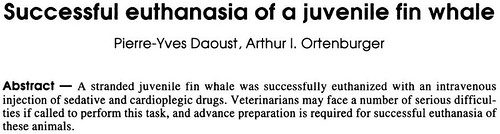
So I spent a little time searching the literature and found a more feasible and humane euthanasia plan [PDF]:
Next, in this hypothetical situation, after Tilikum was dead, there is the problem of how to dispose of his body before the (human, but not necessarily humane) neighbors and SeaWorld visitors file "quality of life" complaints with the local authorities. Again, being Americans, authorities would likely opt for the "American plan" .. erm, explosives:
Of course, it's always possible that local officials might be somewhat sensible -- I know, this is unlikely since they live in Floriduh -- and instead opt for one of a myriad of other methods for dealing with the rotting carcass. Perhaps they would leave the body to .. erm .. "become one with the elements" on its own. In that case, there is the self-exploding problem:
So .. as you've seen, the hypothetical death of Tilikum raises some rather perplexing issues that the local authorities and the SeaWorld officials are incapable of dealing with. Thus, it is my contention that Tilikum's sheer size and popularity has likely saved his life. Let's just hope he doesn't die of "health issues" that conveniently appear in the next few years .. he is only 30 years old, and orcas live to be 90 years old in the wild -- and we all know that wild animals have a shorter life span in the wild than they do in captivity! (although, not in the case of orcas, which have an average captive life span of only four years).
- Log in to post comments
To answer the question in the title: with a seven ton piano.
My understanding it that, unlike some other animals, Cetaceans live significantly shorter in captivity than out in the wild. No reference handy right now, but you may want to check...
An intelligent top predator kept in a tiny cage (compared to his range in the wild) and made to perform tricks... I'd be pretty frikkin' dangerous too. Is there some reason they can't let him go?
We deal with this when whales strand as well. Don't forget that when you use toxic chemicals to kill a whale, all those chemical go somewhere as the carcass decomposes.
Those damn animal rights activists.... oh wait. nm
I think that Seaworld Orlando should be assamed of themselves.MONEY,MONEY,MONEY.Thats all they think about!!certainly not thier employees safety..they ought to load tillian up into a really large truck,move it to the closest cat food factory,unload him & put a .50 cal.round thru it brain & grind him up for cat food.& I'm an enviormentalist. but with his past history,how many more people have to die. score whale 3-people-0. he's got to go,&Seaworld has to get over itself..
I too wonder why they would need to euthanise him. He's not a dog that will hang around the fringes of society and be a danger to children and pets. He's an apex predator. If you want him gone, release him (such intelligent and social animals shouldn't be enclosed anyway, especially not since they echolocate - it must be like being in a loud echo chamber flooded with bright lights, 24/7). He won't come back and eat swimmers, I promise.
Just to second an earlier comment (if not quite its tone). I just don't think you'd need explosives. I'd be amazingly surprised if a 50 caliber rifle shot to the head wouldn't kill it. (Probably on the first shot) Of course there would then be the body disposal issue.
I do agree that letting it go would be better though.
Perhaps I should look closer at the reporting, but I thought the whale was just being playful when he was killing all those people. I'm sure he didn't mean to, I mean how would you expect a whale to know that people are fragile? Surely if he was trying to kill people they would have also been eaten too...
David Taylor mentions in one of his books ("The Wandering Whale", pp. 5â6 of the paperback edition ISBN 0-04-925034-5) that he published details in the Veterinary Record on how to do it. Apparently cetaceans are highly sensitive to the synthetic opioid etorphine, and a small amount will deliver rapid and painless death. IM injection will work in a few minutes; IV in about 30 seconds (circulation time to reach the brain).
Guns are very iffy. Blubber is a great shock absorber, and you have to know your anatomy quite well to find the brain; a whale's "forehead" is a thick blubber acoustic lens and one of the worst places to shoot.
For more details and specific doses, see RSPCA Stranded Cetaceans: Guidelines for veterinary surgeons â Euthanasia and Stranded whales, dolphins and porpoises: A First Aid Guide â Humane killing.
Basically, for a 7Â m adult Orca, you want about 46Â mg of etorphine.
To kill it, drugs/poisons seem the sensible choice.
Whilst not underestimating the power of a .50 calibre round, I would imagine that the whale's brain is fairly well protected since the creature has to cope with the pressure of the depths. It's also a bit devoid of anatomical markers to ensure an accurate shot.
Disposal of the body might be the simplest part: offer the body up to science, or documentary makers. Buyer collects.
However, I've not seen anything which really shows that this is neccessary.
Oh yes: release to the wild doesn't seem like a viable option as Orcas are social animals and after so long in captivity I doubt that it would survive for long on its own.
I hope the whale doesn't need to be destroyed. What young boy hasn't pulled a pretty girl's ponytail. Most have had it turn ugly when she takes it wrong. Who knew a box of crayons would make such an effective club? Understandable that it is heading to euthanasia. Sad, but understandable.
That said the execution is a simple engineering problem. Explosives offers a far more reasonable solution than might otherwise be apparent. Explosives can be used with far more precision and control than most people are aware.
Based on a rough estimate of density I think a shaped charge essentially an explosive lens, or possibly an EFP if you want to get fancy, detonated a distance from the whale would give you an humane execution by penetration and blast without causing a mess. There would be some bleeding but the body would be otherwise intact.
What you do with the body shouldn't be an issue. Sea World has animals to feed. Within a hundred mile driving radius you have aquariums, zoos, and both domestic and wild animal holding facilities where the meat would not go to waste.
I suspect the dogs would love the bones if they were chainsawed into smaller pieces. Although the photo of a Chihuahua attempting to carry off a full rib would be precious.
Anything left over, or just to gross to mess with, would be picked up by front-end loader, dropped into a plastic dumper and hauled to Gatorland where there alligators would make short work of it.
Jacksonville has a few Navy divers that could, for a significant donation to the Navy relief fund, provide the explosives and rigging as a training exercise.
This is an informative article: Killer whales: What to do with captive orcas?
Exploding harpoons - the guns (and projectiles) are light enough to transport. I think it is also the safest option; although something like a recoilless rifle with a HESH round would do beautifully, if you don't hit the whale you'll do a hell of a lot of damage and have shrapnel flying everywhere. A 0.50 Browning machine gun would also do nicely, or even an M60 0.30 caliber machine gun. A single shot from those rifles would probably be cruel, but they fire fairly rapidly and can dispatch the beast in seconds.
One option SeaWorld has is to release the animal into the wild (where it will likely die, but it does have some chance of surviving). Some animal nuts would praise SeaWorld for releasing the beast (until it is reported dead) while others will undoubtedly cry about doing such an irresponsible thing. It is a wild animal though, and animals (wild or not) have their associated risks. I think it is up to the animal keepers rather than SeaWorld to decide the fate of the beast.
@george.w: Depending how long the animal has been in captivity and how old it was when captured, it may not have the skills to survive in the wild. It needs to know how to catch enough of its own food, it needs to be able to find and socialize with other orcas to learn some tricks and for a little protection, and depending on where it is released it may have to find a migration route.
"Let's just say that SeaWorld officials use the most American of options; explosives. "
--Excuse me? just what are you trying to say about Americans? Cheap shots are just that. Cheap. Handsome is as handsome does, I say.
"Of course, it's always possible that local officials might be somewhat sensible -- I know, this is unlikely since they live in Floriduh --" Another cheap shot. The Florida animal welfare and wildlife officers that I have dealt with have been educated, thoughtful, humane and motivated. Your statement says more about your willingness to display a tasteless lack of knowledge than it does about my beloved state.
"How Do You 'Euthanize' A Six Ton Whale?How Do You 'Euthanize' A Six Ton Whale?"
"The latest word is that Tilikum will not be euthanized in retaliation for being associated with his third human death."
Your detailed exploration of fantasy suggests that you are disappointed at this outcome. Perhaps because it is not bloody enough to suit you? Or does the humane outcome fail to sustain your apparent bias against Americans and especially Floridians?
Execution isn't necessary as the whale is already serving a life sentence... in fact, considering that he has been in the whale equivalent of an 8x10 cell for the last 20 years maybe he should be allowed a few murders...
1. You legally cannot harm or kill a killer whale due to the Marine Mammal Protection Act of 1973.
2. You cannot release this whale that's been in captivity for more than two decades. Google Keiko and learn about his demise. You know, "Free Willy". [rolling eyes]
3. I sure wish I had whale ESP like some of you. It must be awesome knowing what whales think, feel and want.
The first incident involving Tilikum in 1991 involved two other female whales, in a tank with him, when the trainer fell in. The orcas then started tossing the trainer around like a beach ball. This is a natural interaction that happens within the pod, in the wild. None of these whales had ever had a human in a tank with them. The second invovled a man who had no business being in the Sea World Park at that time of night much less climbing in the tank with an orca in it. An act deserving of the Darwin Award. The third is a tragic incident. No matter how you look at it- these animals are not domesticated and any person who works with animals knows the risks going in. The animal should not have to suffer for behaving in a natural manner. We let humans live for much worse and the act with malicious intent.
My thoughts and prayers are with the Dawn Brancheau's family. The girls and I have seen the Shamu show many times and very rarely have walked away without tears in our eyes. I have a hard time believing that she would have wanted the orca to suffer.
I feel bad for the woman that died, and I feel bad for her family. But I am also angry that people put this animal in this position. Whales can't be whales in the wild due to the havoc we wreak on the environment, and it seems that we don't know how to keep them in captivity without exploiting them for profit and entertainment.
Ugh. It's one thing to make the point that there are pragmatic/logistical reasons for opting against destroying the whale, it's another to write copy that seems to exploit a pervasive fascination with violence in a way that is neither really informative or helpful. If this is meant to be satiric, it missed the mark with me --in any case, it's just plain creepy.
I am aghast at anyone who suggests that this wild animal be punished for doing what he does natural - kill/eat/ smaller warm blooded mammals.
I say kill the humans who repeatedly asked him to behave like a "tame" creature after the first time he acted like what he is - an animal.
Kelly, Keiko died of pneumonia that was naturally incurred. He was old.
Michelle, you're kind of sick.
i suggest a massive dose of profopol--10 times the dose of the whale devided by 150 ( in pounds) then a muscle depolirizer then a really massive dose of potassium chloride in the heart
Just let the predator free in the ocean. Its a predator to begin with, the fact that it only killed 3 person is already very well behaved.
Why do you have to kill the whale that kill a person, and not the person who kill a whale? Where's justice in it? It's the human who captured the whale and imprisoned it (the whale) to begin with.
This is not the whales fault this is a human fault, utilizing animal for entertainment and economical exploitation is ethically questionable. Now a days that people are able to travel around the world animals should be enjoyed free in their natural environment with us as their guest not all the way around.
Trainers know the risk of their profession, Dawn Brancheau enjoyed Tilikum's company until the last moment and I am sure she wouldn't want anything bad to happen to Tilikum. Animals don't choose and don't want to be confined, so we are the ones to blame for this tragic incident.
By taking away their freedom we assume the responsibility over their wellbeing and behavior. I say ALL animals that have been made dependent on humans shall be protected until they naturally die, but NO other animal should be made captive from now on to end animal cruelty.
I say Sea World should donate it to Japan for research.
Tasty, tasty research.
This is not the whales fault this is a human fault, utilizing animal for entertainment and economical exploitation is ethically questionable. Now a days that people are able to travel around the world animals should be enjoyed free in their natural environment with us as their guest not all the way around.
Trainers know the risk of their profession, Dawn Brancheau enjoyed Tilikum's company until the last moment and I am sure she wouldn't want anything bad to happen to Tilikum. Animals don't choose and don't want to be confined, so we are the ones to blame for this tragic incident.
By taking away their freedom we assume the responsibility over their wellbeing and behavior. I say ALL animals that have been made dependent on humans shall be protected until they naturally die, but NO other animal should be made captive from now on to end animal cruelty.
Dorothy Parker said it.
Razors pain you, rivers are damp, acid stains you, drugs cause cramps, gun aren't lawful, nooses give, gas smells awful, (the whale) might as well live.
I am sad to hear the constant comments about how Sea World only cares about money. Lots of kids that went to Sea World grew up to be conservationists and marine biologists, precisely because they made that trip. Sea World is a major contributor to the rehabilitation and release of injured wildlife as well as educating the public about these creatures and teaching us why we should care. No, not everything they do is PC, but they do a lot of good as well, and people overlook that because of a tragedy that hasn't happened there for 40 years until now. That said, they shouldn't euthanize the whale. The trainers knew his history and most chose not to work with him, the only part of the show he did was where he splashes the audience so he didn't work in the actual show along with the trainers. Dawn, like any of these Steve Irwin types, thought she was superhuman and had some sort of connection with this animal the other trainers didn't and chose to directly work with it. Animals are unpredictable and this creature simply did what killer whales do. It shouldn't be killed for that.
As many have said, releasing it into the wild isn't a viable option since it wouldn't last long on it's own...
....PROBLEM SOLVED!!!!!! No disposal of body since the ocean dwellers will make a meal of it just like what has been going on for millions of years. Borrow the trailer and truck they used on Free Willy and you're done. Though... you'd have top drive it across country and not just a couple miles up some horribly graded dirt road. but I digress.
Or floriduh (i like that! Only they could elect an impeached (for corruption and perjury) judge as a congressman -_____- ) could simply vote for what they want to do with the animal.....but then we'd have to have a recount or six and the whale would probably be dead of old age/natural causes by then.
The whale needs to die. Three people have already. If my dog bites a person, not necessarily kills but just bites, theres a good chance my dog will be euthanized and I will be brought up on charges. Sea-world needs to be charged with murder seeing as though they're the owners, and they need to dynamite the whale. Heck, we just might get a new exploding whale video outta the deal.
Whats the problem?????HARPOON the whale,then cut it up(harvest everything valuable) and throw the remains in a landfill...PROBLEM SOLVED.If you American's cant stomach the job,then call in the Japanese Whalers to do your dirty work for you.....