

tags: Tilikum, Tillikum, Tilly, Orcinus orca, Killer Whale, SeaWorld, Sea World, Orlando, Florida, whales, animals, news, behavior, streaming video
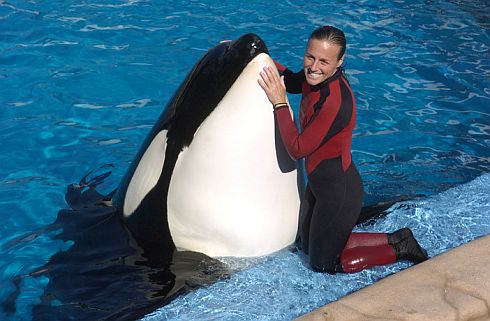
Whale trainer, Dawn Brancheau, with male orca, Tilikum (also spelled as "Tillikum"), at SeaWorld Orlando.
Yesterday afternoon, experienced whale trainer, 40-year-old Dawn Brancheau, was attacked and killed by 30-year-old male orca, Tilikum (also spelled as "Tillikum"), during the afternoon show at SeaWorld, in Orlando, Florida. The 12,300 pound male orca, Orcinus orca, apparently grabbed his trainer and thrashed her to death in front of the horrified audience, including patrons of the popular "Dine with Shamu" show. This animal has killed two other humans during his lifetime.
By the time she was eleven years old, Dawn Brancheau knew she wanted to train whales. Ms Brancheau earned degrees in psychology and animal behavior from the University of South Carolina before being hired by SeaWorld Orlando in the mid-1990s. She began her career as an animal trainer by working with the sea lions before "graduating" to training orcas and other dolphins in Shamu Stadium, which seats 5,500 spectators. Ms Brancheau, who was the youngest of six children, is survived by her husband, parents, five siblings, and her two pet dogs.
Two news reports with the Orange County (Florida) Sheriff's Department reveals the homicide department is conducting a "death investigation". The attack appeared to be an accident, not due to foul play. Dan Brown, general manager for SeaWorld Adventure Park in Orlando, explained that SeaWorld is also are conducting an investigation. "We have never in the history of our parks experienced an incident like this and all of our standard operating procedures will come under review."
This is a more complete news report:
A witness to this tragic event, Eldon Skaggs, tells a different story from that stated by SeaWorld officials, saying that the "trainer was massaging the whale on his belly, then the whale took off really fast, came around, right up to the glass, popped up and started thrashing, grabbed the trainer by the waist, started thrashing, and her shoe came off. The sirens went off."
Visitors who attended the noon show said the SeaWorld orcas were apparently agitated and misbehaved during that show. The noon show was eventually ended early, according to the reports I read. Despite this, the early afternoon show went on as scheduled, despite the orcas' earlier unruly behavior. Were these orcas already capable of aggressive behavior? "It's impossible to tell if an orca is in an aggressive mood," says cetacean expert, Janet Mann of Georgetown University:
Here is a 2007 video by "Rose" (who also goes by the YouTube handle, "TillikmTrainer") that tells her version of Tillikum's life story:
According to "Rose," Tilikum, nicknamed "Tilly" by his handlers, was captured near Iceland and removed from the wild when he was roughly two years old. Tilikum was sent to SeaLand of the Pacific in British Columbia, Canada, where he and two female orcas drowned trainer Keltie Byrne in 1991. Keltie Byrne, 20, was a University of Victoria marine biology student, champion swimmer and part-time trainer. On 20 February 1991, after she had just finished a show, Ms Byrne reportedly slipped and fell into the orca pool. She was pulled underwater and drowned by Tilikum along with two female orcas, in front of horrified spectators. It was several hours before her body could be recovered.
Tilikum was later bought by SeaWorld for breeding purposes and moved to Orlando, Florida. Despite general manager Dan Brown's assurances that SeaWorld has "never in the history of our parks experienced an incident like this," Tilikum was associated with the death of a park visitor in July 1999. This man had hidden in the park and after hours, sneaked into the SeaWorld tank to swim with the whales. The following morning, his nude body was found draped across Tilikum's back.
These are tragic events, but they are not really not surprising in view of the fact that orcas are large and powerful animals that weigh several tons each -- they can easily hurt or kill humans without really "knowing" what they are doing. With their bold black-and-white color patterns, orcas are the pandas of the seas, and so they are a huge crowd pleaser for SeaWorld and other marine parks, so I wonder if anything will really change as a result of this? My guess is that SeaWorld will "investigate", will blame the trainer for her own death, will ban Tilikum from performing publicly and keep him in some behind-the-scenes tank until he expires, but continue their current practices unchanged. After all, it's really all about the money, isn't it?
- Log in to post comments
Just let them go and the problem is solved.
It was a well known fact that Tilikum had the potential to be dangerous. I was surprised to find out that they were using him in the show, that whale is well for lack of a better description fed up.
personally I feel that Orcas should NOT be kept in captivity and used as circus animals.
Correct me if I'm wrong, but isn't Tilikum wild-captured?
Let the orca back into the wild.
The 1999 victim, according to a friend of mine who is a former Shamu Stadium trainer, died of hypothermia. He did after all swim naked in 52 degree water while intoxicated.
As for this incident and the 1991 incident - they took a wild animal, one with the same level of emotional and social complexity as humans and almost the same intelligence, and then kept it captive with very little socialization for almost two decades. Since no trainers were allowed to be in the water with him since the 1999 incident, he as been literally isolated except for breeding.
A tragic, tragic story indeed, but given this, is anyone really that surprised that he rough-housed with someone as soon as they got in the water with him? If it was aggression, she would have been torn to bits. Orca's don't know that people can't hold their breaths for 20 minutes.
I wonder what part of the name "killer whale" they didn't get. Isn't that precisely the way they kill their prey?
actually, the name "Killer Whale" was the result of early sailors watching wild orcas kill a much larger whale. orcas have never been documented to have killed a human -- in the wild.
Creative destruction of capitalism hard at work, although not in the context Marx intended. If you can make a buck off a wild animal, go for it; animal trainers are fungible goods. Attendance at the Orlando facility will like increase as the mob hopes to see more orca attacks on trainers.
I happen to believe that non-human organisms should be granted legal standing as "persons". I realize that this view is very outside the mainstream, spectacularly unlikely to come about in my lifetime, and makes it easy to lump me in with people with whom I would prefer not to be lumped. But in some abstract realm in which it is possible to talk about what should be independent of what actually is, I think that should be.
If Tillikum were granted legal standing as a person, I think he'd have a pretty good case against Sea World for the way he's been treated, and would have a good chance of getting off on the murder/manslaughter charge. I realize that that perspective looks silly from where we sit as a society today, but from where I sit, making a legal finding that this death was an "accident" is equally silly.
I'm not making a case that every caged animal should be freed. But the case of killer whales confined in small tanks by commercial organizations to be circus performers for paying customers is as black-and-white an example as I can think of. It's wrong, and should be illegal. I don't patronize marine parks that engage in the practice, and wish the rest of the world wouldn't either, so the barbaric practice could join bear-baiting and Coliseum fights between Christians and lions in the category of historic curiosities.
The second death at the hands of this orca was actually a Darwin Award winner.
http://www.darwinawards.com/darwin/darwin1999-18.html
This whale wouldn't survice if put back in the wild. He's been in captivity for too long now and besides these whales travel in pods (families). Being in captivity he has no pod, he was taken from his mother back in 1981. I think they should just keep him from performing. Set up a program where park visitors can see him swim in a glass tank and learn about his species. Also has any of these marine biologist ever thought that maybe the animal has had enough or is just disturbed. There are a lot of disturbed people in our world why couldnt it happen with whales??
Kill that Whale its killed 3 times already stop being stupid dumb ass people do what is right because even if you let the fucker go he will still kill again keeping him alive is a risk and calling this a horrifying accident is retarded it it happen once then I would believe its a horrifying accident but its happen 2 times in the past this makes it the 3rd fucking time kill the fucking animal already stop being stupid pussy's horrifying accident what a bunch of bull shit
its bullshit like this that makes people see and think how retarded and stupid Americans are its so sad and 4 the dumb fucks reading this and think I'm wrong I'am an American and I hope you burn in hell kill the whale
This whale was in the wild for two years, do they really think he cannot remember being free? It looked to me from the pictures I've seen that there is a whole pod at sea world, let them loose together.
to the person who called everyone on here a "dumbass".. how would YOU like to be captured by a race that deemed itself superior to yours, taken away from your family and everything you know, placed in a cage or 'habitat' and have others of the race that captured you ogle at you, and make you do tricks for their enjoyment? these are *smart* creatures.. smarter than dogs, pigs, apes.. etc. I know I wouldnt like it and I'd definately lash out at my captors every once in a while. that whale didnt deserve to be abducted and definately doesnt deserve to be killed. to me its quite obvious this whale is resentful and I cant blame it!
I agree with the person who said the whale wont survive being placed back in the wild..it's been too long. unfortunately what's done is done. as a matter of fact, I only approve of zoo's when it comes to the preservation of endangered species. and 9x out of 10 WE are the reason for the endangerment!
letting all the whales back into the wild together seems like a sound idea, but it's quite possible they've forgotten how to hunt in a pack and to survive on their own.. how to truly function as a natural wild pod of whales. some of them may even have been born in captivity and may never have been taught how to survive in the wild to begin with. they'd need to learn or re-learn everything.
I happened to catch the interview on CNN with Jack Hanna, He stated that Tilikum is a very valuable breeding whale and that he should not be destroyed. Although I agree that Tilikum should not be destroyed. I can,t help but think that with todays modern technology of Artificial Insemination for countless endangered species. There is no reason why he should be kept for the purpose of breeding. And should be considered being relocated to a facility that is more like a half way house for Killer whales with minimal human interaction.
This is so sad but really must be expected. These are wild animals held in capivity against their will. Sooner or later they are going to have a bad day and act up. Hopfully they can learn from this so that it never happens again.
Just let the whale go back to the wild and let it be the end of the story. Yes he has killed 3 times now and now something should be done, either kill him or release him into the wild. He wasn't born in captivity and survived for 2yrs in the wild. When he goes back, hopefully natural instinct will take over and he will live in the wild. Holding the orca in captivity isn't right and isn't going to make anything better!
well, ya cant let him go because we are the reason he wont survive. ya cant kill him because, well thats just not the right thing to do. because what purpose would it really serve? as for peta and the free the whales stuff, the reason these whales arent hunted to near extinction anymore is because of seaworld and other places where people learn and see these whales.so heres the thing. these whales and dolphins are evolved enough to be SELF AWARE. tillikum knew what it was doing when it did it. therefore not an accident. so the best option is to do as another post suggested and not let it perform anymore, just breed and live, and people can see him through glass and learn about orcas.
Because of the deaths associated with this animal there should no doubt that it should be destroyed. The decision should no longer be in Sea Worlds hands. The decision should be with the state Sea World lost the right to control long ago when it killed two other people.
So sad. A truly tragic accident. I covered this story as it broke on my show. http://bit.ly/aZDfdL
Investigators so far believe it was the trainers "ponytail" that started the attack. The ponytail apparently flipped in front of the whale, and thatâs when it grabbed the trainer and took her under water. I think they should free that whale. The whale isn't supposed to be in a tank in the first place. This is what happens when you play with nature. Hey but this is still a tragedy. I learned some facts here
http://ketiva.com/News_and_Events/the_possibility_of_a_whale_attack_at_sea_world.html
I think it its awful to kill this whale we took the whale from its home now we keep the whale in captivity then when something goes wrong we are ready to kill!!!!
this is wrong!! wake up people fight for what is right the whales should never be forced to survive with men what would happen if we were made to live on the water
Put them all back
lauralou
Wow.
Can we at least put to rest the myth that the whale killed two previous victims? The first one died from hypothermia, and the second was a moron who broke into the park and jumped into the tank after hours.
It should be destroyed, it has been involved in the death of three people, it is obvious that killer whales are not happy in captivity, look at their dorsal fins, if you cannot release it back in to the wild because they are worried that it would starve to death, which it would not, then you need to destroy it. Laws prevent them from capturing any more killer whales so the ones remaining in captivity are worth their weight in platinum. They value their investment over the lives of any guests or employees, maybe this whale knows he is being exploited and is acting out, trying to force their hand, kill me or let me go, because I am not happy doing tricks for humans.
One of the most memorable experiences of my life was when my parents took me to the Vancouver Aquarium. I was a little kid; I couldn't have been older than eight.
One of the Orcas came over, put its eye to the glass, and gave me a long, curious stare. It was a transcendent moment. I knew I was looking at an intelligent creature.
To this day, Orcas are one of my favorite animals.
AB:
Kill the whale? Seriously??
I wish you'd kill yourself instead. It would be one less idiot in the pool.
This matter has been mishandled for 15 years. According to all reports, there is no certainty that Tilikum was responsible for the earlier deaths of anyone. The fact they didn't have 24/7 camera surveillance amazes me. In the first case, there were 3 orcas potentially involved. In the 2nd case, there was a complete moron who snuck past security, for all we know, determined to commit suicide. His scratches and bruises were as likely the result of Tilikum trying to save his life as anything else. Then we have 11 years of him being ostracized from human contact, while he's still made to perform for shows. What, exactly, did these geniuses expect??? Tilikum finally got so frustrated he MADE a trainer join him in the water. Whether he actually intended to kill her is irrelevant. This animal is now so permanently emotionally traumatized, the only decent thing to do is to put him down. He's a companion to the other whales? Orcas are more intelligent than humans. They know what he did. Good company? No. Part of their breeding program? He killed someone. If Sea World weren't such negligent bastards, this tragedy could have been averted. But now, the only sensible thing is to end it, and Tilikum. I only wish the board members could be put down with him. End of story.
Don't scoff, it worked for Ahab.
OK, bad example.
Isn't this always the case? For every 8 people with empathy and good intentions (at least half of whom are probably un/misinformed), we'll have about 2 whose solution to everything involves violence and/or killing.
Ah, for a lethal flu virus that would select only those 2!
I am an avid animal lover who hates to see animals treated cruelly. I attended Sea World for the first time in San Diego 40 or so years ago, and was spellbound by the orcas. Of course, there are questions about whether they're "happy" in captivity. They can't really tell us, so we assume that because captivity is for them an unnatural setting, that they're not happy. As an aside, houses for us strictly speaking aren't really our "natural" settings either. But in spite of my concerns, I know that Sea World treats them very well because they are extremely valuable animals. And those who work with them obviously love them. But most importantly, I know that hundreds of millions of people in the world now love them and have learned about them precisely because they have seen them in these parks. When accidents like this happen (and I was in the audience in San Diego when an orca accidentally landed on and critically injured a trainer), all the questions come up again. But even though such incidents are horribly tragic, they're also very rare. I hope everyone does their best to keep things in perspective. Meanwhile, heartfelt condolences to Dawn's family and friends. She died doing something she loved doing, and I hope that gives them some comfort.
NO TANK IS BIG ENOUGH for Orcas or dolphins. They are very intelligent beings and know what they are doing. This whale was taken from the wild to live a life performing stupid human tricks for people inside a tank. They hundreds of miles each day and this whale is obviously bored and pissed off.
If you want to teach your kids about animals skip Sea World or any other zoo or circus and take your kids on a real trip to view wildlife in their homes.
They should keep the whale because they are almost a few left in the world so don't kill them they are mammals just like us and they also have feelings you know and if all the orcas are gone in the world there might not be any left in the world and that is what we need in our life animals they are a part of nature so just becareful in what you do just think about it do you want to let a part of nature just disaper you should be a sham of your self all the animals are a part of nature yes Tilikum killed 3 peopel but to him that was plainghe didn't knoe better he's just an animal who had no idea what he was doing and just because of that you shoulent just kill an animal you should keep it in capitivity or else if he goes back to the wild he might not know how to hut for food or it might not know how to pertect it's self ok he might but he might get sick or die and thats why i think Tilikam should stay in capitivity.
Monse - there are far, far more than a 'few' orcas left in the world. They are not an endangered species at all, nor are they true 'whales' (largest members of the dolphin family). Not trying to imply any opinion as to whether or not he should be kept/killed/released, just setting some facts straight.
Is there anyone that would know whether or not Tilkam was a Transient or did he belong to a Local Pod? The URL I have read up on is fascinating about how they stick together. It's almost disturbing to know that Tilkum was ripped away from his family like at the young age of age of 2, now that I have become educated on how the Pods work. Granted he survived and started his own family but wow. I couldn't imagine someone taking my daughter away from me at any point in my life. It is simply absurd to imagine. I am just as guilty as the next person for going to Sea World and watching the Orca Shows. I find them absolutely fascinating and it would be a dream to see them in their natural habitat. I have heard there is a place up in Iceland where they allow the Orcas' to retire but I can only imagine that they are probably even still penned up and not allowed to roam about freely without depending on a food source. Just a sad story all around for Orcas' and for the Trainer and her family.
Why did yo remove my comment? Do you discriminate by origin?
The trainer killed by Tilikum wouldn't of wanted Tilikum to be killed. I have done research and have come to the conclusion that Tilikum killed people because he was stressed from being held captive since he was two years old. Now he is thirty. I don't think that letting the whales loose is the answer because A)they wouldn't know how to survive in the wild and the transition would be difficult and B) SeaWorld uses their hard earned money to study animals and help their well being. We wouldn't have come nearly this far in the world of animal research if it wasn't for the research SeaWorld has done. Unlike Sealand, where Tilikum was involved in his first murdering case, SeaWorld seems to care about orca's well being. For example, in Sealand, the three orcas held captive could barely turn around. To please all of you bloggers who wish for the orcas to be free, maybe someone should suggest that SeaWorld holds a charity that raises money towards buildig a bigger tank for the orcas. And to all of the unfortunate people who use their anger on persuasive blogs and say inappropriate things, a word of wisdom: Innapropriate is a sign of a weak mind trying to express itself. Instead,
change that energy into things that will help the world. You'll thank me some day.
I agree with what Lee Wiegand said. I was thinking about the second death Tilikum allegedly committed and it was no different than an incident that occurred at my own zoo. The Toledo Zoo here in Ohio has polar bears. Apparently, a few years ago, some intoxicated idiot managed to sneak into the zoo in the middle of night and got into the bear pen. Needless to say, his dead body was found later that morning before the zoo opened. I don't blame the bears for the death of some fool and I truly believe the death of the trainer was an accident. Sure, I'm willing to think that Tilikum was agitated but animals, unlike humans, aren't out to kill for the same reasons as most human murderers. Think of the historical man-eaters here on land. They were often old or infirm and so killed humans as a source of easy prey. They also kill in self-defense. I doubt Tilikum killed anyone on purpose. Yes, orcas are smart animals. Yes, they can plan attack strategies. But that knowledge is for hunting purposes and they don't actively kill humans in the wild. Also animals don't know right from wrong which is what makes humans unique of all beings. Tilikum didn't think he was doing anything wrong so can he rightfully be blamed for these deaths? No. I say, keep Tilikum for viewing purposes but keeping him out of shows. He's been out of the wild for too long to be able to survive without his birth pod. Also to the idiot who said Tilikum should be killed: Go screw yourself, you heartless bastard.
sandra: i haven't removed any comments. i also checked the pending comments and there was nothing there at all that was waiting to be published. perhaps you are looking for this comment, which appears on a different thread? i apologize, but i don't know what happened. feel free to post your comments again, though.
Yes, this is the one. But there is some new informations coming out from the investigation that I want to add.
Now came up that there was some construction work near by the whales tanks. How would you like to be in a earth quake for several days? Besides, pressure waves HURT those whales were suffering and they TOLD their trainers so by being UNRULING just before the show. So, the problem once again is people not listening!
In addition, apparently Tilikum grabed Dawn just after she said, "we are ready to go", may be he didn't want to GO there, and don't tell me animals don't understand words, we are the ones that don't speak their language.
But what can we expect if institutions and companies stress out and harrass people until the are in a corner and some go out in killing rampage, why wouldn't the whales?
This is not the whales fault this is a human fault, utilizing animal for entertainment and economical exploitation is ethically questionable. Now a days that people are able to travel around the world animals should be enjoyed free in their natural environment with us as their guest not all the way around.
Trainers know the risk of their profession, Dawn Brancheau enjoyed Tilikum's company until the last moment and I am sure she wouldn't want anything bad to happen to Tilikum. Animals don't choose and don't want to be confined, so we are the ones to blame for this tragic incident.
By taking away their freedom we assume the responsibility over their wellbeing and behavior. I say ALL animals that have been made dependent on humans shall be protected until they naturally die, but NO other animal should be made captive from now on to end animal cruelty.
This was a tragic story and my prayers go to family and friends of the trainer. Tilikum is a huge whale and should really be watched over before any more shows. I pray that no more incidents to happen in ANY SeaWorld Park. I don't mind seeing what the animals can do in shows, but it is true...whales that or like 10 years old or older should be released back into their natural habbitat until their life has come to an end.