

tags: Paleontology, birds, Genyornis newtoni, rock art, aboriginal peoples, Archaeology, Australia, Niwarla Gabarnmung, Arnhem Land, Flinders University
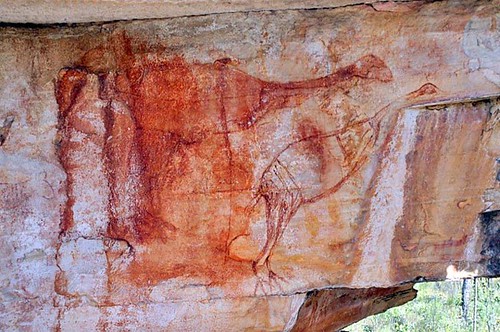
Australia's oldest painting?
A red ochre rock art depiction of two emu-like birds (Genyornis newtoni?)
with their necks outstretched.
An Australian Aboriginal rock art may depict a giant bird that is thought to have become extinct some 40,000 years ago, thereby making it the oldest rock painting on the island continent. The red ochre drawing was first discovered two years ago, but archaeologists were only able to confirm the finding two weeks ago, when they first visited the remote site on the Arnhem Land plateau in north Australia.
"Initially, we thought it was another big emu," said consulting archaeologist Ben Gunn, a founding member of the Australian Rock Art Research Association who was documenting the Niwarla Gabarnmung site for the Jawoyn Association.
Niwarla Gabarnmung is located in southwest Arnhem Land in Australia's Northern Territory, a region that is filled with thousands of aboriginal rock art sites.
"The animal wasn't an emu; it looked like the megafauna bird Genyornis, with thick, huge toes and short legs," stated Mr Gunn.
"When we got to the beak we knew that was no emu. We thought, 'goodness do we have a Genyornis?'," said anthropologist and paleontologist Peter Murray, who is now retired from the Museum and Art Gallery of the Northern Territory.
Genyornis had a big beak that it used to eat fruits and probably smaller animals that were either too stupid or too slow to escape. Genyornis fossils reveal that it had large hoof-like claws on its toes, adapting it to a cursorial life.
"If it is a Genyornis -- and it certainly does have all the features of one -- it would be the oldest dated visual painting that we've got in Australia," said Mr Gunn.
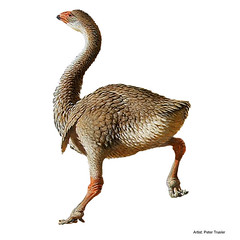
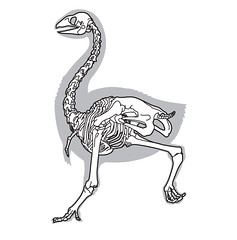
Genyornis newtoni.
Illustration: Peter Trusler/Melbourne Museum
[larger view of painting and larger view of skeleton]
Genyornis was a giant flightless bird that was taller and heavier than either the ostrich or emu. It had powerful legs and tiny wings, and probably closely resembled ducks and geese, its closest living relatives. Bones from a number of Genyornis have been unearthed, suggesting that they lived in flocks. Fossil eggs and footprints have also been found.
Interestingly, Genyornis bones have been excavated in association with human artifacts in Cuddie Springs in the Australian state of New South Wales. It is likely that humans lived alongside these birds, and some scientists think that humans may have contributed to their extinction.
"The details on this painting indicate that it was done by someone who knew that animal very well," remarked Mr Gunn, adding that the details could not have been passed down through oral storytelling.
Paintings of other extinct animals, including the thylacine, or tasmanian tiger, the giant echidna and giant kangaroo, are also found in the area.
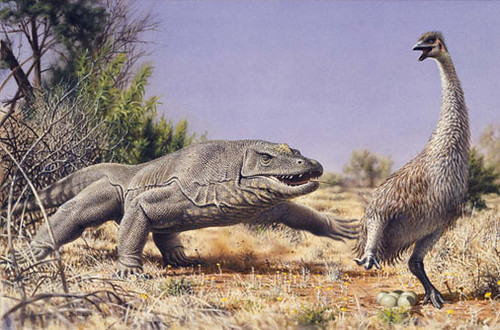
Two of the long-vanished big beasts of Pleistocene Australia,
the Komodo dragon-like Megalania and a species of giant flightless bird
known as Genyornis newtoni.
Illustration: Peter Trusler for Wildlife of Gondwana/NOVA (PBS).
Genyornis lived during the Pleistocene and was the last of the dromornithids, a group of large, flightless birds whose fossil bones have only been found in Australia.
"Either the painting is 40,000 years old, which is when science thinks Genyornis disappeared," Mr Gunn elaborated. "Or alternatively, Genyornis lived a lot longer than science has been able to establish."
"We have very few dates from northern Australia, aside from the earliest human dates from Arnhem Land," commented paleontologist Gavin Prideaux, a megafauna expert with Flinders University in Adelaide, adding that it's difficult to know exactly when Genyornis went extinct.
"It's currently disputed in scientific circles."
"You can't be sure [it's a Genornis] because there's stylistic elements [to rock art], but I can't think of any reason it's not Genyornis," said Dr Prideaux.
The Jawoyn people say they are excited the painting could be Australia's oldest dated rock art. The Jawoyn are a group of Indigenous peoples who are the traditional owners of the land in Australia's Northern Territory.
Wes Miller, executive director of the Jawoyn Association, says the painting is one of thousands that has been rediscovered throughout Arnhem Land in recent years.
"It verifies that the Jawoyn people were living in this country for a very, very long time," said Mr Miller.
"Once again this is clearly a demonstration of how long Jawoyn people have been in this country," remarked Mr Miller. "It's great from that point of view. It's pretty exciting stuff."
But other experts disagree with the painting's antiquity.
"We need to take this discovery with great caution. The probability of having a painting surviving so long outside of caves is very small," stated Robert Bednarik, the world's authority on rock art. Further studies, such as radiocarbon dating of the paint, are planned.
If this painting is as old as some authorities think, it will be among the oldest ever discovered. For example, the earliest known European cave paintings were created roughly 32,000 years ago.
Sources:
ABC News [quotes, image of the painting]
The Australian [quotes].
- Log in to post comments
the Jawoyn are right to get excited about this - everyone is - but it might have been painted by the poor saps they kicked out when they took over the land. 40000 years is a long time, and humans tend to be utter bastards, even the indigenous ones.
Maybe it was just an emu ... he was drawing with a rock after all ...
Are the oldest cave paintings in Europe really 32,000 years old? I thought Chauvet, France, was dated at 35,000 bp.
Anyway, there are drawings of extinct creatures in some of the French caves, too. Cougnac has at least one illustration of the giant deer, megaceros. It seems like a great way to prove how accurate paleontological reconstructions really are.
Even with an element of stylisum in art it certainly is an interesting piece of rock art suggestive of Genyornis, hope they are able to extract a date. On the Jawoyn people themselves Wazza whilst what you say may have been true on the otherhand if it does turn out to be 40000 years old then with 40000 years of genetic mixing of the aborigines tribes within Australia you could almost be certian that they (along with the bulk of other aborigines) could claim it is their ancestors even if the Jawoyn people have not exsited as that group or at that location for the entire period.
Extinct 40,000 years? Bulldust. The Same Scientists at large in the NT couldnt find their butts with their hands. They didnt even notice an endangered 'kangaroo mouse' living in the spinifex of the Simpson Desert also living in a Spinifex field almost a thousand miles north on the red cliffs of fog bay (just for the record - the spinifex desert once extended all the way to Mandora in the city of Darwin).
If Giant Bush turkeys are painted on a rock wall in the Arnhemland plateau it will be because the desert was as far north as the base of the JimJim falls making it one of the few sources of permanent fresh water in a continent spanning drought.
I'm doubtful about previous claims for depiction of Austalian megafauna (Thylacoleo, Palorchestes) in Top End rock art and even more skepticalabout this one. The right hand bird differs little in basic shape from X-Ray style art said to be Emus and to be mid-late Holocene. The left-hand bird is more interesting but a distorted depiction of an Emu seems far more plausible than 40000 year survival of a Genyornis image.
It's important to note that these paintings are often "maintained" by aborigial "banman (clever man) who is the healer". They are painted over and over and over over the years. If that's the case for this art, then it might complicate the dating process.(although I think this can be accounted for by going down to the deepest layer of pigment). I'm pretty sure the results will remain inconclusive.
HI ALL:
You can read more about these "Giant Geese" in this book: Magnificent Mihirungs: The Colossal Flightless Birds of the Australian Dreamtime (Life of the Past).
How can they speculate that humans caused this animals extinction when they just found out humans saw the thing? It wasn't lions looking for meet on sticks, but the few people alive on the entire continent of Australia.
If they raised the birds, then that would indicate the opposite, wouldn't it. 99% of animals go extinct without human intervention.
JackF you are an idiot --> 99% where did you get that from (your ass obviously as it smells of shit)
Looks like theres a brontosaurus behind too. :0
Actually considering the hundreds of millions -> billions of species that were around before modern humans evolved a few hundred thousand years ago, JackF is correct in his argument that 99% of animals go extinct without human intervention. That isn't to say he didn't pull that number out of his rectum, but... ;o)
----------
JackF,
It's very common for aboriginal peoples to be 'responsible' for the extinction of animals in their region without much evidence to support such a claim. It's right up there with 99.999% (totally made up) of unknown structures being "ceremonial" centers of one sort or another. Apparently when our ancestors weren't eradicating every animal that came within their reach, they were praying about it. At least they felt bad, no?
In the end, "...may have contributed in their extinction..." basically translates to "we have no freakin' clue, but it sounds good." Just like, "may have been a religious center" better translates to "we have no freakin' clue but, it sounds good." ;o)
Actually dogmeat, there is a fair amount of evidence that people were involved in megafauna extinction in Australia. Just some of the papers... But don't let facts get in your way!
Roberts, et al. 2001. New ages for the last Australian megafauna: continent-wide extinction about 46,000 years ago. Science 292: 1888-1892.
Prideaux et al. 2007. Mammalian responses to Pleistocene climate change in southeastern Australia. Geology, v. 35, n. 1, p. 33-36.
Turney et al. 2008 Late-surviving megafauna in Tasmania, Australia, implicate human involvement in their extinction
PNAS vol. 105, no34, pp. 12150-12153
Prideaux et al. 2009. Extinction implications of a chenopod browse diet for a giant Pleistocene kangaroo PNAS vol. 106 no. 28 11646-11650
dude's gotta eat, and can you imagine the drumsticks on those things? :P
Seriously, though, in Australia at least the extinction of megafauna is mostly blamed on climate and habitat changes caused by human use of fire, rather than hunting, though the latter must have had some effect as well.
The really weird thing, IMO, is that the ABC filed this under regular news and not under News In Science (http://www.abc.net.au/science/news/) where you'd expect it...
Are you sure they aren't supposed to be depictions of a star-bellied sneetch?
In which way we may distinguish between different Aboriginal peoples? Without projecting contemporary ideas and methods, that is. Much more, how can we do that for a period as far back as 40 millenia?
So, it seems to me that Aboriginals, and those living in the area in particular, can rightly consider this rock art as a work of their ancestors.
If people and Geryornis, or something, lived together before 40 thousands years, the conclusion that people may have contributed to its extinction comes from the fact that today its only the people that are around.
And am I the only one that has noticed this comforting expression "the traditional owners of the land"? Goodness, for a moment I thought we will now have to aknowledge taking over their country.
-.