

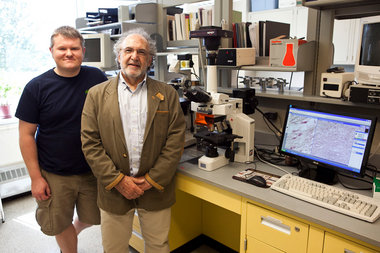
Left: Derrik Hilton, an asistant in the laboratory of Dr. Charles Ide (right) at Western Michigan University. Image from: Katie Selden / Kalamazoo Gazette
Dr. Charles Ide from Western Michigan University has become a leader in the fight against Multiple symptom atrophy, or MSA, all because of frogs. His research on how contaminants in the Kalamazoo River impacts the health of frogs lead to the discovery that frogs injected with PCBs developed Parkinson's disease like symptoms.
Dr. Ide describes MSA (aka: atypical Parkinson's Disease) as being a trio of disorders making it especially life-threatening: Parkinson's disease, cellular ataxia (affecting balance and movement) as well as autonomic failure (leading to loss of ability to swallow and breath). There is no known cause or cure for this devastating disease affecting approximately 100,000 people.
Currently, there is very little funding provided for this rare disease, so Dr. Ide has been receiving funding from public and private donors such as NFL football players or family members of victims. He is using this funding to test brain tissues from deceased MSA patients to study changes in gene expression compared to healthy brain tissues. In one study, he found that Myelin Basic Protein was decreased in patients with MSA. This protein is important in forming insulating layers around neurons to help them send signals. This loss of myelin is similarly seen in a more familiar disease, multiple sclerosis. Examination of the expression of an immune cell regulator, Butyrophilin Like 8, showed higher levels in the brains of MSA patients. In studies of multiple sclerosis, Butyrophilin Like 8 is thought to activate killer T-cells. His research is continuing to identify differences in protein expression in the brains of MSA patients as well as what these differences might mean. Perhaps the similarities between MSA and multiple sclerosis will help in the search for a cure for both of these severely debilitating and life-threatening diseases.
Source:
- Log in to post comments
I have some elderly relatives that died with parkinsons
so is pcb responsible or not, not sure here?
There are studies linking Parkinson's (not just MSA) with PCBs as well:
http://toxsci.oxfordjournals.org/content/92/2/490.abstract
http://www.cdc.gov/niosh/pgms/worknotify/PCB2.html
I've got a theory that because my brother who is a Baptist minister and Billy Graham have and the ex Pope had Parkinsons that religion is the major cause. This is God's reward for piety, just like the huge incidence of breast cancer among nuns is their reward. It's the stress of freaking out about burning in Hell and God testing them for loyalty combined. Job, who is the Bibles number one masochist said, when covered in carbuncles and sundry other pestilence, 'Though he slay me yet will I trust him.'. Weird sort of logic, but then it takes all sort of nutters to take the piss out of.