

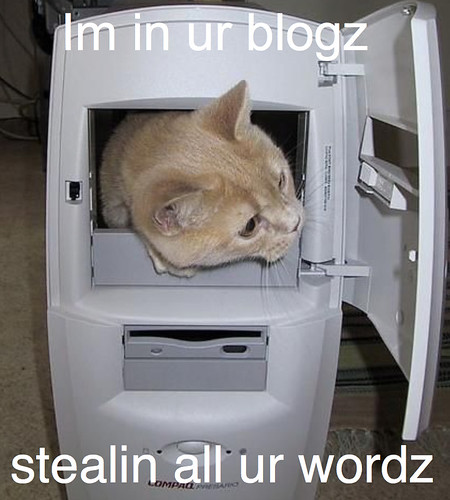
This displeases us greatly.
I received an email from ScienceBlogling Mike Dunford that Reed Elsevier had excerpted one of my posts. No problem there--I like it when people read my stuff....except for one thing:
The fuckers copyrighted my words.
MINES!!!
Lookee:


Mike Dunford lays out why this is such a fucking shitty thing to do:
This blog, like almost all blogs, is an open-access publication. There's no charge to read this blog. If you've got an internet connection and time to waste, you can scroll through the things I've written to your heart's content. The thing is, open access doesn't mean that nobody gets paid.
If you're reading this material on my blog, you're going to see some ads. The ads bring in income for the Seed Overlords. They use that income to cover the not-insignificant costs of running this online Zoo. They also pay me (and the rest of the bloggers). The more people read my posts, the more opportunities there are for someone to actually look at one of the ads, and the more I get paid. I don't get paid when people read this on someone else's website.
Advertising-supported web publishing is a business model that Elsevier understands quite well. In fact, it's a business model that they use. They run a cancer information site that's open access and supported by advertising. And because they get paid only for the ads that appear on their site, they have a copyright policy that prohibits reposting their material on other sites without their consent.
That's not the only time that Elsevier has shown a very acute awareness of where their money comes from. They've consistently opposed open access initiatives around the world, because open access requirements would have a very large impact on their bottom line. In fact, they've gone to great lengths to try to protect their income stream. As you may remember, they were one of the publishers involved in the astroturf group "PRISM" that their attack dog PR expert put together to lobby Congress in opposition to an open access initiative.
Elsevier has spent a great deal of time, energy, and money in an effort to get people to respect their income flow. They apparently didn't bother to think about mine.
The irony is that they stole posts that criticized them for being greedy bastards:
The worst offender, in my book, is Reed Elsevier. Their prices--which you or your offspring pay for in terms in higher library expenditures and thus higher tuition fees--are obscene, and often for really shitty journals. Faculty usually put up with this crap because publications are the lifeblood of tenure packages and grant proposals. No one wants to piss these guys off. I'm not talking about muttering what gonifs these guys are, I mean taking them out at the fucking knees.
That's why I almost never review articles for these journals anymore (as opposed to Open Access journals, which I do--two in the last month alone, and that's during grant season). Seriously, if they ever did want me to review, then they have to pay me just like any other business who wanted to consult my expertise would. If enough of us did that, well, things would get very interesting....
And the best part is this javascript disclaimer from the stolen post:
This document and any links, illustrations, comments or other information included in or accompanying it are independently provided by your firm through either independent creation or based upon independent relationships between your firm and third party sources other than LexisNexis®. LexisNexis® has not created, supplied, reviewed or endorsed this document and accompanying information.
To the best of my knowledge (and that of our Benevolent Seed Overlords), no such relationship exists.
Reed Elsevier: Pusbags of Publishing.
So, let me get this right...
If I want to publish in a journal, I pay the journal and they get to keep the copyright. Then if I want to read the journal I have to pay again. Basically the only thing the journal do that I couldn't do myself by sticking a PDF on the university webserver and pinging Google Scholar is to provide credibility and prestige via. accepted peer-review, and the review is done by other people who don't get paid. Yes?
I can't see how deliberately stowing publications behind someone else's paywall would help me as a scientist. How are they still in business? Seems to me that someone could design an open-peer-review system and render them wholly obsolete, aside from the value of their back-catalogue.
Does Seed/Science Blogs publish under a Creative Commons license or other license? What is its use policy terms for its bloggers?
I don't understand how ReedElsevier can steal your work and copyright it.
Sorry to be so dense. And I'm sorry that this has happened to you.
This is from the Seed TOS:
But this appears to be for non-SB authored content appearing on SB or Seed. Does ReedElsevier publish a similar TOS for copyright infringement?
IANAL, but Seed seems to be a US company, and I believe US law says that unless otherwise specified, all works are copyrighted, all rights reserved, by their authors. So Elsevier could be sued (probably not for enough to make it worthwhile, but I dunno) for copyright infringement.
As a blogger participating on this site, are you bound by this statement?
"Any Submissions submitted by you to the Site through the Venues or otherwise will be deemed non-proprietary and non-confidential, and may be used by Seed Media without restriction. Without limiting the foregoing, by offering any Submissions through the Site, you grant to Seed Media the worldwide, perpetual, royalty-free, irrevocable, nonexclusive right and license to reproduce, modify, edit, publish, display, perform, adapt, distribute, sublicense and otherwise use and exploit such Submissions (and any and all proprietary rights therein that you may have) in any and all forms and media, now or hereafter discovered, without compensation or attribution to you."
I can't tell if this applies to bloggers or only people participating in Seed Media-created content.
> grant to Seed Media the worldwide, perpetual,
> royalty-free, irrevocable, nonexclusive right and
> license to ... modify, edit, ... otherwise use and exploit
> such Submissions ... , without compensation or attribution ...
Seed damn well _better_ remove any attribution to me from anything they've modified or edited.
Because if they edit and modify something I wrote and then _do_ attribute it to me, I'm going to see about what it takes to shove that final important comma right where it belongs.
thanks for performance
thanks very good blog
Where can one obtain a list of Elsevier journals?
You know, the ones I'm going to refuse to referee for...
(And shan't submit in.)
I think this is very good idea, but I am affraid but not for me
porno dvd
sex shop
I follow your site constantly and offers a very good share. I expect continued share
thanks for all
sex shop
penis büyütücü
biber hapı
vakum pompası
vakum pompası
nicostop
sigara bırakma
tütüne son
sigarayı bırakma