

And do we want to? Maybe it could help formally include non-publishing activities in a scientist's evaluation?
When I first read this PLoS Computational Biology article, "I Am Not a Scientist, I Am a Number", I was ready to beat down on its ass. After all, how seriously can you take something like this which describes a "Scholar Factor":
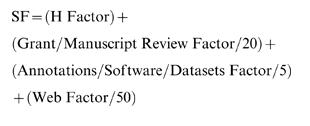
I'm surprised there's no arcsine transformation in there (I said I wouldn't beat the crap out of it, not give it hugs and kisses). By way of further explanation (if you really want it):
H Factor is as it is now--the number of papers cited more than H times--thus, an H factor of 20 indicates that an author has 20 papers cited more than 20 times....
Grant/Manuscript Review Factor is the accumulative number of authenticated... grant and paper reviews you have done (data provided to the grant funding agencies and journals)....
Annotations/Software/Datasets Factor is the accumulative number of authenticated entries you have made in a public database, for example, microarray datasets, gene sequences, macromolecular structures, or software entries you have added to an open access archive. If n scientists were involved in making the entry, you get 1/n of an entry; 5 entries increase your SF by 1....
Web Factor is the number of authenticated blog posts, wiki postings, etc., you make that show x or more links to them (a measure of their value), where x is to be determined; 50 entries increases your SF by 1.
I still get the strong feeling that more personal away time for the authors would be a good idea. Nonetheless, even though the parameterization leaves a lot to be desired, there is the germ of a good idea here. Essentially, a lot of these 'other' activities (i.e., not published papers) would formally receive credit--which could greatly help academics for tenure, as well as aid non-academic scientists.
Discuss.
Cited article: Bourne PE, Fink JL 2008 I Am Not a Scientist, I Am a Number. PLoS Computational Biology 4(12): e1000247 doi:10.1371/journal.pcbi.1000247.
- Log in to post comments
42.
Thank you for tipping me off to that article. I fully support the effort to quantify scientists' productivity, not just with authorship and citations, but with contributions to public databases/wikis/blogs, and reviews, all as mentioned.
I posted a preliminary attempt at quantifying such variables several months ago on my Wikispaces site (http://sharescienceideas.wikispaces.com/Public+Contribution+Rating), and would love to get your opinions and spread the word.
No formula will satisfy everyone, but with diverse input, we can certainly spur improvements in the current system of evaluating promotion and tenure.
Thanks! Noam Harel
In my opinion the largest threat for California are cataclysms and ecological catastrophes. Not important is how many money we have because one tragedy can us take all.