

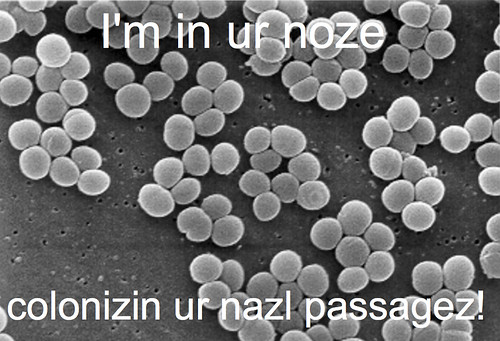
I've been meaning to get to a really interesting article titled "Killing niche competitors by remote-control bacteriophage induction." So, let's talk about your nose.
Two species that are found in the human nose are Staphylococcus aureus (methicillin resistant strains are called MRSA) and Streptococcus pneumoniae. Typically, only one species or the other is found: they usually don't coexist in your schnozz. One mechanism that S. pneumoniae uses to displace S. aureus is to make hydrogen peroxide, but it's unclear how this actually works, since hydrogen peroxide, at concentrations which are lethal to S. aureus, is also lethal to S. pneumoniae.
What this study found is that hydrogen peroxide, at levels usually produced by S. pneumoniae, kills those S. aureus strains that have a lysogenic phage--a bacterial virus that has incorporated itself into the S. aureus genome. Usually, the lysogenic phage acts like any other stretch of DNA, but when the S. aureus cell is stressed, as is the case when exposed to low levels of hydrogen peroxide, the phage becomes lytic: it turns the cell into a phage factory, kills the cell, and then the phage infects other cells (which, if also stressed, will be killed, and so on).
This gets interesting in several ways. First, many S. aureus have bacteriophage, so they're susceptible to hydrogen peroxide. These bacteriophage, when existing as part of the bacterial genome, often encode proteins that help cause disease. This could result in a tradeoff between persistence in your schnozz and the ability to cause disease.
Second, other stress agents, such as the antibiotic ciprofloxacin, were shown in the study to induce this response. That means that these drugs are more effective against the lysogenic strains than the non-lysogenic ones.
It's like a Mutual of Omaha special...in your nose.
Hee-hee: I have an image of "Jim" holding down some of the staph as they explode....
But it is funny, it's been all hydrogen peroxide all day for me. I was reading that new paper about H2O2 as a call to leukocytes: http://www.ncbi.nlm.nih.gov/pubmed/19494811 and I went looking for the promoter on the reporter construct. It is a bacterial H2O2 sensor.
Hmmm.
Don't the S. pneumoniae microbes then run the risk of infection by the phages, particularly if they happen to mutate?
Mike come on this is just a phage they're going through
Please bear with me. 15 years ago I worked in a lab and it was five years before that I had a micro rotation. At this point my understanding is weak, at best. Does Staph Aureus smell like grapes or sweaty gym socks? Is it the normally ubiquitous organism that becomes problematic in hospitals, particularly burn patients? Again, it has been a long time and I'm trying to straighten it out in my mind. A very good article, I enjoyed it alot. Even if I'm a bit unclear on particulars learning of their mechanisms is very, very, very cool. Thanks for posting this!
My apologies I realized I could find this out on my own: Pseudomonas, not staph. Sorry, cool post though.
I can't access the full paper on this computer, but the system you're describing sounds exactly like the lambdoid prophage 933W in enterohemorrhagic Escherichia coli O157:H7 strains. It too gets induced by the SOS response through the action of RecA on the LexA repressor and then Shiga toxin gets made. The EHEC cells also die.
So this kind of phage induction is conserved? Even from Gram negative to Gram positive?
SWEET!