

Sometimes, it's not the high end technology that saves lives, but the cheaper low end stuff. One of the ways microbiologists identify different bacteria is by growing them on 'defined' growth media. We have built up a vast knowledge of which growth conditions will support particular bacteria (and what those bacteria will look like on those media).
One of those media is blood agar plates.
A biological sample, such as infected blood, sputum (the gross stuff you hack up), or other disgusting bodily fluid will be cultured on an agar plate that contains a variety of nutrients (the agar, derived from seaweed, is what solidifies the plate into a hard gel--it feels like mushy rubber). Blood agar plates are like regular nutrient plates, except that they're composed of five percent blood. VAMPIREZ!!!! ZOMG!!!
What these plates measure is the ability to produce haemolysin, a toxin that destroys blood cells (and, yes, that's as bad for you as it sounds). If a bacterial colony (a clump of cells visible to the human eye) produces haemolysin, then a 'halo' occurs around the colony and the plate, in that region, is no longer opaque, like so:
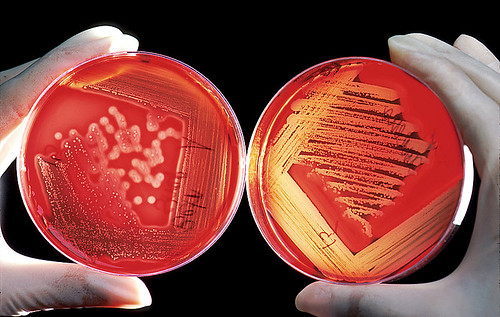
The two plates have blood cells infected with different types of bacteria. The plate on the left shows a positive staphylococcus infection. The plate on the right shows a positive streptococcus infection and with the halo effect shows specifically a beta-hemolytic group A (click to embiggen).
(from here)

In developing countries, human blood is used VAMPIREZ!!!! ZOMG!!! because it's cheaper than using wool sheep or horse blood. Unfortunately, human blood agar isn't a very good diagnostic: lots of bacteria, even though they are good at causing sepsis infections (growing in human blood), don't grow on or lyse human blood cells, making accurate diagnosis difficult. In some cases, streptococcal infections are misdiagnosed as malaria, partly because malarial tests aren't always effective, and the bacterial cultures don't indicate a bacterial infection because the cells can't grow (I have former colleagues funded to work on this problem). Instead of treating with an antibacterial, patients are then treated with an antimalarial, which does nothing to stop the infection.
A recent PLoS paper found that using hair sheep blood, which is cheap and widely available, is just as good as horse or wool sheep blood:
The results of all studies showed that blood agar prepared from citrated hair sheep blood is suitable for microbiological tests used in routine identification and susceptibility profiling of human pathogens. The validation of citrated hair sheep blood eliminates the labor-intensive and equipment-requiring process of manual defibrination. Use of hair sheep blood, in lieu of human blood currently used by many developing world laboratories and as an alternative to cost-prohibitive commercial sheep blood, offers the opportunity to dramatically improve the safety and accuracy of laboratory diagnosis of pathogenic bacteria in resource-poor countries.
This is a good low-tech solution to a very important problem. It also highlights the importance of Open Access: anyone with an internet connection can find out exactly how to make this media--no expensive journal subscription is needed.
Very interesting. After a quick read I had some questions:
(Not important) What is a hair sheep?
(Not too important) Why is human blood cheaper than wool sheep blood or horse blood?
(More important) How often are diagnositic cultures indicating the wrong diagnosis because the culture media selects for a less significant pathogen?
I didn't know human blood was less expensive. We used to have a bottle of horse blood in the fridge for making blood-agar plates, it always seemed a bit macabre...
I didn't know human blood was less expensive. We used to have a bottle of horse blood in the fridge for making blood-agar plates, it always seemed a bit macabre...
According to the internet, a hair sheep is any breed of sheep which still has the long hair of the wild species with only a short wooly undercoat. Sheep bred for wool now have a long undercoat and no regular hair.
Can you put this post on ResearchBlogging.org please? That makes it eligible for the Blog Of The Month prize...
We actually tried using human blood for our blood agar plates after the university's vet school quit giving us sheep blood and we saw how expensive it was to order it (plus random delays in delivery and what not).
It was very troubling that our C. perfringens wasn't particularly hemolytic on human blood agar plates.
As to why it's cheaper, our human blood came from me and our sheep's blood came from Fisher Scientific :p
Great post.Thanks.
RT JohnV, Is your research intended to ultimately help treatment or prevent clinical cases of human C. perfringen infection? If so, wouldn't it be best to use growth media encouraging culture of strains most like those found in humans rather than more hemolytic strains encouraged by sheep blood?
Our research was directed towards human gangrene and food poisoning. We used 3 "wild-type" strains: an environmental isolate that could cause gangrene in a mouse model (and presumably people but who knows), a human food poisoning isolate, and the type strain (whose origin I couldn't ever nail down but was purported to be a human gangrene isolate).
Because of the cost and tedium of having to keep the plates in the refrigerator that was outside of the anaerobic chamber and the short life span of the plates, we didn't routinely use blood agar plates. We just used them to screen for alpha/beta/gamma hemolysis, colony morphology and motility in various mutants.
For the isolation of strains from mixed samples you use something like tryptone-sulphite-cycloserine+egg yolk agar which of course would potentially cause you to miss any strains showing aberrant phospholipase production.
Anyone got prices for hair sheep blood and the demand ratio?
Someone has suggested to setup a farm in Cambodia raising sheepskin for this purpose, and ship blood to labs around the world.
Anyone with comments on feasibility?
To me, it seems not feasible because: deliver time, deliver cost, high cost (to keep sheeps for this), marketing cost (labs need awareness and action) e.g. Limited actual demand.
Hello, I can answer some questions, as senior author of the paper.
Human blood is free - outdated human blood bank donated blood is used, so it is even worse quality because it is old.
Hair sheep are ancient sheep - humans bred sheep to make more wool. 90% of west African sheep are hair sheep. They are goat-sheep-like. Google image them to see different breeds.
We have sheep in Cambodia now (an NGO maintains them for us) but they are wool sheep, very hard to maintain and now some of them are ill. If we could get hair sheep into the country (and other tropical developing countries) it would solve problems. I have sources willing to donate the sheep. I have tried but Heifer.org is not helpful.