

It's not as bad as the Great Brooklyn Tampon Shortage, but it's just become a lot harder to study marine viruses. There are two basic ways to figure out how many viruses are in a given sample, such as a milliliter of seawater. One method is to mix a bacterial (or algal) cell with a certain amount of seawater and look for plaques--holes in the lawn:
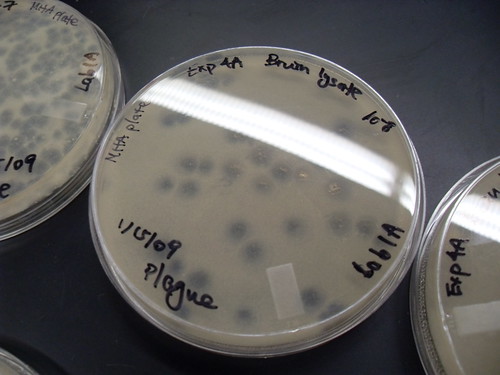
(from here)

The number of plaques equals the number of viruses.
This method has several problems, perhaps the most obvious of which is that you will only observe plaques if the virus can infect those cells. A culture-independent method filters the sample through an Anodisc filter--the viruses don't pass through the filter--and then stains the viruses with a fluorescent dye. Using a microscope, you then simply count the number of fluorescent dots. Anodisc filters, made by Whatman, are critical because, unlike other filters, they don't fluoresce when exposed to the dye.
Simple enough, right? Enter the joys of mergers and acquisitions:
Researchers studying viruses in the environment are scrambling to stockpile tiny laboratory filters called Anodiscs after GE Healthcare announced it would stop making them at the end of the year.
Down to their last filters and with boxes on back-order, many labs have stopped ongoing research projects. Environmental microbiologist Jed Fuhrman of the University of Southern California in Los Angeles calls the situation a "nightmare" adding that his lab paused a 10-year project of collecting monthly virus samples from the waters between Los Angeles and nearby Catalina Island. The filter shortage "pretty much killed that project," Fuhrman says....
Unlike filters made by other companies, these quarter-sized filters don't glow themselves, which allows scientists to pick out the faint virus spots from a dark background. "It's a little bit of a house of cards, because these techniques are all built on one filter made by one manufacturer," says environmental microbiologist Eric Wommack of the University of Delaware in Newark. An alternative counting method called flow cytometry requires more expensive equipment and greater expertise to get reliable data.
GE Healthcare acquired Whatman, the company that previously made Anodiscs, in 2008 and plans to discontinue the product on 31 December. In an e-mail to ScienceInsider, a company spokesman wrote that GE Healthcare is looking for "potential solutions," but wouldn't disclose what they were.
GE, we bring good things to life!
This sucks. If you dig virology, you might think about sending GE a letter.
- Log in to post comments
It's a nice idea, but I doubt it will make any difference to GE.
We used to use GE Healthcare products for various purposes--they bought Wave and a couple of other companies that produce cheap mouse antibodies, so we just kept buying those things.
Quality rapidly went downhill while prices doubled in less than five years. We are a major purchaser of these products, as we are SuperMegaPharma--not a minor academic buyer, we run through this stuff like toilet paper and it is not cheap. This year, our Purchasing manager suggested reviewing competing products. Long story short, we were so fed up with GE's non-customer service that we told Purchasing if they could find any substitute with better service and support, we didn't care if it cost a million bucks a minute. We found cheaper and better alternatives (Sartorius and Invitrogen, in case anyone is interested) who were pleased to have our business and have treated us well.
To this day, GE has not been at all concerned with the loss of a multimillion $$ client. Once, they sent a sales rep to pitch a new product which had absolutely no relevance to our work, but she was a newbie who had no inkling of our past troubles. Haven't seen hide nor hair of them since.
Shoulda stuck to making lightbulbs.
They colluded to fix prices on the lightbulbs.
GE Healthcare sucks. As far as I can tell they are a company that shows no regard for customers, or the impact of their decisions on research. In the case of Anodisc filters, which are used for virus counting, there are currently no alternatives. After acquiring Whatman a little over a year ago, the cost of these membranes tripled. GE Healthcare has now announced they they no longer intend to produce the product. The lack of availability of this product has already had a major impact on many research programs. Discontinuing production of Anodiscs will result in a worldwide halt to many research projects in environmental virology. This is fundamental research with far-reaching implications. As a result of this decision, I will be instructing everyone in my research group (as well as colleagues) not to purchase GE Healthcare products whenever an alternative is available.
The news is bad for nanotechnology, too. (Anodized aluminum oxide is excellent for making nanowires and nanotubes.) Having a commercial source saved a lot of us researchers from having to delve into electrochemistry.
Spread the word. There is a company that's making AAO:
http://www.synkera.com/