
In an otherwise not-too-bad post about the value added tax (VAT), Edmund Andrews goes off the rails:
I would submit that many middle-income people (including me) SHOULD pay more. The government needs to raise more revenue to provide the services that voters demand, and middle-class people benefit from those services too.
This policy shouldn't be pushed for during a depression, but, as a general proposition it's defensible. But this next bit just isn't factually true (italics mine):
Rich people should pay more taxes, and I support repealing the Bush tax cuts for households earning more than $200,000. But our system is already too dependent on the very top earners, and you cannot raise all the additional money needed just by hitting up the top 2 percent. Some of that money has to come from furtther down the income ladder. And why shouldn't it? Where is it written that 40 percent or so of taxpayers should not owe income tax?
Funny thing is that the IRS, when murderers aren't flying planes into it, collects these things known as data*.
In 2007, only 1.3% of returns had no gross adjusted taxable income. 1.3% is kinda like forty percent except not really. Looked at from a different angle, 29 percent of returns paid less than five percent of their taxable income. Since the average amount for those returns was three percent (and that's remarkably constant across all income brackets), many of those returns paid some tax. Also, the Earned Income Tax Credit applies to about 20% of households--keep in mind that many of these eligible households still pay some income tax (just less than they would without the credit); that's not forty percent either. Clearly, forty percent is a bogus number.
But let's examine a more common proposition--that the upper class pays far more taxes than the middle (and upper middle) class. Here's a table I pulled from the 2007 data (reconfigured; the original has a gazillion columns):
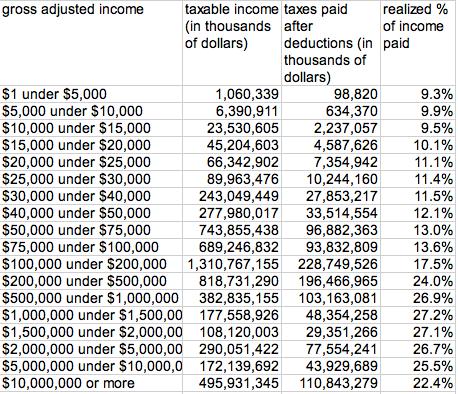
Yes, on average, the wealthy do pay far more as a percentage of their income in income tax.

Note this is only income tax. But every household that makes under $100,000 adds 7.65% in payroll taxes (Social Security and Medicare). For the average income in the $100,000 - $200,000, add about four percent. For the $200,000 - $500,000 bracket, it's slightly over one percent. Above that, it's negligible compared to income taxes.
So do people who make $50,000 per year pay less in federal taxes as a fraction of their income? Yes, but it's hardly soak the rich territory. And for those who say we can't raise much money by taxing the rich, well, actually we can. If the $200,000 - $500,000 incomes paid a realized thirty percent of income (however you want to make that happen), and above a half million paid 35 percent, that alone would raise $155 billion. With that kind of money, we could, like, invade two countries full of brown people and blow the shit out of them. And we haven't even tackled capital gains taxes....
Finally, here's a very tangentially related video by The Fashion:
*To the best of my Googling, I've been able to track down the forty percent figure to a Wikipedia entry. In the entry, there's a link to an AP article by Charles Babington who isn't a particularly reliable source.
<record="broken">
Alternately we could place a very small flat tax on property -- including stocks, bonds, cash under the mattress, undeveloped real estate, etc.
Some stuff would leak through, but contrasted with the personal-property taxes from before the electronic economy it wouldn't be much -- especially when you consider that any serious property would be insured.
No need for any progressive scale, because property ownership is already vastly more progressive than any income taxes. Best of all, it would actually stimulate the economy. Our current system favors sitting on assets relative to productive use, while a property tax would favor production over unproductive holding of assets.
</record>
D. C. Sessions: "No need for any progressive scale, because property ownership is already vastly more progressive than any income taxes. Best of all, it would actually stimulate the economy."
Amen, bro! Amen. :)
I've seen this figure bandied about constantly, although it ranges from ~40% to ~50%.
Most recently, I've seen this cited as the source:
"In 2009, roughly 47% of households, or 71 million, will not owe any federal income tax, according to estimates by the nonpartisan Tax Policy Center."
http://money.cnn.com/2009/09/30/pf/taxes/who_pays_taxes/index.htm
It would seem the disparity is between the proportion of people who actually file tax returns who don't have any tax liability, and the proportion of the total population (or total households) that don't pay any income tax (presumably because they don't file?)
That article only breaks out < $50,000 as the lowest grouping of income, which has the highest percentage of households who pay no Fed tax. This needs to be broken down further, as the next grouping up, 50 - 100K, shows a 75% reduction of non tax paying households.
Also, the fact that the figure is growing is likely not indicative of a too lenient tax rate on lower income earners, but rather is an indication that the number of very poor households is growing.
What is Edmund Andrews reply? Tax the poor even more! What a pig.
In a truly healthy economy, everybody would be earning enough to pay taxes. Secretly, the Republicans are very happy to see the percentage of working poor growing ever higher - it depresses the wages they need to pay to them.
Lost my first paragraph! try again:
That article only breaks out < $50,000 as the lowest grouping of income, which has the highest percentage of households who pay no Fed tax. This needs to be broken down further, as the next grouping up, 50 - 100K, shows a 75% reduction of non tax paying households.
Also, the fact that the figure is growing is likely not indicative of a too lenient tax rate on lower income earners, but rather is an indication that the number of very poor households is growing.
What is Edmund Andrews reply? Tax the poor even more! What a pig.
In a truly healthy economy, everybody would be earning enough to pay taxes. Secretly, the Republicans are very happy to see the percentage of working poor growing ever higher - it depresses the wages they need to pay to them.
Ok - understand now - I had used a left hand carat instead of writing out "less than" ($50,000). Sorry about that.
That article only breaks out less than $50,000 as the lowest grouping of income, which has the highest percentage of households who pay no Fed tax. This needs to be broken down further, as the next grouping up, 50 - 100K, shows a 75% reduction of non tax paying households.
Also, the fact that the figure is growing is likely not indicative of a too lenient tax rate on lower income earners, but rather is an indication that the number of very poor households is growing.
What is Edmund Andrews reply? Tax the poor even more! What a pig.
In a truly healthy economy, everybody would be earning enough to pay taxes. Secretly, the Republicans are very happy to see the percentage of working poor growing ever higher - it depresses the wages they need to pay to them.