

Sadly, I'm not talking about the desire to learn. A recent survey of teachers (pdf) revealed the following about hunger in the U.S. classroom:
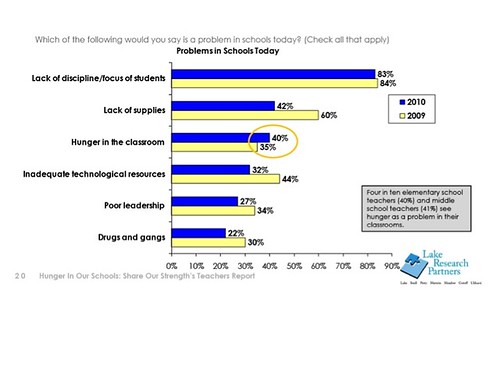
â¢When K-8 public school teachers consider a list of problems they face in the classroom, they rate discipline as the top problem (83 percent), with student hunger falling among the second tier of problems (40 percent), alongside lack of supplies (42 percent):
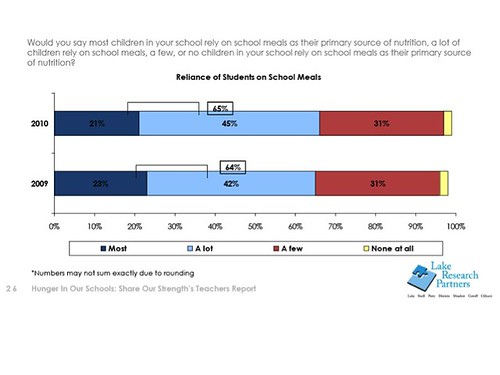
â¢Similar to 2009, four in ten teachers say that children coming to school hungry because they have not had enough to eat at home is a serious problem at their school (43 percent rate the problem between 6 and 10 on a scale where ten means it is a very serious problem and zero means not a problem at all; 44 percent rated it 6-10 in 2009).â¢Around two-thirds of teachers (65 percent) say there are children in their classrooms who regularly come to school hungry because they are not getting enough to eat at home (64 percent of elementary school teachers; 69 percent of middle school teachers).
â¢For nearly half (46 percent) of K-8 public school teachers overall, 25 percent or more of their students come to school hungry on a weekly basis (29 percent: 25-50 percent of students come to school hungry; 17 percent: 50 percent).
â¢Over eight in ten K-8 public school teachers (86 percent) say they frequently see children coming to school hungry, with four in ten (40 percent) saying this happens more than three times a week in their classrooms.
As to why this happens, teachers cite the following reasons:
- Unstable home environment (72 percent);
- Parents or caregivers not having enough money to buy food (55 percent);
- Parents or caregivers working or not around to prepare food for children (50 percent, and this is a particularly big problem seen by middle school teachers: 57 percent);
- Not having any food at home (45 percent).
And school nutrition programs are critical in combating student hunger:
So what are these corrupt union thugs teachers doing about this? They're buying food for their students out of their own pockets. Sixty-one percent buy food for the whole class to feed the hungry kids, while 41 percent buy food for hungry students to eat at home at least several times per month. (Heartless bastards!).
Explain to me how value added testing* or any of the other statistically questionable methods fix the fundamental problem of under- and poorly nourished children. Answer: they don't. This is one of the key ways poverty affects educational outcomes.
Or we can blame teachers. When I hear progressives like Matthew Yglesias prattle on about 'edunihilism' (and I'll have a lot more to write about that idiocy), I don't think he even realizes what most schools are like, what most teachers' working conditions (and thus, their students' learning conditions) are like. And this is one problem that's pretty straightforward to solve: feed the kids.
*I'll have more to say about the massive statistical failure of value added testing tomorrow (TEH SCIENTISMZ! permitting).
Mike,
maybe I'm misinterpreting one or both of you, but I think when Yglesias said that (edunihilism) he was saying the same thing you are, ie that poverty is the main driver of educational problems, and that we should stop spending so much time/energy/money on issues like charter schools, teacher merit pay, teachers unions etc, and instead work to reduce levels of poverty. Do you interpret things differently?
Isn't that the problem with conservatives in general? They don't understand what the lives of real people are like. (While claiming to be the "real Americans")
I can't help wondering how much of the bad behaviour and lack of focus in the first problem-category is exacerbated by hunger: even as an adult I can get pretty cranky if I'm tired and missing meals.
@stripey_cat, I know, right? I'm definitely not on my best behavior when I've missed a meal, no matter how hard I try.
This brings to mind an argument I had with some conservative asshole, like, ten years ago, when I pointed out that a lot of kids show up at school hungry and never have the same chance to succeed as the kids with advantages that come along with having wealthy parents. He insisted that if the hungry kids would just try harder, they could forget about/overcome being hungry and succeed in school anyway. Ten years and I haven't stopped wanting to punch him in the face.
When are we, collectively, going to get this through our heads? Conservatives, as a group, don't give a shit about what happens to anybody besides them. They occasionally pretend like they do as a way to mask their utter inhumaneness.
Short version: in their world, anybody who isn't just like us doesn't deserve anything at all. Let 'em die. Or let 'em live, if they figure out how to be just like us. But we're not helping them.
It is impossible to conceive of the span of conservative ignorance on public school conditions. When I got into "debates" on this topic while I was still teaching, I'd always start out by asking them if they'd believe me when I told them that the schools in which I taught had no air conditioning--in May, June, and September, and for the luckless summer classes too. To the last one, none of them believed me and they all thought I was joking. They had never heard of a building in America that didn't have air conditioning.
When are we,escort collectively, going to get this through our heads? Conservatives, as a group, don't give a shit about what happens to anybody model besides them. They occasionally pretend like they do as a way to mask their utter inhumaneness.thanx admin