

In light of the nuclear power plant partial meltdowns in Japan, there are calls for not expanding the U.S. nuclear power plant capacity, and even shutting down existing plants. What bothers me about this is that there is no discussion of how we make up the energy production shortfall--I'll get to energy conservation in a bit. As the U.S. begins the 21st century, we still are generating most of our power by lighting things on fire: oil, gas, and coal. While renewable energy (which despite its name still has some CO2 footprint) could pick up some slack, given our dysfunctional political system, if wind, solar and tidal power could reach fifteen percent of energy production, that would be a minor miracle.
If we ever want to reduce our production of CO2 over the next 20-30 years, we'll have to develop nuclear power (although I would like to see thorium-powered reactors which produce less super-long term radioactive waste, instead of our current reactor technology). And as to environmental effects, well, Deepwater Horizon, mountain top removal, and fracking. No impact there. At all.
Ideally, we would undertake serious energy conservation measures. Making the energy grid less leaky would be a good start (although Republicans have ridiculed this). Other smaller effects, such as improving appliance efficiency, reducing food transport, and so on would help--at this point, the situation is dire enough that everything helps.
But we can't be serious about energy conservation until we tackle this figure:
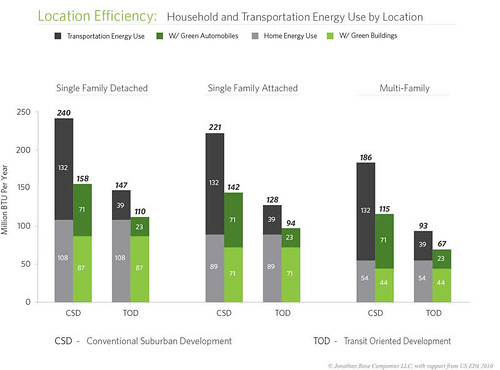
One of the best ways to reduce the amount of stuff we have to light on fire is to move from single detached housing in areas with no efficient mass transit to apartments with access to mass transit (keep in mind that residential use and transporation account for about two-thirds of total energy consumption). In other words, we have to massively 'desuburbanize' and simultaneously 'reurbanize.'
Just how likely is that? Hell, whenever I write something nice about Boston, I get people showing up and claiming that they couldn't live in the city because those people will rape all their stuff and steal all the women (or is it the other way around? I get confused).
Would we really be able to change the myriad number of economic and funding incentives in favor of the suburbs and the disincentives for living in urban areas?
Will we remove the mortgage interest tax deduction (most urbanites are renters and most suburbanites are owners)?
Will we decrease the massive subsidies and externalizations at the federal, state and local levels for driving?
Will we intelligently zone communities so apartment buildings could be built in more places? (which, of course, could lead to an influx of those people. AAAIIEEE!!!)
Will we adequately fund mass transit, both short- and long-distance? Especially when conservative governors actively refuse what is basically free money?
Probably not. And that's just the short list. In fact, environmental organizations never discuss the issue of suburbanization, even though it is probably the single most significant contributor to energy consumption. So we're left with either nukes or lighting carbonaceous compounds on fire. And we're running out of time with regards to global warming.
So that leaves the nukes as the second best option.
- Log in to post comments
It's hard to see exactly how nukes will cut car oriented transportation emissions. Also, you list all the political obstacles to other energy solutions and ignore them re nukes. There is probably a political component to way we have not built a new nuke in 40 years and the political problems just got much worse!
Hell, whenever I write something nice about Boston, I get people showing up and claiming that they couldn't live in the city because those people will rape all their stuff and steal all the women (or is it the other way around? I get confused).
Not that this will convince your critics, but my actual experience is that moving out to suburbia doesn't help this problem. Burglaries happen in suburbia, too, and walking at night is often more dangerous than in urban areas precisely because hardly anybody in suburbia walks anywhere.
[sarcasm]
I have a better solution. 2050, 9,6 billion people. Let's build gas chambers and exterminate poor people because they are going to kill the Planet and the society that we rich people sustain with our marvelous capacities. They are just parasites, aren't they? Poor people in the ghettos and in chinese villages don't deserve to live a more comfortable life. Cities and mass-transportation are commie collectivist ideals that are going to brainwash our kids into becoming homosexuals.
[/sarcasm]
I assume that the first best option is combo wind and solar.
It takes time to build a new reactor and get the government approvals, environmental impact statements, construction, etc. During that entire process, we are still depending on fossil fuels.
Instead, we use that money to build wind turbines and solar thermal plants. We get non-polluting electricity in months rather than years.
If the government quit subsidizing fossil fuels and used the money to build wind turbines, we'd be getting an extra 7-10 gigawatts of capacity per year. In four years, that would be enough wind power to run the entire state of Texas (at current capacity vs. actual production numbers).
I agree with you that suburban living is not environmentally friendly, but for all my complaining, I'm not giving it up to live in an apartment in the city. Me, I'll buy an electric motorcycle and ride it to work.
"One of the best ways to reduce the amount of stuff we have to light on fire is to move from single detached housing in areas with no efficient mass transit to apartments with access to mass transit (keep in mind that residential use and transporation account for about two-thirds of total energy consumption). In other words, we have to massively 'desuburbanize' and simultaneously 'reurbanize."
Question: What about telecommuting? Can't a great deal of office work be decentralized?
It's hard to see exactly how nukes will cut car oriented transportation emissions.
That can be achieved by using more nuclear power, plus more all-electric cars recharging their batteries from a nuke-supplied grid, plus subway systems using electricity from the same grid.
The actual source of environmental problems is the amount of total resources consumed by humans as a whole. We can fix this one of two ways - reducing the average consumption per person, and reducing the number of people. We give tax breaks for electric cars and solar panels, why not tax breaks for getting a vasectomy / tubal ligation before ever having kids? After all, the CO2 footprint of a family which always has kids is effectively infinite, because it never stops, while my CO2 footprint ends the day you kick me in a hole and dump dirt on top of me.
I mean, if we're going to talk about lifestyle choices that have real climatic impact, why not at least acknowledge the 6.8 billion elephants in the room and admit that maybe, just maybe, adding to that number is irresponsible?
----------
With regards to cities, remember that city =/= multi-family apartment. I live in Providence (*much* nicer than Boston), and while I currently rent in a house converted into two apartments (one per floor), there are plenty of nice houses with spacious yards around me, all on the bus line (RIPTA now has plenty of new diesel hybrid busses, too). Give folks the option of single-family homes with yards near the city, and they take it - houses near me sell well, even in this market and with New England real estate prices.
Also, note that if you rent, your environmental impact may go *up* if the place isn't well-insulated and has inefficient appliances. That's my current issue - our CO2 footprint is mostly home heating, which we can't do anything* about because we don't actually own the property.
* - I improved door and window sealing and use that clear plastic window cover in winter, but I'm powerless to do things like having the house re-insulated, insulating the basement, buy solar panels, or buying better appliances.
The main problem with nuclear power isn't the danger of meltdown, although over at Class M the point is usefully made that the worst-case scenario for solar thermal or wind is pretty mild. The main problem with nuclear is its up-front energy and financial costs - the scaling of nuclear power sufficient to make a difference in transportation is a many-trillion dollared thing, which is enormously unlikely until fossil fuel costs make it necessary.
But, of course, at that point, the fossil fuel accruing costs (since nuclear power plants use an enormous amount of fossil energy coming online - they essentially front-load energy returns on an enormous scale and only return more than invested after several decades) those drive up the costs and make it less likely they will be built. Scaling nuclear might have been possible 30 years ago, but it won't happen now.
As for desuburbanization - it will happen in some measure, but again, we just did an enormous infrastructure of housing build out and one has to imagine where the money would come from in an era of no or negative growth. Unfortunately, we spent the last 30 years (or 70 depending on how you want to count it) building out exactly the wrong stuff.
Sharon
What other choice? NONE.
All this talk about alternativesâhype. Do the numbers. All this wasted bandwidth about how we should move huge chunks of the population into urban areasâridiculous.
In America it's like this:
1.) You will NEVER get the current generation of adults to conserve in any meaningful way short of an epic disaster (war, or think The Road). This is the reality.
2.) The sooner we come to the conclusion that nuclear energy is our ONLY choice at this moment in history, the better job we can do of regulating the design, construction, and operation of nuclear power plants. If we don't do this, we'll have another headlong clusterfuck like we did in the 70s.
3.) DOE is trying to come up with a standard nuclear plant design (or two) so that all new plants will be templated, so that they are easier to comprehend by builders and operators. With standard designs, as bugs are discovered and solved in one plant, those improvements can be propagated to all the other plants of that given design.
4.) And we have to keep on working the nuclear waste problem, but that shouldn't stop us. We KNOW fossil fuel will destroy the Earth (if it's not too late alreadyâand I know plenty of climate scientists who think it is).
5.) Suck it up and let's do it. The whiners can STFU. In an emergency, you aren't presented with perfect choices, only (hopefully) survivable ones.
I'm 53 years old, been an environmentalist since I was in grade school reading National Wildlife magazine. And I hate the idea of more nuke plants as much as you. But we don't have the luxury any more. We pissed any other opportunity away by allowing our government to be completely co-opted by business interests in the last 30 years. (When I was an undergrad in the 70s, I sat through multiple lectures in Geology class about how our disruption of the carbon cycle would kill us. This news ain't new.) Now we pay the piper.
"What bothers me about this is that there is no discussion of how we make up the energy production shortfall--I'll get to energy conservation in a bit"
Which means there IS a discussion on how to make up the shortfall, doesn't it?
And Nuclear may be a second option, but it's rather like Iraq having the fifth largest army. There's a hell of a drop off after the third. Heck the Hari Krishna's have the sixth largest, and they've already got your airports.
Paco nailed it. there's only so many options to choose from; conservation is politically and sociologically untenable (you just WON'T convince enough people to do enough of it, face that fact and cope), renewables have technological issues with scaling and base-load shortfalls as well as financial uncertainties.
nukes work, nukes scale, nukes are cheap enough per kilowatt hour to compete with coal --- and whatever we try WILL HAVE TO compete financially with burning coal until we all choke. political reality, cope.
really, the only problem with nukes is we should have started building them out twenty years ago and didn't; now we may be too far behind the curve for it to matter.
Quibble: Palo Verde went to full operation in 1988.
Engineering works on a cycle, things are built until something fails the failure is studied and the lessons learned are incorporated in new construction. For Earthquakes consider that until 1933 there were no construction standards in Ca then schools fell down in the 1933 Long Beach Earthquake, so the schools had to be strengthened/replaced. 1971 Olive View Hospital fell over, and then hospitals had to be rebuild or strengthened (it takes 30 years to get this done of course). Likewise the lessons learned from these disasters will be absorbed in designs. Actually the newest BWR type design the ESBWR (see Wikipedia for details) is designed to run for 72 hours with no electricity at all. It has large pools of cooling water above the reactor that can be released into it.
Note also that the plants put the backup generators several stories up, I have not seen where the backup generators were in Japan, but to have the Tsunami affect them they had to be reasonably low down. Just like happened in Houston after Tropical Storm Allison where several hospitals had their power systems in the basement and they flooded and now power equipment must be placed where it will not flood, you can be sure that backup equipment will be moved to where a 10 m tsunami will not affect it.
nukes are cheap enough per kilowatt hour to compete with coal
[citation needed]
There may be a political component to why we haven't built a lot of nuclear capacity in this country in the last 30 years, but the main reason it hasn't happened is cost. Back in the late 70s/early 80s, multiple utilities went bankrupt over the costs of constructing nuclear power plants. Among those utilities was my local provider, PSNH; we're still paying for PSNH's stranded costs in the Seabrook plant. (Which, like Fukushima Daiichi/Daini, is on a coastal plain on real estate bordered by salt water--I hope we never get a direct hit from a landfalling major hurricane.)
Part of the high cost is due to the inherent inefficiencies of the permitting process in this country (effectively, every nuclear reactor in the US must be custom designed, unlike in France or Japan where design of the reactor proper is standardized). Good luck getting that to change, especially after the recent problems in Fukushima, and especially given the well-founded mistrust of the American public in the corporations that would be building the plants.
Maybe the marginal costs per kWh are lower, but it takes at least three to four decades of lower marginal costs to amortize the higher up-front investment in the plant.
Since you can see a hurricane coming, they shut the plant down 12-24 hours before the storm hits. Assuming they have their generators placed above the storm surge level, then their would not be a problem. If the grain elevator in Greensburg Kansas could survive the storm that leveled the rest of the town, given that the containment is much stronger than a grain elevator the plant would survive. Since it is known that Hurricanes strike the real question might be what is the design hurricane.
Lyle: apparently the specification for tsunami flooding for Fukushima was just under 6m - say two stories up - and the actual wave was over 10m - so four stories....
I guess that's what happens with a top-5-of-all-time earthquake.
On molten-salt thorium reactors: I am firmly in the camp that holds this is a great concept that should definitely be developed further. But I also think it shouldn't hold us back from building and further developing the existing reactor designs, or form other innovations. In particular the modular light-water reactors hold tremendous promise (to me), without any technological "unknowns", for a rapid factory-standardized build out of nuclear power.
I think Scott Free @1 is indulging in a classic case of "blame A for the faults of B". Political obstacles and arguments are raised all the time against nuclear power. It's the other major obstacle (after deregulation) that stands in the way of major nuclear power roll-out.
I don't know how much re-urbanization enters the discussion, but it is certainly linked in my mind with various pro-sustainability anti-corporate lifestyle movements (for instance, slow foods). Farmers' markets in cities, urban gardening, and independent retailers and restaurants are all part of urban revitalisation.
At the end of the day unless we reduce consumption of energy massively we are not going to get anywhere. We could replace all our fossil fuels tomorrow with nuclear energy, solve the climate change problem and move straight onto the next problem caused by the simple fact that our energy consumption drives natural resource consumption or enviornmental degradation above the basic ecological limits that comfortably sustain humans.
In any event, i am almost certain that adoption of nuclear energy would not alter the trajectory of carbon emissions 1 iota, because we would simply add the energy available through additional nuclear ontop of the existing trajectory of increased fossil fuel energy.
People often assume with nuclear, that it will "replace" fossil fuels - well you can't seriously say that unless you can point to anything which stops the burning of fossil fuels.
I'm also particularly concerned as to what appears to be the most likely scenario of serious climate change already being locked in, or at least likely due to partial inaction, bringing major global enviro-social-economic turmoil in 10-20 years at the same time as massively increased stocks of nuclear materials lying around from every countries promised "nuclear fix", now at greater risk to be used as weapons or released by the highly changing and unpredicable "acts of god" events, or simply being left poorly managed due to the more pressing concerns of nations in dealing with more immediate climate change impacts.
"you just WON'T convince enough people to do enough of it, face that fact and cope"
Really? How do you know? Has anyone done the maths?
It really seems to me that this is spouted by those who WILL NOT do enough so therefore they project that on to a majority so they won't have to feel bad about themselves, whilst also ensuring that they get to continue as they want.
There are over 6 billion people on the planet, and you don't know even a tiny fraction of them.
Double the price of electricity and give the extra cash out as a blanket handout so that the poorest get a well needed boost to pay for it whilst the profligate pay for it and the rich don't notice the difference.
If you demand this is wrong, then you have proven that you are the one that won't change because for those willing to change, halving your energy use whilst retaining your lifestyle is not difficult neither is it expensive and if you make that change, the tax on energy won't affect you.
nuclear power plants are the honeypots of evolution to eliminate the human species.