

Jeremy Yoder has a good takedown of another article by Jesse Bering. This time, Bering argues that homophobia is adaptive. This is the key point:
Bering's post focuses on a series of studies by the evolutionary psychologist Gordon Gallup. Gallup was interested in the question of whether there might be an adaptive explanation for homophobia--which, given the fact that many (although far from all) human cultures treat homosexuality as a taboo--is a fair question for research. He hypothesized that treating homosexuality as taboo helped to prevent homosexual adults from contacting a homophobic parent's children, which would reduce, however slightly, the prospects of those children growing up to be homosexual, and ensure more grandchildren for the homophobe.
Gallup supported this adaptive hypothesis with ... evidence that straight people were uncomfortable about homosexuals coming into contact with children [$a]. Here's the opening sentence of that paper's abstract:
In a series of four surveys administered either to college students or adults, reactions toward homosexuals were found to vary as a function of (1) the homosexual's likelihood of having contact with children and (2) the reproductive status (either real or imagined) of the respondent.
If you've noticed that this doesn't mention evidence of heritability or a fitness benefit to homophobia, that's not because I left it out--that's because Gallup's work contains no data to support either.
I'm starting to see a pattern here. You might remember that Bering wrote a piece for Slate, in which he argued that rape avoidance was adaptive.
There too, Bering cited an article with weak evidence:
Claim #3 is really problematic. The article claims:
German investigators Arndt Bröder and Natalia Hohmann established, ovulating women are not less active in general--they're still busy shopping, going to church, visiting friends, and so on--but they avoid doing those things that make them sexually vulnerable. (link is to a pdf)
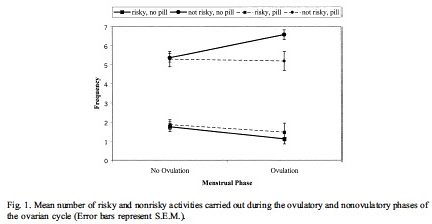
I'm not sure they've established much of anything. Risky versus non-risky activities were scored by 23 women on a scale of 1-5 (5 being the most risky), and the average score was used. I would have used the median score instead: a few 'nervous Nellies' could easily raise a score. This sounds technical, but it could make a huge difference in scoring. I'll also note that college students were used to assess risk, and college students are fantastic risk assessors (Got Four Loko?) But what really bothers me is this figure:
The largest change in behavior is among women not on the pill (the pill simulates some of the effects of pregnancy, most notably preventing ovulation): they increase non-risky activities, far more than they decrease risky activities (which is still statistically significant). Ovulating women seem to be more active overall. Maybe ovulation makes women want to do more stuff, and that causes a decrease in risky activity--there are only so many hours in a day. Finally, by the authors' own admission, this is a relatively weak effect (related to this, keep in mind the scoring caveat noted above). One study that demonstrates a weak effect needs a lot more follow up (didn't the sciencebloggysphere just have a humongous conniption fit over the Decline Effect?).
What bothers me about Bering is that he treats barstool speculation based on weak or non-existent evidence as settled consensus. Then it follows the scientific equivalent of Cokie's Law: once it's out there, we have to discuss and refute it, even if the premise is poor.
That's makes Bering's statement of intellectual boldness all the more ridiculous, as Yoder notes:
Why on Earth would Bering dredge up Gallup's adaptive fairytale a decade and a half after it was published, if it was baseless to begin with and no new evidence supports it? Well, according to Bering, because he's a hard-nosed scientist who isn't afraid to consider uncomfortable possibilities.
Sometimes, science can be exceedingly rude--unpalatable, even. The rare batch of data, especially from the psychological sciences, can abruptly expose a society's hypocrisies and capital delusions, all the ugly little seams in a culturally valued fable. I have always had a special affection for those scientists like Gallup who, in investigating highly charged subject matter, operate without curtseying to the court of public opinion.
Of course, says Bering, Gallup's work isn't conclusive, but it sure would be interesting if someone tested it.
Except, when Gallup was forming his hypotheses about the evolutionary benefits of gay-hating--he first proposed the idea in a 1983 article--he was hardly thumbing his nose at public opinion. He was, in fact, giving natural selection's approval to the prevailing ugly stereotypes about gay men.
A responsible scientist who cares about his discipline doesn't mainstream speculative claims. This is not helping the field of evolutionary psychology--and that's too bad, because if done rigorously, we could learn a lot about human behavior.
- Log in to post comments
Might have to steal this one...
Sex in general is an abomination, whether it's homosexual or heterosexual. Sex is the cause of the most heinous crimes that humans have ever committed.
There is not much advantage in being heterosexual, for instance, if you get periodically raped by a representative of an opposite sex, get pregnant and subject your child to the brutal treatment of people in general, such as discrimination, deprivation of basic means to survive and so on.
There is also a possibilty that a heterosexual couple may produce a homosexual child that will have to undergo torturous treatment on the part of heterosexual haters. And the question is - what's the purpose of bringing a child into this world to begin with, if all they are going to get is constant brutal torture and mistreatment?
Homosexuality is great in a sense that it curbs, and keeps in check the unbridled and spun of our control, human overpopulation.
This is particularly beneficial in the United States, where there is a tremendous competition for resources, and where resources are consumed recklessly and without limit because of unbelievable greed, where people are constantly looking for ways to dwindle as many people as possible from their territory.
Furthermore, giving birth should be criminalised, because trusting people in general with your kids, can cause your kids a tremendous damage. For instance, you kid might get bullied at school to the point that they might either get killed or commit suicide.
Of all the crimes that humans have ever committed, there is a high chance that at least one of them, will be committed against your kid throughtout their lifetime, and if you are a good person, you would not want to subject your child to what people can potentially do to them. I wouldn't be able to live with myself, if some man raped my daughter and she committed suicide or if she was bullied and then committed suicide. How can anyone trust their child with anyone?
"Why are we listening to Bering?"
Exactly! Why can't each person just go and screw themselves!
So, are you saying this has no Bering on the issue? Wah, wah, waaaaahhhhh. Thank you, I'll be here all week!
I wonder what's next for him? Maybe he can branch out - tell us how we are space aliens built the pyramids, how autism is caused by vaccines, or how climate change is not occurring. Or maybe how saying stuff you pulled out of your ass is adaptive?
I guess you could call this the Bering Scared Straight Theory.
"I guess you could call this the Bering Scared Straight Theory."
I think the word homophobia should be substituted with the word "humophobia".
Humans in general are quite scary, irregardless of their sexual orientation. You may choose not to be afraid of them, but it won't stop them from causing you harm, unfortunately. And the most terrible part about it is that sometimes this incurred damage is permanent, and you'll have to live with it, and suffer from it for the rest of your life. And that's what's really scary!
If you are a women, homosexuals are actually less likely to cause you harm, because a gay man is less likely to rape you, for instance, and a gay woman may not even be able to do it at all, compared to a heterosexual predator man.
I lived in a predominantly gay community, and I never felt safer. Plus my sexual orientation hasn't changed into homosexual either. Not to mention, they are all highly educated.
If you are a women, homosexuals are actually less likely to cause you harm, because a gay man is less likely to rape you, for instance, and a gay woman may not even be able to do it at all, compared to a heterosexual predator man.
"Furthermore, giving birth should be criminalised..."
It's really sad that our existence in the modern society, to a great extent, depends on other people. And, unfortunately, people are or can be unbelievably cruel. By giving birth to a child, you'll be exposing them to all this cruelty that's going to be very hard to escape. Even when the person isolates themselves, this cruelty will still be effecting this person indirectly.
Many people just love being cruel. They can't be stopped or changed. The more you tell them not to be cruel, the more cruel they become. With that in consideration, you have to be completely out of your mind to let and watch your DNA undergo all this "torture" for nothing.
"Gallup was interested in the question of whether there might be an adaptive explanation for homophobia--which, given the fact that many (although far from all) human cultures treat homosexuality as a taboo--is a fair question for research."
Humans are normally very controlling of the people around them. They want to control your biology, acquired behavior, looks, intelligence level, communication, education level, financial status, marital status, who you have sex with, and everything else. They mistakenly believe that these characteristics of the people around them effect them as well.
Making homosexuality a taboo is a highly intrusive human behavioral characteristic. Technically, you can pretend to be a heterosexual, and have homosexual partners for sexual gratification in places, where heterosexuals can't spot you. In this case, heterosexuals will never know of your sexual orientation, and will not be bothered by it. However, once they find out that you are gay, and even though you have sex in places where heterosexuals are not watching you, they become bothered by the fact that you are gay.
The question is - if they don't witness your intercourse, shouldn't they be not bothered by your sexual orientation?
Another question is - what will the people, who are trying to change other people's sexual orientation, gain from it? The fact that you'll be having sex with a woman? But they'll never see it anyway.
Can I give sdfkdf a hug? S/he sounds so depressed... It's not that bad out there, really. Some people are very happy. We're not entirely without hope.