

In his comment to my post on conceptual metaphor theory (CMT), reposted here, Dr. Gibbs writes:
The topic of why conceptual metaphor theory arouses such vehemence is one that greatly interests me and is again the subject of my in progress book. My own opinion is that conceptual metaphor theory, and other related ideas from cognitive linguistics are threatening to traditional scholars because it is contrary to prevailing, enduring beliefs that the mind is literal and disembodied. Put simply, many cognitive scientists could not continue to work in the ways they do if they embraced some of these alternative views. Might this be the reason why some scholars seem resistant to looking at the real evidence?
There's probably something to this point. Mainstream cognitive science has traditionally been dominated by functionalist approaches to mind, and the corresponding computer metaphor of mind. These approaches generally involve discrete representations -- usually described as existing in the form of propositions, or a mental language (mentalese) -- and a syntax, or set of rules, for manipulating those representations. This view allows mental representations, and the rules used to process them, to be amodal or disembodied. Theoretically, you can use the same representations and rules with any hardware, whether it's another brain or an actual computer.
This traditional view of mind has been challenged from several directions within cognitive science. The most well known of these challenges is connectionism, or neural networks. Connectionism, instead of using propositional representations, uses units, connections of different strengths between those units.
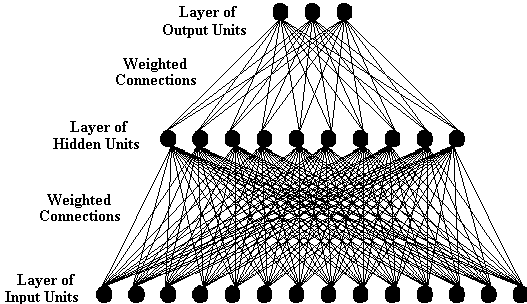
Since neural nets are designed to simulate the human nervous system, it readily lends itself to the idea that the "mind" is embodied, and thus in addition to providing a different modeling paradigm, connectionism can also provide a different theoretical paradigm for studying cognition. Over the years, connectionism and computationalism (or symbolism), as the traditional view is often called, have become largely integrated within mainstream cognitive science, though there are some connectionists who still treat the two paradigms as irreconcilable. Other challanges to computationalism have come from dynamic systems theory, which has been very successful in modeling some motor processes, though entirely unsuccessful at modeling higher order cognitive and perceptual processes; from perceptual symbol systems theory (and related "empiricist" theories of representation); and as Dr. Gibbs notes, from cognitive linguistics.
The foundation of cognitive linguistics is CMT, which argues that our concepts are structured (i.e., they get their form and some of their content) through metaphorical mappings to the representations of more concrete concepts. If you follow the train of metaphorical mappings all the way down, you eventually get to direct embodied experience. So at base, all concepts are grounded in embodied experience, either directly (through direct mappings to that experience, for highly concrete concepts) or indirectly, through mappings to more concrete concepts. A common example of a conceptual metaphor is "ARGUMENT is WAR." CMT argues that ARGUMENT is structured through a mapping to WAR, which allows arguments to have sides, winners, etc. Other examples include GOOD is UP, ANGER is a HEATED FLUID IN A CONTAINER, and NATION is a FAMILY. In each case, the first concept (often called the target, in the metaphor literature) is the abstract concept, and the second concept (often called the base or vehicle) is the more concrete, structuring concept.
Obviously, the focus on the embodied grounding of concepts is inconsistent with traditional functionalism and computationalism, and thus, inconsistent with much of the theoretical work in cognitive science over the last 50 years. I suppose this is a good candidate, then, for explaining why researchers have largely ignored CMT (and when they've paid attention, either dismissed it or argued vehemently for rejecting it) since Lakoff and Johnson first described CMT in Metaphors We Live By.
But I don't think it's the right explanation. For one, cognitive science has grown up a lot in the last 27 years. Connectionism forced computationalists to closely examine many of their assumptions, including their functionalism. I don't know any mainstream cognitive psychologists today who are the least bit wedded to the idea of a disembodied mind. To see this, one only has to look at the debate centering around the perceptual symbol systems theory I mentioned above. This theory, championed by Larry Barsalou (see the paper linked above), argued that concepts are represented perceptually (i.e., in the perceptual systems of the brain), rather than propositionally. Insiders will recognize that this is not a new position. One of the most heated debates in the history of cognitive science -- the great imagery debate -- took place in the 1970s between image-representation theorists and propositional-representation theorists (analogous to "amodal" representation theorists). The debate ended largely in a stalemate, with Zenon Pylyshyn, a member of the proposition camp, arguing convincingly that the two types of representations couldn't be distinguished empirically (that is, any data would be consistent with both). But Barsalou's work, and that he's inspired, has infused the debate with new energy, and though no data has yet been produced that is inconsistent with "amodal" representations, the focus on the perceptual aspects of representations has produced some interesting experimental results. So despite the fact that perceptual symbol systems theory, which requires an embodied mind, is inconsistent with traditional functionalism/computationalism, its productiveness has led researchers to seriously engage it. And in doing so, they've readily admitted that at least some of the content of representations has to be perceptual, and therefore embodied.
If researchers are willing to admit that concepts have perceptual (i.e., embodied) content in discussions of perceptual symbol systems theory, then it's difficult to explain the rejection of CMT as being a result of the rejection of theories that highlight the embodied aspects of cognition. Furthermore, in conversations about cognitive linguistics, I've heard over and over from metaphor and analogy researchers that they find the theory interesting, and believe that its major forms (CMT, blending, etc.) could benefit from what we've learned about analogical and metaphorical mappings in mainstream cognitive science, particularly what we've learned about the process of structural alignment. As far as I can tell, little if any work has been done by cognitive linguists to integrate their theories of concepts with research on analogical/metaphorical mapping, however.
So it seems that basic philosophical and theoretical differences is insufficient to explain the rejection of CMT in mainstream cognitive science. A better candidate might be methodological differences. CMT was inspired by linguistic evidence that people use words from one domain (e.g., the domain of WAR) to talk about other domains (e.g., the domain of ARGUMENT), and for most of its history, cognitive linguists have relied on this evidence to support CMT. The argument from linguistic evidence to a theory of concepts does require a theoretical commitment, namely that the words we use closely reflect the way we conceptualize things, and that's not a trivial commitment. However, I think most cognitive scientists would be willing to admit that there's some truth to it. There is even evidence from experimental research that the names we use to refer to concepts are privileged over other features of those concepts2. So the theoretical commitment is not a big problem. However, the methodology is. Arguments from linguistic data are notoriously circular, as Greg Murphy pointed out in his 1996 paper arguing against conceptual metaphor theory3. He wrote:
In [Metaphors We Live By], a cultural metaphor is identified on the basis of various idioms and collocations, such as I destroyed her argument; he lambasted me in class; she undermined my position. Then a metaphoric representation is proposed on the basis of these data, such as ARGUMENT IS WAR. What predictions or consequences are derived from this metaphoric representation? In [Metaphors We Live By], it is further idioms and collocations: He can't defend against that argument, etc. There is an absence of other psychological data given in support of this view. Lakoff (1993, pp. 205, 246) identifies five types of evidence for the metaphoric representation view: Four of them are linguistic) and one of them is psycholinguistic experiments. Notably, none of them provides a nonlinguistic measure of conceptual structure. Standard theories of concepts have had implications for findings in induction, problem-solving, object recognition, conceptual development and memory, among other areas. It would be useful to see evidence for metaphorical concepts from these domains, in order to escape the linguistic circularity. (p. 183-184)
And there's the problem. As I've previously noted, the only experimental work on issues like induction, problem-solving, etc. within CMT has been with temporal metaphors [UPDATE: Note that I'm qualifying my previous claim here. There is data from psycholinguistic experiments that is consistent with CMT, but none in the areas that Murphy mentions in the above quote.]. There, Lera Boroditsky and her colleagues have shown that when primed with a particular temporal schema, that schema can influence people's interpretations of temporal statements, which is a form of induction4. But that work is being challenged from several different directions, and even if in the end those results stand up, the use of a mapping between temporal concepts and spatial ones is hardly evidence for a general theory of all concepts. It could very well be that time is a unique conceptual domain.
There are other methodological issues as well. Boaz Keysar has shown that people have a hard time guessing the original meaning of conventional idioms like those used as evidence for CMT5. If people can't access the original meanings of those idioms, and when asked to interpret them, produce what amounts to guesses that differ depending on the context, then it's unlikely that either the linguistic data can provide a reliable source of evidence for CMT (because the idioms are opaque for CMT researchers too), and it's unlikely that in interpreting those idioms, people are using mappings between the domains in the idioms. Furthermore, research on conventional metaphors has shown that conventional metaphors (like the war metaphors used to talk about arguments) are in fact "dead" metaphors. That is, they no longer involve mappings between the concepts involved, but are instead individual lexical entries with their own meanings that are specific to the new domain (perhaps in the form of new categories formed during the mapping process)6. In a way, conventional metaphors involve polysemous senses of the original meaning of the words. Thus, finding that conventional metaphors are ubiquitous in everyday speech cannot provide evidence for CMT, because those metaphors may no longer involve the mappings that CMT requires. At least, linguistic can't distinguish between dead and "living" metaphors.
So there appear to be good methodological reasons for rejecting the evidence for CMT, and as the last few paragraphs suggest, there is actually empirical evidence from controlled experiments that argues against CMT. In fact, there's pretty strong experimental evidence that people are not using those mappings even when using Lakoff and Johnson's favorite CMT examples (e.g., ARGUMENT is WAR)7. And there's a lot of evidence for theories of concepts and categorization that don't involve on-line mappings from one domain to another. For a discussion of these theories, see the posts here, here, here, and here. Lakoff adopts a prototype view of concepts (see the third link in the previous sentence), but not one based on existing prototype models, or on data about how prototype-based concepts are processed. Suffice it to say, there's no evidence from concept research that prototype-based representations include, much less require, mappings between concepts. Of course, there are problems with prototype representations, too, and if prototype theory ultimately fails, it's not clear what would happen to CMT. But even if it's doesn't, empirical work designed to show how conceptual mappings affect prototype-based representations of concepts and their use are pretty much nonexistent.
My belief, then, is that CMT has been rejected not due to deep philosophical differences between cognitive linguists and mainstream cognitive scientists, but due to serious methodological issues in cognitive linguistics, and a fair amount of disconfirming evidnece (in the form of direct tests of CMT predictions, work on conventional metaphors, and the huge body of research on concepts and categories, none of which suggests conceptual mapping is involved). But I do think that deep philosophical differences are at play in the "metaphor wars" between cognitive linguists and the rest of cognitive science. Specifically, I believe that because Lakoff and Johnson started from the position that CMT required a second cognitive revolution, an anti-objectivist revolution in which all cognition is grounded in embodied experience, and because as a result, cognitive linguists have continued to feel that their theories are fundamentally incompatible with virtually all of the rest of cognitive science, cognitive linguists have been loathe to engage the rest of cognitive science seriously. As I said earlier in the post, I and others think that CMT and blending would benefit greatly from research on analogy. If these theories had a testable model of how mappings between conceptual domains are formed, interpreted, and used -- a model that structure mapping theory can provide -- it would be possible to make some concrete, experimentally testable predictions about things like inference, object recognition, etc. Furthermore, if cognitive linguists engaged data supporting other theories of concepts (exemplar theories, e.g.) and produced an experimentally testable model to compete with such theories, they would be able to test CMT in ways that the rest of cognitive science would not be able to ignore. And I can only think of two explanations for why they haven't done these things yet: either they can't come up with such models, or they are so committed to the perceived (but, as I've argued, not actual) deep philosophical differences underlying CMT and more mainstream theories of analogy and concepts, they believe that engaging those theories would be unproductive. Where people like Dr. Gibbs are concerned, I'm inclined to believe it's the latter, because he's clearly willing to engage people outside of cognitive linguistics. I'd just like to see a deeper engagement, involving the theoretical and empirical engagement of the wealth of data on metaphor, mapping, and concepts already existing, because that data and the theories it's produced don't require disembodied, dualistic (i.e. literal) theories of mind, and most of the researchers working with them aren't wedded to such theories. I know I'm not.
1Title taken from the book Dr. Gibbs is writing, which he mentions in his comment.
2See e.g., Yamauchi, T., & Markman, A.B. (2000). Inference using categories. Journal of Experimental Psychology: Learning, Memory, and Cognition, 26, 776-795; Gelman, S.A., & Heyman, G.D. (1999). Carrot-eaters and creature believers: The effects of lexicalization on children's inferences about social categories. Psychological Science, 10(6), 489-493.
3Murphy, G. 1996. On metaphorical representation. Cognition, 60, 173-204.
4For example, Boroditsky, L. (2000). Metaphoric Structuring: Understanding time through spatial metaphors. Cognition, 75(1), 1-28, & Boroditsky, L. (2001). Does language shape thought? English and Mandarin speakers' conceptions of time. Cognitive Psychology, 43(1), 1-22.
5 Keysar, K, & Bly, B. (1995). Intuitions of the transparency of idioms: Can one keep a secret by spilling the beans? Journal of Memory and Language, 34, 89-109.
6Bowdle, B., & Gentner, D. (2005). The career of metaphor. Psychological Review, 112(1), 193-216.
7See e.g., Keysar, B., Shen, Y., Glucksberg, S., & Horton, W. (2000). Conventional Language: How Metaphorical Is It? Journal of Memory and Language, 43, 576-593 & McGlone, M. S. (1996). Conceptual metaphors and figurative language interpretation: Food for thought? Journal of Memory and Language, 35, 544-565. I discussed the experiments in these two papers here.
- Log in to post comments
Chris, this is a really impressive piece of writing. I've been busy with my dissertation, so I haven't commented on your posts in a while, but it's thoughtful, honest ones like this that keep me coming back for more.
Todd, thanks, I appreciate the compliment. Good luck with your dissertation.
I'm not terribly familiar with cognitive linguistics (haven't touched it since a few graduate school courses), but doesn't it assume the existence of language, or at least most of the structural underpinnings of language?
If so, doesn't non-human cognition present a bit of a problem? Either you are saying that many animals - not limited to primate or even mammals - have most of the mechanisms of producing and understanding language but for some reason only humans have gone "all the way" in actually using these mecdhanisms for communication; or non-human/non-primate animals have a different set of mechanisms for dealing with representation, and somehow, for some reason, primates switched to a different representational system?
I have enjoyed these discussions, and look forward to the book from Dr. Gibbs. A couple of points. The ARGUMENT IS WAR metaphor is no longer a pet example of Lakoff and Johnson, as they now prefer to showcase "primary metaphors", where they can more easily point to a more embodied basis, such as GOOD IS UP. I think many in cognitive linguistics would now concede that you can explain ARGUMENT IS WAR with something like structure mapping theory, but primary metaphors such as GOOD IS UP are derived from correlations in early experience.
I wouldn't say the foundation of cognitive linguistics is CMT. Cognitive linguistics is hard to define, but it represents a number of shared assumptions, of which CMT is not one. You can be a fervent cognitive linguist without subscribing to CMT, for example, Langacker isn't big on CMT.
I agree with you for the reasons as to why CMT is not popular outside of cognitive linguistics and the social sciences. I think in addition a lot of its unpopularity stems from its presentation by Lakoff and Johnson. As the originators and most prominent proponents of the theory, and they are prone to making grandiose and excessively strong claims about the power and evidence for CMT. While this has helped them sell books, scientists don't like it. I do imagine Lakoff & Johnson are passionate believers in the theory, but they are not good at dealing with criticism or counter-evidence. They rarely, if ever, acknowledge alternative explanations, and tend to ignore criticism, and/or deal with their critics in an underhand manner, which I think partly motivates Chris's distrust of Lakoff (for a good example of both the overblown claims and their handling of criticism, see Johnson and Lakoff (2002)). I think this is a shame, as I think a dislike of the work of Lakoff and Johnson has meant that certain phenomena worthy of explanation, such as the widespread linguistic evidence of systematic polysemy that Dr. Gibbs mentions, has not had the attention it deserves in psychology.
As for why cognitive linguistics don't embrace ideas from psychology and cognitive sciences, I think its largely not ideological. Ray Gibbs is an exception, in that he is a psychologist, but cognitive linguists, by definition, are normally all linguists. As linguists, they are not often well versed in current work in cognitive psychology, or its methodologies. Cognitive linguistics had a good claim to the title "cognitive" back in the early eighties, when cognitive linguistic thinking was based on work in cognitive science (such as Rosch's work on categorisation), but cognitive linguistics as it developed into its own discipline with its own theories, has become isolated from the rest of cognitive sciences. However, there is a growing trend in cognitive linguistics to embrace empirical methods (with some conferences and books to this purpose), so hopefully we should see more contact between cognitive linguistics and psychology.
Shane, thanks. I had noticed that "ARGUMENT is WAR" is not a common example within CL anymore, but it is a very easy one to explain, so I like to use it. Nothing I said wouldn't apply to GOOD is UP, however. And if one of the more abstract concepts in our repertoire maps directly onto embodied experience (of UP, which, I might say, is kinda abstract in itself... when I lie on my side, the embodied experience of UP is quite different from what it is when I'm standing up), then CL has some major work to do in figuring out what the hell "mapping" is and how it works in an example like this. And I don't think calling it a "mesh" or a "blend," and drawing lines between circles or pictures, is going to help.
Also, when I say that CMT is the foundation of CL, I mean that in a couple ways. It was CL's first major theory, and it's still one of its major theories. What I've said here would also apply, however, to blending, though blending is less obviously committed to embodiment (to be honest, I'm not sure what the hell it is committed to).
Finally, I'll end with a description of a fun little experiment that didn't work. I decided at a party once that it would be fun to test the embodied aspects of conceptual metaphors directly. So I started looking at how being in different bodily states affected people's representations of the target concepts in various conceptual metaphors. In one, I tested the HAPPY is UP metaphor by having people approached while either on their way up or down an escalator and asked to rate their mood on a 5-point scale consisting of smiley faces (I called it a Smilekert scale, which is a bad joke I know). Unfortunately, we got nothin'.
Hey Chris,
Great post on why there's such a gulf between cognitive linguistics and the cog sci mainstream. Your point that L&J seem to want a second revolution in cognitive science is bourne out on every page of Philosophy in the Flesh. They make this point quite explicit. Readers usually leave the book fervent partisans or rather put off by the overheated rhetoric. It takes a while for someone in the latter camp (like me) to come back and acknowledge (as Dr. Gibbs very rightly pointed out) that there are some striking linguistic data out there to be accounted for.
Like Shane, I'm a little skeptical about saying CMT is the basis for CL. Where does Talmy's work on say force dynamics and verb+preposition semantics and typology fit in? It's certainly not all CMT.
Andrew, I definitely don't mean to imply that it's all CMT.
On the linguistic evidence. I suspect there's probably a pretty good explanation for this: analogies and metaphors, particularly those that involve structural/relational comparisons rather than merely surface ones, are very powerful. They're a great way to think and communicate about things. As a result, we use them all the time, and some are so successful that they get used a lot and end up becoming lexicalized.
And of course, there's a pretty straightforward way to test the two views. It wouldn't involve showing whether information from the base domain (e.g., UP or WAR) bleeds over into our representation of the target when we use lexicalized, or conventional metaphors/idioms. That we'd expect both from what we know about how word meanings are activated (e.g., Gernsbacher's work on suppression). But the simple transfer of features is a far cry from a metaphorical mapping, much less a structuring one. If that's what happens, then we would expect that using different conceptual metaphors would fundamentally alter the inferences people make about a concept, what people remember about particular instances of a concept (say, an instance described in one metaphor vs. another), and so on. And I don't just mean cross-cultural differences. If the co-activation, on-line(!), of the target and base concepts is what's going on, and that's what any non-trivial version of CMT posits (as opposed to the structuring being done once or over a few instances during learning, with the metaphorical terminology then being polysemous in subsequent uses), then we'd expect the use of different metaphors not only to produce different interpretations of sentences (that's what we'd expect from priming different associated concepts, literal or metaphorical), but to produce differences in classification, categorical induction, memory, and even object recognition (as Murphy notes). And there is absolutely no evidence that anything like that occurs.
I'll give a concrete example. We know that activating different schemas, frames, or perspectives, produces different recall and recognition memory (the old Anderson and Pichert experiment, for example). If I give people a story about, say, an angry individual, with anger described using either the HEATED FLUID IN A CONTAINER metaphor or the HEAT metaphor ("he's on fire," "he gave a fiery speech," and so on), then presumably people would activate different ANGER schemas (different structures for the concept), and if the story is constructed right (so that the differences in the two structures are reflected in the content of the story), we'd expect people to remember different information about the story (at least the parts related to the angry individual). It's a simple experiment, but I don't think anyone's attempted it. And I don't think they'd find a damn thing if they did.
And another. Take two conceptual metaphors for the same concept (e.g., LOVE is WAR and LOVE is a JOURNEY), and prime one with, say, sentences using familiar idioms associated with one of the two metaphors. Then give people a situation involving love, and ask them to make inferences about it. "John loves Mary. Mary has done X. What will John do?" Presumably, they would produce broadly different inferences, depending on the metaphor. If love is a war, John's next action should be consistent with love as a conflict (e.g., if Mary was flirting with another man, then John will flirt with another woman, as his return salvo in the war of love), whereas if love is a journey, then John should take some step forward in the relationship (say, telling Mary that he wants to be exclusive). Again, I've seen nothing like this, but it's a simple experiment, and if you get the results CMT predicts, it'd be difficult to ignore. I don't think you'd get anything like those results, though.
Oh, I very much agree that there's little evidence that base concepts actually structure the targets.
(And the lack of much of a processing theory to go along with L&J's representational theory makes predicting results a little hard... I've never understood what the online processing implications of metaphorical "structuring" were supposed to be. I seem to recall Boroditsky broadly laying out the landscape of possible processing theories in her one of her introductions.)
All of which to say that I agree you don't need CMT to explain the linguistic "evidence". However, you might need to go further than merely saying that metaphors and analogies are powerful, since it's the regular use of particular source/target pairs that L&J always point to, along with the ability to form novel metaphorical expressions. Again, though, this needn't require anything as drastic as CMT.
Chris and others:
Thanks so much for all your thoughtful comments on CMT and cognitive science. I can�t help but offer a few other brief observations.
First, I agree with practically everyone that part of the difficulty with CMT is the occasional over-inflated prose of Lakoff and Johnson and others (and this may in some cases include me). I know of many people in cognitive psychology, especially, who voice negative reactions to the ideas of cognitive linguistics exactly because of these sorts of rhetorical issues.
At the same time, even though one can also find folks within cognitive linguistics who have similar reactions, you have to at least give credit where credit is due by acknowledging the incredible impact that Lakoff and Johnson have had on the study of metaphor (and polsemy, gesture, text comprehension etc). I travel extensively in interdisciplinary metaphor circles and can honestly say that there are literally thousands of scholars and students whose interests in metaphor, and whose guiding beliefs about metaphor, was sparked by the work of Lakoff and Johnson. CMT is by far and away the most dominant theory of metaphor out there today, at least in the sense that it offers a working framework for doing metaphor analyses that scholars from many disciplines have embraced. To give just one example, last month I gave a keynote address in China at their 5th annual cognitive linguistics meetings, and of the 350 participants, I�d estimate that at least 200 of them had talks that directly cited Lakoff and Johnson. Cognitive linguistics associations are springing up all over Europe, Asia and South America, and include people who are doing applied linguistics, literary studies, cultural studies, and so on. I have given a week-long series of lectures on CMT and related issues in Brazil to 150 people, 150 in Tunisia, 100 in Japan, and many European venues. There is the professional society called �Research and Applying Metaphor� or RAAM, based in the UK, that has held bi-annual meetings over the past 12 years, with around 150 participants, where CMT is one of the central focus of study and debate. The International Cognitive Linguistics Association meetings every two years has around 1000 attendees, many of whom are interested in all things Lakoffian (not always uncritically).
I cite these numbers not to argue that �CMT wins� because of popularity, but to drive home the important point, often lost to more traditional cognitive scientists, that CMT is very influential and generative of some really terrific research in many fields of study. And so Lakoff and Johnson�s prose, despite its problems, has changed the face of metaphor studies at the very least. None of this is likely to impress those who are turned off by the overblown prose, or believe that the intellectual center of the world is the Psychonomic Society or Cognitive Science meetings (both forums I have been to and talked at on many occasions). But from where I sit, with a hand in many fields of scholarship, studying CMT has been a powerful intellectual experience, and has really shaped metaphor scholarship around the world.
I think Chris is right when he states that part of the problem with CMT is methodological and not just philosophical. But we should not ignore the enduring problems with embodied perspectives on cognition, despite Chris�s view that few would argue with this belief. Believe me when I say that many do have deep issues with embodied cognition, and voice these concerns throughout the cognitive science literature. To give one example, I recently gave a talk on embodied metaphor understanding at a highly respected university with many great cognitive psychologists, and these folks clearly had difficulties with embodied cognition. One metaphor scholar there argued that her/his problem with embodiment and metaphor is that the source domains of metaphor are not embodied, but just things people are familiar with. But isn�t our bodily experiences, especially recurring ones, things we are perhaps most familiar with? I replied. And thus the stalemate. Thus, philosophical beliefs about the embodied grounding of language and thought are still central to disagreements in the metaphor wars.
Chris also cites work by Keysar and Bly (1995) and Keysar et al. (2000) which is claimed to be empirical evidence against CMT. For what it is worth, please see my chapter in the Katz et al. 1999 book for a counterexplanation of why Keysar and Bly (1995) have little to do with metaphor. Also see a wonderful book by Alice Deignan titled �Metaphor in corpus linguistics� for a corpora analysis of the Keysar et al (2000) stimuli which suggest that these are not at all representative of normal metaphor patterns in language (and indeed some of their stimuli may not convey the novel metaphorical meanings in the way they assumed).
Related to this is another HUGE yet hidden factor in the metaphor wars. Many traditional metaphor scholars, like the vast majority in experimental psycholinguistics, study metaphor expressions of the �A is B� form, such as �Lawyers are sharks� and �My love is a red, red, rose.� These metaphorical forms are historically of greatest interest because they reflect novel, creative ideas, which is exactly what people have always believed to be the reason for metaphorical language. It is interesting to note that some corpus studies show that only 5% of all metaphors are of the �A is B� form, so all the effort to studying how these are understood is vastly skewed compared to the vast number of metaphorical words and phrase that have implicit source domains such as �We hit a dead-end street� in reference to one�s marriage. Cognitive linguistic studies mostly focus on these more conventional forms of metaphor precisely because they are so prevalent and indicative, in their view, of enduring metaphorical thought. In any event, one problem for the lack of communication in the metaphor wars, and why both fans and critics of CMT tend to not acknowledge the other�s work, is that they are focusing on different aspects of metaphoric language!
I also agree, nonetheless, with Chris when he says that CMT would do well to look more closely at theories such as �structure mapping� because some of its tenets are consistent with those of CMT, with theories like structure mapping perhaps being able to offer more precision in regard to mapping mechanisms etc.
In general, people from all points of view on metaphor need to read each other�s work and take it seriously.
Finally, Chris in his most recent post suggests the need for empirical studies that look at the different inference patterns that may arise when people read different conceptual metaphors for the same target or topic (e.g., LOVE IS A JOURNEY and LOVE IS WAR). I think that some of my published writing have already done just what Chris suggests, in some ways at least. Please see Nayak & Gibbs (1990), Gibbs (1992) and Gibbs et al. (1997) for different examples related to these using different methods. Thus, it is my contention that such work exists already!
Cheers!
Ray
"The foundation of cognitive linguistics is CMT"
Chris, if the above were true, your antipathy would be warranted. However, CMT as put forward by L&J is but one small part of the "cognitive linguistics enterprise" (as Vyvyan Evans calls it). I recommend reading his "overview" as a way to form to a more balanced perspective concerning the field's intellectual history. Certainly, Lakoff's work was very influential. However I don't think cognitive linguisitics would crumble if particular claims made by CMT prove to be empirically false.
http://www.vyvevans.net/CLoverview.pdf
You (an apparently anonymous blog author using a real name) mention two people who argued against conceptual metaphor theory and imply that all of cognitive science has rejected it. What is the relevance, anyway, since conceptual metaphor is about linguistics, not general cognition, although it does rely on an embodied view of cognitive processes. And the embodied cognition viewpoint has not been rejected by cognitive science by a long shot.
There is a huge body of experimental and theoretical writings out there in support of the embodied view of cognition that I don't think you are aware of. Do a search on perception & action & imagery, for example (Bernhard Hommel, Wolfgang Prinz, Jean Decety, and others).
Look at the research on the effects of action and embodiment in cognitive processes such as analogy (Craig, Nerssessian, Catrambone 2006 article for example in Memory & Cognition), reading comprehension and memory (work by Arthur Glenberg), learning and math understanding (Susan Goldin-Meadow and educational researchers such as David Tall, Ricardo Nemirovsky), gestures and communication, etc. There are about plenty of other theoretical/philosophical authors out there as well although you seem to be focused solely on Lakoff & Johnson, who, again, argued for a theory about linguistics, not cognition, and they mainly targeted Chomsky & the straw man argument against those who believe cognition is completely symbolic, amodal, and disembodied.
You seem to have a very traditional view of the nature of science and how experimental research and cognitive theory development should be done (you might read any philosophy of science book published in the past 50 years, try Kuhn for example), compounded by the vitriol and irrationality in your anonymous blog posts. That's unfortunate because I think there is a positive point buried in all this somewhere. I think that people who like the ideas presented by Lakoff & Johnson or by research in embodied cognition should not view it simply as a rejection or repudiation of all cognitive research that went before it. That mistake has been made too many times. Cognitive science threw out the baby (motor action) with the bath water (behaviorism) before as well, which is why we are here now. I think we would be well served by experiments or literature reviews that re-visit some (still valid) cognitive findings from an embodied/situated point of view, such as for example the science misconceptions literature (McCloskey), contrasting cases, bridging analogies (Clement), ontological pre-training (Chi)...those are just some of the more educationally relevant ones that come to my mind first.
"If so, doesn't non-human cognition present a bit of a problem? Either you are saying that many animals - not limited to primate or even mammals - have most of the mechanisms of producing and understanding language but for some reason only humans have gone "all the way" in actually using these mecdhanisms for communication;"
Janne you might want to check out the work by Duane and Sue Savage-Rumbaugh. They do say what you said. Bonobos, for example, can use language like we can when give some technological help (a symbol board to vocalize the words). If their vocal chords and vocal chord control were better developed, they might have been able to talk just like we do.
Holton, up front, Dr. Gibbs knows who I am, so I'm not anonymous to everyone here.
Now, I did only mention two sets of researchers (Keysar and McGlone didn't write alone), plus Murphy, because his paper is widely cited, but I mentioned them as representative, not as the only exemplars. If you'd like, I can provide you with more references, but more importantly, I could point you to pretty much any list of references on concepts and categories outside of cognitive linguistics, and you'd be unlikely to find any references to Lakoff and Johnson on them, or even in the references within the papers on those lists. That, to me, says that it's been rejected or ignored, but you could have a different set of criteria for applying those two words.
Also, as I'm sure Dr. Gibbs would agree, Lakoff and Johnson, and CMT independent of them, is not simply a theory in linguistics. It's touted as a theory of cognition, and it is specificially a theory of concepts (at least some concepts, depending on how strong you take its claims to be) and knowledge representation, which automatically makes it more general(concepts are mental entities that may or may not be separable from language, but are not identical with it).
I should point out that if the list of papers on concepts contains work by Larry Barsalou or one of his students, it might contain a couple papers that include in their references papers/books by Lakoff and Johnson, because Barsalou considers PSS theory as compatible, and at least of a kindred spirit, with CMT. However, PSS is, much like blending, little more than a promisory note at this point, and to date, has yet to produce an empirical result that would distinguish it from "amodal" symbol systems theories. So if the only related/inspired theory in the study of concepts within cognitive psychology (outside of the CL tradition) is PSS, then CMT isn't doin' so well.