


Some unfortunate, but probably unsurprising news today - Peter and I have decided that we will no longer be publishing Obesity Panacea on Scienceblogs. Future posts will be found on our new site at http://blogs.plos.org/obesitypancea. We have come to this decision for a number of reasons, but the recent PepsiCo advertorial played the largest part.
For a full explanation of our decision, click here.
The RSS feed has been updated, so subscribing to our feed here on Scienceblogs will still bring you all of the content at our new home. If you experience any problems with…
As our regular readers will recall, my partner, Marina, and I are travelling for the summer throughout South America as a means to celebrate the successful defense of both of our PhDs (Read about our travel adventures and reflections here).
I know things are hitting the fan at SciBlogs with the whole PepsiCo sponsored blog fiasco. I only superficially understand the ensuing controversy.
Alas, I have VERY limited internet access available, and thus would prefer to discuss another issue which I have noticed while moving through Bolivia for the past 2 weeks.
I've previously discussed the…
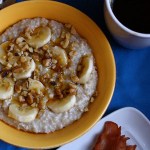
Image by thebittenword.com
Last year I posted results from a study which suggest that having a breakfast high in fibre may be more satiating for a smaller number of calories, and thus may be one important way to help manage hunger and thus caloric intake. Today I came across another new study which suggests that a breakfast high in fibre and with a low glycemic index (the degree to which an ingested food causes a spike in blood glucose levels) may enhance fat oxidation during a subsequent bout of exercise.
In this small study published in the Journal of Nutrition, 8 young and sedentary…
Regular readers of the Scienceblogs network will know that a new "advertorial" blog run by Pepsi has just been opened up on the network. Since then, we've lost at least 2 of my favourite bloggers (here and here). I'm actually on a self-imposed blog break at the moment (the posts this week were scheduled a while back), so I haven't had a chance to check out the new Pepsi blog, or decide how I feel about it, or at least how to present my thoughts in a coherent blog post. So I would suggest that anyone interested in the issue check out the Pepsi Blog here, and read PalMDs…
Today we have Scibling Showdown # 2 - the pros and cons of grad school. This episode includes Jason Goldman of the Thoughtful Animal, Christie Wilcox of Observations of a Nerd and Scicurious of Neurotopia. We talk about how we chose our current labs, things we wish we had known before we started grad school, and where we plan to end up (spoiler: none of us have any idea!).
We also discuss how blogging plays into the graduate school experience, and here it sounds like we've all had overwhelmingly positive experiences. I think any student will admit that grad school is…

Happy Canada Day! It looks like a pretty nice day here in the capital as well as the rest of the country - a great chance to get in some physical activity with your friends and family! Enjoy the long weekend!
Travis
When many people set out to exercise, they do so with the primary goal of losing fat mass. There is much advice floating around about how to optimize or maximize fat loss during exercise; one of the most commonly touted is that of the fat burning zone. Essentially, it is suggested that when performing aerobic exercise (walking, jogging, swimming, etc.) one should work at a fairly low intensity - the fat burning zone - to augment fat oxidation and thus fat loss (pictured above). The fat burning zone target exercise intensity varies from source to source but is approximately 50-60% of your…

Image by shanevaughn
Today is the first day of summer vacation here in Ontario, and I assume that the summer break has begun in most other parts of North America as well. That means that millions of kids are looking at 8 gloriously school-free weeks in July and August. Now while physical activity promotion folks like myself would hope that all of these kids are going to spend their summer outside being physically active, there is plenty of evidence to suggest that that is not the case for most kids.
Since these are kids, parents obviously have a huge amount of control over…
By now, readers of Obesity Panacea have hopefully learned that excess weight is not directly predictive of health risk, and that excess fat mass is not in itself unhealthy. Recall that approximately 30% of individuals who are classified as obese by their body weight turn out to be metabolically healthy, and in fact seem not to get much metabolic benefit (or may even get worse) when they lose weight. Also consider that individuals who have NO fat tissue (e.g. lipodystrophy) have extremely elevated metabolic risk factors, meanwhile others who can apparently indefinitely grow more fat mass (…
As our regular readers will recall, my partner, Marina, and I are travelling for the summer throughout South America as a means to celebrate the successful defense of both of our PhDs (Read about our travel adventures).
Many people often take holidays to relax and unwind from the stresses of their daily life. Unfortunately, this can result in a week or two of poor if not excessive eating and drinking and little physical activity - not the best way to recharge one's battery. As part of our South American adventure, we've tried to add as much physical activity into our travels as possible.…
Image by thienzieyung
Most people know that consuming too much fat, and especially saturated fat, is bad for your health. That's why there has been a concerted push for several decades to get people to reduce the amount of saturated fat that they consume, and to replace it with complex carbohydrates. Now unfortunately people often misinterpret that to mean that fat is evil, but carbs are ok. This is problematic since consuming too many simple carbs is also likely to increase the risk of obesity, diabetes, and cardiovascular disease - exactly what we are trying to prevent in the…
Image by love janine.
Although this may surprise some of our readers, I really like junk food. I eat far too much pizza, I love chicken wings, and Nutella, the original chocolate hazelnut spread, is one of my favourite breakfast condiments (it's tasty on a bagel, but its unbeatable inside a fresh crepe with whipped cream and bananas). The interesting thing about Nutella is that its commercials seem to suggest that it is some sort of health food. For example, check out the French Nutella commercial below (for our email subscribers, click on the title of today's post to view the video…
While we regularly post lengthy discussions on Obesity Panacea, there are many research updates, news stories, videos, etc. in the field of obesity, physical activity and nutrition that we come across on a daily basis that never grace the pages of the blog. Most of these mini-stories we share with our followers on Twitter, and we encourage those of you with active Twitter accounts to communicate with us there to get real-time updates of all the stuff we are discussing (Follow Peter and/or Follow Travis). For those of you who shy away from Twitter, enjoy below the best mini-stories that we…
Image by pugetsoundphotowalks.
Apologies in advance for a very Warning - a proudly Canada-centric post today. First, a bit of background - we Canadians pay two kinds of sales tax. The goods and services tax (5%) which is consistent across Canada, in addition to provincial sales taxes that varies from location to location (with the exception of Alberta, which has no provincial sales tax at all). If I understand it correctly, neither the PST nor GST applies to all purchases (for example basic groceries are exempt from both, while in Ontario gym fees are exempt only from the PST).…

Regular readers know that that Peter and I do a semi-regular podcast on obesity-related issues. This week, I have a discussion with psychology researcher (and fellow ScienceBlogger) Jason Goldman (UPDATE: Jason's thoughts on the podcast here). For the uninitiated, self-report data refers to information that people provide themselves - questionnaires and interviews are very common examples. This is in contrast to direct measurement, which is exactly what it sounds like - researchers measuring your height and weight themselves, etc. The podcast was inspired by a recent…
While we regularly post lengthy discussions on Obesity Panacea, there are many research updates, news stories, videos, etc. in the field of obesity, physical activity and nutrition that we come across on a daily basis that never grace the pages of the blog. Most of these mini-stories we share with our followers on Twitter, and we encourage those of you with active Twitter accounts to communicate with us there to get real-time updates of all the stuff we are discussing (Follow Peter and/or Follow Travis). For those of you who shy away from Twitter, enjoy below the best mini-stories that we…
As our regular readers will recall, my partner, Marina, and I are travelling for the summer throughout South America as a means to celebrate the successful defense of both of our PhDs (Read about our travel adventures). Last week I discussed the dietary habits on the Galapagos islands.
This week I will discuss my experience at a local indigenous food market in Latacunga, Ecuador - a town a couple hours south of Quito.
Sitting on a filthy butcher's table with legs spread open, a toddler drinks fresh cow blood out of a plastic cup. Our eyes meet, as he finishes a gulp, and his face breaks into…
Most weekends on Obesity Panacea we post our favourite obesity and fitness related news, stories and videos. This week I am only linking to one thing, because it is incredibly important and I'd really like everyone to check it out. The final version of Toronto Charter for Physical Activity is now online. I discussed the Charter in detail a few weeks ago, and it has also been discussed by Speaking of Medicine.
Essentially, the Charter aims to convince world leaders of the important role that physical activity plays in physical, mental, social, environmental, and economic well-…
One of the most interesting things about exercise is that it results in important health improvements even in the absence of weight loss. For example, just a single session of exercise can result in improved insulin sensitivity, increased levels of HDL cholesterol (aka the "good" cholesterol) and reductions in plasma triglyceride levels - all tremendously important markers of disease risk. In addition to these metabolic changes, new research by our friend and former labmate Lance Davidson suggests once-again that exercise can also prevent the accumulation of abdominal fat,…

In June of last year, I discussed the results of a large epidemiological study in women that showed that women with larger breasts have an increased risk of developing type-2 diabetes.
As soon as Travis and I read this study, we knew we had to do a follow-up study of our own to see if this finding was simply spurious or if there was actually something to large breasts that indicated health risk - beyond that explained by obesity per se.
The project that Travis and I began over a year ago has culminated in both a hot-off-the-press publication in the journal Obesity, as well as my…