

 Most animals reproduce sexually. This means that every individual has to find another individual to mate with - and they have to convince that other that they're worthy of the privilege. More often than not when it comes to picking that special someone, it's the girls that get to be choosy. Females spend a lot more energy per offspring than males from the get-go due to the size of our eggs (let alone most child rearing responsibilities), so as a gender, females want to make sure they don't waste their efforts. To ensure top notch kids, females choose the best male they can find. It's no wonder that male animals have all kinds of ways of advertising that they're #1 - from showy feathers to intricate dances or even deadly fights.
Of course, it's not like the decision is final. In humans, we know all too well that even after commitments are made, women compare their man to other guys. They feel proud when he proves himself to be the best, and disappointed (or worse, pick a new man) when he falls short of his peers. But what about animals? Do animals feel the pang of regret when they realize they could have done better? Or satisfied with themselves when they've chosen the best of the bunch?
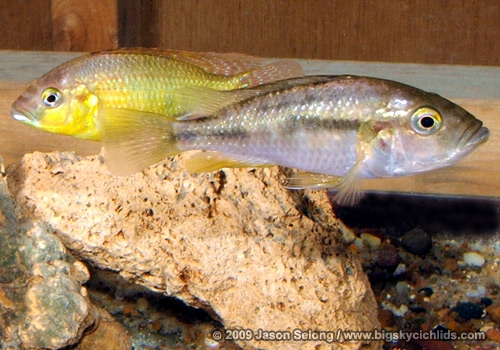 They do, according to new research coming out of the Department of Biology at Stanford University. Scientists had ready-to-mate female African cichlid fish (Astatotilapia burtoni) pick a mate from two potential male suitors. Once she'd made her decision, they had her watch fights between the two: sometimes her man would win, other times, he would lose.
Since we can't ask a fish how she's feeling, what the scientists wanted to know was how her brain reacted to each scenario. Certain regions of the vertebrate brain, collectively called the Social Brain Network (SBN), have been shown to have higher activity in response to social information.  . The lateral septum, for example, becomes more active when animals are anxious, nervous or upset, while other areas, like the preoptic area, fire in response to reproductive stimuli. Since we don't have MRI machines for small fish, the researchers instead looked at the expression of immediate early genes (precursors to signaling cascades and other genes which turn on when neurons are activated) as a proxy for brain activity in different areas of the SBN.
The results were dramatic. When a female fish watched the man she chose lose, the lateral septum saw large increases in expression. Meanwhile, when she saw him win, other areas fired just as strongly.
These results strongly suggest that just seeing social interactions between males can alter gene expression in a female's brain, affecting how she feels. While these results aren't shocking when we consider that picking the right mate is very important evolutionarily and thus reacting to information about mate quality would be highly advantageous, this study is one of only a handful to show that animal's brains directly respond to social information at a genetic level. This kind of information may help scientists understand how the brain processes social information, even in very distantly related animals like ourselves.
Citation: Desjardins, J., Klausner, J., & Fernald, R. (2010). Female genomic response to mate information Proceedings of the National Academy of Sciences, 107 (49), 21176-21180 DOI: 10.1073/pnas.1010442107
It's a fascinating study and a good write-up, though I'd be wary of suggesting that the fish *feels* anything. There is a difference in the expression of this or that gene, in this or that region of the brain, and then those differential gene expressions may turn out to be related to this or that overt behavior or emotion.
But feeling is something different from behaving in a way that we might think is concordant with a given feeling.
And feeling is different from emotion, for that matter. (e.g. angry behavior need not require the *feeling* of anger, which requires conscious awareness)
Those altered gene expressions in a female cichlid's brain, affecting how she 'feels' (which I take to mean 'affects how she experiences her environment'), sound to me like evidence that 'self-awareness' is a very deeply rooted characteristic. The more that we learn about how animals experience the world the less 'different' human consciousness seems. We have elaborated a lot on the basics that we share with others....but we apparently do share the basics of self-awareness with a lot of creatures.....
I get what you're saying, Jason, but I'd argue that the expression of these genes - which are linked to increases in certain pathways and neural activity - is feeling. It may not be an emotion, in a human sense of the word, but all sensations (pain, etc) are, technically speaking, caused by neural activity and the release of various neurotransmitters. So if there are changes in neural activity (which is what this differential gene expression suggests), then they are 'feeling' something - exactly what, however, can be debated :)
Ah, well, the thing you refer to as "increases in certain pathways and neural activity" I (and some other psychologists) would call "emotions," while feelings are emotions made conscious.
So I think we're saying the same thing, but have slightly different jargon for it :-)
Silly psychologists! Don't you know you're supposed to use MY jargon? After all, MY jargon is the best :)
Well, at least we come by it honestly, then.
Oh this is fascinating--and I enjoyed the comments too. The distinction between feeling and emotion is an interesting one.
From http://www.consciousentities.com/damasio.htm
"according to Damasio, consciousness, selfhood, and the emotions all spring ultimately from a single source: awareness of the current state of the body. The way they develop is complex, but this shared underlying focus neatly clarifies the relationship between them and ensures a close integration all the way up'.
All the way up from fish to human! (No surprise to the bacteria.)
I have a question about the interpretation because of the time lag. What was the time lag between the stimulus and the assay for immediate early gene expression? The full regulatory cascade would take even longer. Then there has to be the translation of the genes and finally the morphological changes.
Damasio likes to stress that emotions are a rapid response, before we have time to think. If there was an emotional response in the fish, this assay would show the effect of the response, not the cause of the emotions. It could just be something involved in the formation of an unconscious memory in response to the stimulus. I don't think it says anything about emotions.
How do you think this helps illustrate whether fish feel pain? I am a sport fisherman (all fish released) and am interested in whether fish feel pain as it would strongly affect whether I continue fishing.
I tend to think that fish do feel pain because of the way they react to being hooked.