



After nearly a year on the road I'm pleased to announce that The Primate Diaries now has a permanent home at the new Scientific American blog network. I would like to thank everyone who supported my work here and during my "exile." I look forward to the continuing conversation at my new home.
Please update your readers and blogrolls with the following links:
URL: http://blogs.scientificamerican.com/primate-diaries
RSS: http://rss.sciam.com/primate-diaries/feed
Thanks to support from readers and fellow bloggers I'm pleased to say that The Primate Diaries has taken the show on tour. You can update your RSS feed here or follow the #PDEx hashtag on Twitter.

Three years ago I didn't even know what science blogging was. Frustrated as a freelance writer, I typed "science blog" into my search engine and was thrilled when this network showed up first on the list. Here was a community of researchers and writers whose love of learning and the sharing of knowledge was communicated on a daily (and sometimes hourly) basis. After spending much of the day reading through posts by GrrlScientist, PZ, Bora, Carl, Chris and Sheril as well as John and Afarensis I was hooked. I made a decision right then and there that I would write for ScienceBlogs. I…
In what was probably the worst idea since Crystal Pepsi, the corporate sponsored advertiblog has met an early and decisive end. The announcement was made this morning:
We have removed Food Frontiers from SB.
We apologize for what some of you viewed as a violation of your immense trust in ScienceBlogs. Although we (and many of you) believe strongly in the need to engage industry in pursuit of science-driven social change, this was clearly not the right way.
My hat's off to all the writer's at ScienceBlogs who put their principles ahead of their page hits. I guarantee you, however, that this…
I'll be taking a break from blogging for the time being because I said I would. Follow me on twitter or facebook to keep tabs on what I'm up to.
For more on this see here, here, and related issues here. But I'm sure everything is different now.

At ScienceBlogs we value our independence. Just consider the recent posts over the laughable PepsiCo nutrition blog to see how seriously people take this. But one thing that would never happen is for anything we write to be edited without our consent.
As I wrote yesterday, I am disappointed in the Huffington Post's decision to grant a public stage to David Klinghoffer, Senior Fellow at the intelligent design "think tank" known as the Discovery Institute. DI is a self-avowed propaganda vehicle seeking to "wedge" religion into public schools. Once HuffPo handed him the megaphone…
My response to David Klinghoffer's piece in the Huffington Post has just been published:
Creationists are fond of laying the blame for Nazi eugenics on Charles Darwin. They insist that his materialist argument that humans evolved from animals and his conception of natural selection inspired the Nazis to implement a widespread policy of artificial selection within the Fatherland. However, these claims are as baseless as was the so-called "science" that the Nazis employed.
The latest example of this ignorance disguised as revelation was recently published on The Huffington Post by a Senior…

Image: via PZ Myers
PZ Myers has a new post condemning Discovery Institute ideologue David Klinghoffer's recent post connecting Darwin to the eugenic policies of Hitler. He trots out some of the same points that have been refuted time and again.
Darwin elaborated a picture of how the world works, how creatures war with each other for survival thus selecting out the fittest specimens and advancing the species. In this portrait of animal life, man is no exception. Any animal that strives to preserve the weak, as man does, is committing racial suicide. "Thus the weak members of civilized…

The latest issue of the journal Science has an essay by Greg Miller looking at the explosion of research into epigenetics and what this work could suggest about human society.
In 2004, Szyf and Meaney published a paper in Nature Neuroscience that helped launch the behavioral epigenetics revolution. It remains one of the most cited papers that journal has ever published. The paper built on more than a decade of research in Meaney's lab on rodent mothering styles.
Rat moms vary naturally in their nurturing tendencies. Some lick and groom their pups extensively and arch their backs to make it…

As I highlighted in my previous post, evolution works on zombies just like any other organism, the main difference is that they reproduce like cells rather than like animals. Darwin's discovery that zombies pass on hereditary material in their bites, and that this has resulted in natural selection, helps to explain the diversity of zombies now before us. Below are a few of the main strategies that an evolutionary understanding can bring to counter the marauding hordes of decomposing evil that now threaten to overwhelm us.
#1 - Don't get bitten. Okay, this is a no-brainer (pun intended).…

Credit: Revenant Magazine
The origin of zombies (Genus: Zumbi) is well understood today, but this wasn't the case when they were first discovered in the early 1800s. Charles Darwin was the first to recognize that zombie "reproduction" results in a process of descent with modification in a way analogous to that of non-undead species. Darwin's insight was that, even though zombie's don't reproduce sexually, random mutations in hereditary material can be passed along after a zombie bite. Each "daughter zombie" then inherits the traits of their parent and pass those traits along to their…

Author's Note: The following is an excerpt from my review of Sex At Dawn: The Prehistoric Origins of Modern Sexuality. For additional information see my posts Reexamining Ardipithecus ramidus in Light of Human Origins, Those Cheating Testicles, or Who's Your Baby? as well as Helen's Lament and the Origins of Forbidden Love. Christopher Ryan also blogs at Psychology Today.
When we think of the first swinger parties most of us imagine 1970s counter-culture, we don't picture Top Gun fighter pilots in World War II. Yet, according to researchers Joan and Dwight Dixon, it was on military bases…
Thanks to Greg Laden for the anniversary wishes. One year ago today I wrote my first post here at ScienceBlogs (technically, my first post was yesterday, but that was posting the live twitter transcript of my son's birth). I would like to thank everyone at Sb (bloggers, administrators, and commenters alike) for their support as well as for their arguments. Without the feedback I'm certain I wouldn't have been challenged to interrogate my own assumptions and produce the best analysis that I could.
I haven't had the opportunity to write as often as I would like the last few weeks since I'm…

When most people think of evolutionary biology the first thing that comes to mind probably isn't lyrical poetry. However one of the earliest proponents of evolution, none other than Charles Darwin's grandfather Erasmus, presented his vision for the origin of life in the form of an epic poem in 1803. In his critically acclaimed work The Temple of Nature Darwin mused on the natural history of human beings:
Imperious man, who rules the bestial crowd,
Of language, reason, and reflection proud,
With brow erect who scorns this earthly sod,
And styles himself the image of his God;
Arose from…

Chimpanzees have culture (or not) depending on your definition.Image: Irish Wildcat / Creative Commons
Author's Note: The following is an expansion on my reply to anthropologist Dan Sperber on the PLoS ONE article "Prestige Affects Cultural Learning in Chimpanzees."
Culture is like art or pornography, it's hard for people to define but everyone knows it when they see it. Cultural anthropologists have long struggled to develop a consistent definition of the very thing that they study, a problem that has resulted in bitter arguments between scholars that, to an outsider, may seem as esoteric…

(updated below)The Quark Award is now down to the last few days for general voting. One of the top twenty posts that you vote for will then go to Richard Dawkins to judge as the best science post of the year. My piece Chimpanzees Prefer Fair Play to Reaping an Unjust Reward has been nominated as have posts by my friends Ed Yong, Zinjanthropus, Razib, David Dobbs, Scicurious, Carl Zimmer, Christie Wilcox, PZ, Christina Agapakis, and Jason Goldman among many more.
Please click on this link and cast your vote. Today and Monday are the last days to vote and the top selections will be posted on…
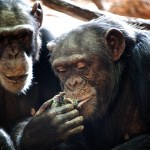
New research finds chimpanzees follow prestigious models when learning new tasks. Monika Thorpe / Creative CommonsIf one were to play psychiatrist to the natural world, most human beings would be committed for our certifiable obsession with other peoples' behavior. We compulsively examine, study, appraise, size up, and scope out what those around us are doing and then gossip with others about what we've seen or heard. New ideas or behaviors are especially compelling and will often have cultural critics…
Author's Note: This post was selected as the topic for the ResearchBlogCast as part of ResearchBlogging.org. Listen to the discussion here.
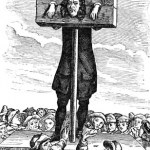
Could punishing bad behavior be the origin of human cooperation?Humans are one of the most cooperative species on the planet. Our ability to coordinate behavior and work collaboratively with others has allowed us to create the natural world's largest and most densely populated societies, outside of deep sea microbial mats and a few…

A new study shows that chimps sacrifice their own advantage if they earned it unfairly.Image: Owen Booth / Creative Commons
Fairness is the basis of the social contract. As citizens we expect that when we contribute our fair share we should receive our just reward. When social benefits are handed out unequally or when prior agreements are not honored it represents a breach of trust. Based on this, Americans were justifiably outraged when, not just one, but two administrations bailed out the wealthiest institutions in the country while tens of thousands of homeowners (many of whom were…

(Source)
But which one should be diagnosed?
Diagnostic criteria for 313.81 Oppositional Defiant Disorder
A. A pattern of negativistic, hostile, and defiant behavior lasting at least 6 months, during which four (or more) of the following are present:
(1) often loses temper
(2) often argues with adults
(3) often actively defies or refuses to comply with adults' requests or rules
(4) often deliberately annoys people
(5) often blames others for his or her mistakes or misbehavior
(6) is often touchy or easily annoyed by others
(7) is often angry and resentful
(…