

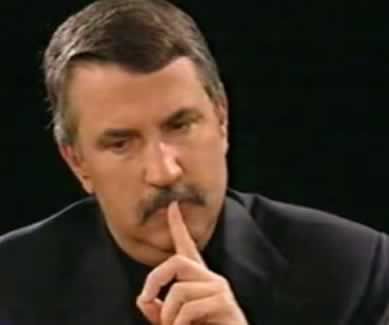
 The New York Times Chief Foreign Affairs Correspondent Thomas Friedman, by his own definition, is insane. Many understood this when he published The Lexus and the Olive Tree and asserted that military socialism was a good thing because it promoted American business:
McDonald's cannot flourish without McDonnell Douglas, the designer of the U.S. Air Force F-15. And the hidden fist that keeps the world safe for Silicon Valley's technologies to flourish is called the U.S. Army, Air Force, Navy and Marine Corps. And these fighting forces and institutions are paid for by American taxpayer dollars.
However, this only makes Friedman insane for those that watched America's surge towards global economic saturation as a bubble of self-inflated hubris (as the current financial crisis is beginning to reveal). It takes a very specific kind of crazy to meet Friedman's own high standards.
Remarkably, he has managed to meet them. Glenn Greenwald reported yesterday at Salon.com on Friedman's latest assertion. In discussing the case of Nidal Malik Hasan and the tragic shooting at Fort Hood, Friedman stated:
Major Hasan may have been mentally unbalanced -- I assume anyone who shoots up innocent people is.
To this Greenwald applied the Friedman test and, sure enough, he fit the definition perfectly.
Tom Friedman, The Charlie Rose Show, May 30, 2003:
ROSE: Now that the war is over, and there's some difficulty with the peace, was it worth doing?
FRIEDMAN: I think it was unquestionably worth doing, Charlie. I think that, looking back, I now certainly feel I understand more what the war was about . . . . What we needed to do was go over to that part of the world, I'm afraid, and burst that bubble. We needed to go over there basically, and take out a very big stick, right in the heart of that world, and burst that bubble. . . .
And what they needed to see was American boys and girls going from house to house, from Basra to Baghdad, and basically saying: which part of this sentence do you understand? You don't think we care about our open society? . . . . Well, Suck. On. This. That, Charlie, was what this war was about.
We could have hit Saudi Arabia. It was part of that bubble. Could have hit Pakistan. We hit Iraq because we could. That's the real truth.
Tom Friedman, NPR's Talk of the Nation, September 23, 2003 (via NEXIS):
That's what I believe ultimately this war was about. And guess what? People there got the message, OK, in the neighborhood. This is a rough neighborhood, and sometimes it takes a 2-by-4 across the side of the head to get that message.
I expect that Friedman will now take a leave of absence from his post at The Times and seek the help that he so clearly needs. If he won't leave voluntarily than perhaps it's time for an intervention. But his diagnosis raises further troubling questions. If the United States premier foreign affairs correspondent is insane, what does that say about U.S. foreign policy?
- Log in to post comments
Here's another Friedman quote
Let's at least have a real air war. The idea that people are still holding rock concerts in Belgrade, or going out for Sunday merry-go-round rides, while their fellow Serbs are "cleansing" Kosovo, is outrageous. It should be lights out in Belgrade: Every power grid, water pipe, bridge, road and war-related factory has to be targeted.
Like it or not, we are at war with the Serbian nation (the Serbs certainly think so), and the stakes have to be very clear: Every week you ravage Kosovo is another decade we will set your country back by pulverizing you. You want 1950? We can do 1950. You want 1389? We can do 1389 too.
(http://www.fair.org/extra/9907/kosovo-crimes.html)
Your clearly confusing Freidman's description of existing and historical attitudes and the tacit understandings of the actors representing us and determining military and foreign policy with his own personal views, attitudes and preferences.
So it seems the wingnut right isn't the only side to attempt to purge those who fail to clearly toe the party line and end up shooting the messengers. And your showing that texts can be taken out of context to support a POV and vilify people who stray too close to heretical concepts. Even if they only visit them in an attempt to explain the existing situation, the historical attitudes that served to get us here, and shine light on the dynamics of what we are up against.
Friedman is not "left." He's a pro-emperialism, radical market fundamentalist. Those a views most often associated with the "right."
Gathly @ # 4 - If you're far enough to the right, Friedman is "left".
Maybe that perspective makes me a political relativist, but so far it's the only way I can understand the attitude of the Foxoids, teabaggers, dittoheads, hyperchristians, and related ideological fauna: they're so paranoid because they are surrounded by hostile leftists.