

 As people who have been following the issue are well aware, there is a crisis of scientific literacy in the United States. Unscientific America may have had a poor explanation for why the problem exists, but it effectively announced the severity of the problem to a wide audience. To combat this problem it will take a a great diversity of tactics including education, popular culture, involved parenting, economics and political will. Everyone who cares about this issue should use the skills they have to both draw attention to the crisis of scientific literacy and seek positive solutions.
One problem I see is in the often rigid division between the humanities and the sciences on university campuses. While only about 25% of the US population graduates with at least a bachelor's degree, nearly all primary and secondary school students will be taught by someone with such a degree. The vast majority of teachers receive their degrees in education or humanities and are only required to take the minimum university requirements in math or science (81% of teachers in primary school and 74% in secondary major in one of those two areas). While this is bad enough for science education, less than 30% of math or science teachers in secondary education even majored in the very topic that they are now teaching to students. This means that the area of focus should be in the humanities, not the sciences, if we hope to address this problem at the academic level.
The trouble is that there are very few courses available that teach science as a humanity. Every science course I've taken has been geared towards majors in that field and emphasizes the skills they'll need to work in a lab. However, teachers don't need laboratory skills to teach science effectively, they need a conceptual framework of science in the same way they would about politics, economics or history. In thinking about this question I have designed the outline for a course and I would appreciate your feedback on how useful you think it might be for helping to bridge the "two cultures" in the modern university.
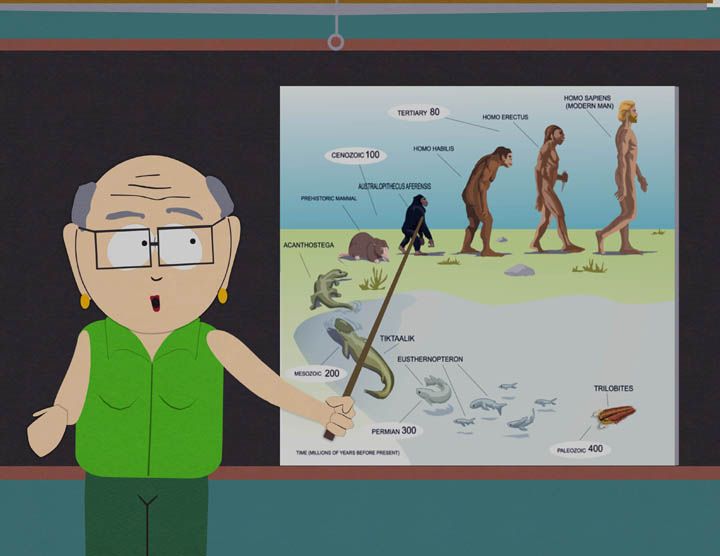
Evolutionary History would be a course cross-listed in history and biology and would emphasize the science of evolutionary biology as well as the social and political context in which these discoveries were made. As we all know, science is never static and historical factors have influenced how a scientific theory was framed during a given time. The course would be organized chronologically based on important geological epochs (probably starting with the Cambrian explosion). Each major epoch would include the historiography of science emphasizing the researchers in different time periods and show the changing social/political factors that influenced their research. While the general trend has been greater precision in scientific results and more knowledge about the time period in question, historical factors have also played their role in why a certain idea arose at a specific time. By teaching the course in this way the evidence of evolutionary history would be framed within the history of evolution as a theory.
I envision three major assignments for this course:
- A review of a professional scientific journal article from one of the major geological epochs.
- A review of a historical work on the science and/or scientists of one geological epoch.
- A final paper placing the scientific research of a given epoch within a social or political context.
In this way the course would be designed so that the evidence of evolution occurs alongside the history of science. This helps to make the findings of biology come alive as students learn about what drove specific scientists to ask a certain question at a given time. It would also allow room for bringing an analysis of gender into the discussion of science, especially when discussing the 19th and early 20th century, as primarily male evolutionary scientists imposed their gender biases onto their own research (and, of course, both male and female scientists are guilty of that today in imposing a strictly heterosexual bias).
I also see this as a way to bring together academics between disciplines. I continue to experience great tension between the sciences and humanities. As my circle has long existed between the two I regularly hear denunciations of the other on a fairly regular basis (one colleague of mine, I won't say which discipline, recently told me that the other side needs to be "treated like children" because they just don't get it). As long as this intransigence exists between academics I don't see how we can expect to effectively train our future educators. What I've presented is a first draft at creating a synthesis between two different approaches to understanding our world. My hope is to begin a conversation so that, at least on the academic front, we can fashion effective strategies that can build off of strategies in other areas.
- Log in to post comments
" * A review of a professional scientific journal article from one of the major geological epochs.
* A review of a historical work on the science and/or scientists of one geological epoch.
* A final paper placing the scientific research of a given epoch within a social or political context.
"
Uh.... Every professional scientific journal, every scientist, and every example of scientific research that I have ever heard of took place in the same geological epoch (unless you divide the Holocene in to the Holocene and the Anthropocene, which case it is two epochs). Perhaps you meant 'about one of the major geological epochs', 'studying a geological epoch', and 'on a given epoch'?
It should be perfectly obvious that's what I meant.
This seems to be totally brilliant to me. Good luck on pushing this.
I don't have any special credentials for this, but I do have some opinions and suggestions. I would also like to require teachers to take a series of courses on comparitive religion. I'd also like to require middle and high school students to take comparitive religion every other year.
It's just my opinion, but I wish I had been required to do that when I was young.
Someone made a comment to the effect that when you teach about the history of science, you are teaching humanities. I was fortunate to have had a wonderful history of biology course. I think it is important for us to understand how we came to know what we know, and why we thought it important in the first place. I have included as much history as I could in teaching various biology courses. So there is a good bit to be said for your general idea. I am also concerned that at my university, a chemist, physicist or engineer could receive a BS without taking a single biology course. I thought it odd that a music major would be better versed in biology than a chemist.
"It should be perfectly obvious that's what I meant."
It should be. But it is not. Sloppy sentence construction when there is only one plausible sensible meaning can be fun, but it is the slippery slope to sloppy sentence construction when there is more than one plausible meaning.
(That there is currently only one sensible meaning to your original list may be minimally problematic now, but if our species manages to be long-term survivors there may be quite a few scientific journals that were published in different geologic epochs....)
@Prof.Pedant: Then perhaps we can just allow those future post-Holocene historians to criticize my statement for not being adequately inclusive. There's little need for it now.
Interesting. I wonder if PZed will notice: from his descriptions of his teaching, I think he tries similar ideas.
P.S. a couple of days ago I had to remind my wife who Mary Anning was. Now there's a story full of social and sexual politics!
Do you think a mandatory philosophy of science course would go over well?
@Bob O'H: Exactly. That's the sort of thing that often gets overlooked in a straight biology or geology course. Emphasizing the fascinating lives and struggles of individual scientists and naturalists could help to encourage non-science majors into caring about science. I've long wondered why the intellectual struggles of, say, Kepler, Newton, or Rosalind Franklin aren't considered as fascinating as the intellectual struggles of writers or artists. There have been some great movies about Paul Verlaine, Janet Frame, Virginia Woolf, Oscar Wilde, Jackson Pollock, and dozens of others (and that's just off the top of my head). Why no comparable work about a scientist? The personal and creative struggles are just as intense. Get on that Hollywood.
EMJ,
That is a brilliant and long overdue push to make. After all, it's the non-scientists haven't trouble grappling with science, not the scientists.
Your plan sounds like a scholarly echo of Carl Sagan's "Great Story."
Yours,
CBB
History of science classes already exist. I could be wrong, but I assumed any credible institution already had at least a couple such courses. The only way your proposal is novel is that it suggests studying the history of science from a topical perspective rather than basing classes on particular time periods. This strikes me as quite difficult to do well, for a couple reasons.
First, it's not clear to me that you could reasonably delineate criteria by which you determine whether a historical theory addresses the topic in question. This is especially true for something like "The Cambrian", which was only established as a specific entity in the early 1800s. Are we going to completely ignore geology and paleontology before Adam Sedgwick defined the Cambrian? If so, how are we going to understand where Sedgwick himself got the idea?
Secondly, it can be well-nigh impossible to understand a scientific argument without a thorough background in the thought of the time period. Any history of laboratory techniques would have to include alchemy, but it's difficult to give alchemy due credit without understanding its connections to humanism, natural magic/neo-Platonism, and the other currents of the time.
Third, it would tend to give a very accumulationist view of science, where science was seen as nothing more than an increasingly precise description of reality. This is not a very useful way of looking at the history of science, and I would argue it's dangerous to teach undergraduates such a simplistic view of science. Having a population that views science and scientists as some platonic ideal of rationality is in fact part of the problem, as we see with the extreme overreaction to the climate emails a few months back.
I agree that the population needs a better exposure to science, and I think history and philosophy of science is a good way to do that. But I'm not convinced by your specific proposal. I don't think it's better, and it may in fact be worse, than the way history of science is traditionally done.
This sounds a lot like the Darwinian Revolution class I took as an undergrad.
Do you think that such a class should be cross-listed in history (or HoS if a separate dept. exists) and biology AND a required course for biology majors. In the course I took, there were several biology majors in the class and they got a lot out of it...
Are you preparing a mock syllabus?
@Michael D. Barton: I haven't thought about potential readings. Any suggestions? I like Bowler's "Evolution: The History of an Idea." There's also Carl Zimmer's latest "The Tangled Bank," but I haven't read it yet. Then, of course, there's the book I would have written by then. (Don't you love it when professors assign their own work? Yeah, I didn't think so.) I'm not sure it should necessarily be required of biology majors, since I think the purpose should be to educate non-science majors about scientific practice and embed that within a humanities discussion.
@Peter Borah: Perhaps if the books used covered the range of issues in the history of biology it would address some of your concerns. The lectures could be presented using the geological epochs as a structuring device but the readings would provide greater theoretical background and avoid the accumulationist approach? The reason for the structuring of the class would be so that students get a feel for evolutionary change over time, which standard histories don't do very effectively. You're right, of course, that some schools have history of science courses. I think this trend should be expanded and the discussion should be on how to teach good science alongside good history.
I recently had a grad student colleague argue that it's not necessary to understand a given science to teach the history of that science. This is part of the problem that I think needs to be addressed. The history of science also needs to teach science as praxis.
Re # 11 I had just such a history of science course on Darwin and Darwinism in 1970 at Lyman Briggs College at MSU. LBC was big on science studies and also required philosophy of science courses. However it was given to science majors. Somehow general education science is taught as a trotting out of a lot of facts not how science works.
What I would do is show several examples (from earth sciences about paradigm shifts and their effects) First it would be the Bretz (Glacial Lake Missoula/channeled scablands in Washington state), then the whole plate tectonics revolution, and finally darwinism. BTW the most exciting course I ever took was a survey geophysics course in spring 1970 at MSU right in the middle of the plate tectonic revolution it was interesting to see the two paradigms contenting and people trying to feel out what the new paradigm meant.
In particular one should point out the underlying postulates of the biology essentially uniforitarianism, or put more bluntly there is no supernatural intervention in the world now or in the past. (Teaching Lyell who greatly influenced Darwing would get make this point clear after the concept of catastrophism is discussed.) One can not discuss evolution without geology discussions as Lyell was a major influence on Darwin.
I teach a Darwinian Revolution course here at the University of Minnesota and I regularly enroll education majors and students working on their certification (and/or master's in education). I have gotten consistent positive feedback from them on the value of history/philosophy of science in their experience. Before coming to Minnesota I taught at Lyman Briggs and given the preceding comment I couldn't resist chiming in. Shoot me an email if you want a copy of my syllabus.
I had to take a similar class when I was working towards a degree in Computer Science. In fact, the Philosophy of Science course was required for graduation (at least it was 10 years ago). The course was through the Philosophy department and covered quite a bit of what you are suggesting:
http://www.sjsu.edu/people/james.lindahl/courses/Phil160/
In addition to the Computer Science degree I also have an Evolutionary Anthropology degree (from the UW in Seattle) and still found the material in this course enlightening.
@Bob O'H:
As a student of his, yes, he does. The newly reformed intro to bio course here at Morris, Fundamentals of Genetics, Evolution and Development spends a great deal of time on the history of scienc, biology and the philosophy of science (Aristotle, Bacon, Leeuwenhoek and of course Darwin and Mendel). From my memory, however, there wasn't much history past Darwin/Mendel unfortunately. Could be wrong though. I am also a bit skeptical as to how well people understand evolutionary theory coming out of the course, especially a year after they have taken it, but that is just my own personal observation.
Because of that, I really like EMJ's idea. My small school (~2000 students) doesn't teach a history of science or even a philosophy of science course, but some great interdisciplinary courses are taught. Although I have not taken it, we have a course called "Sagas before the Fall: Culture, Climate, and Collapse in Medieval Iceland" that looks at the history of Iceland in terms of climate change and other areas typically the domain of science. We also have courses about the Trial of Galileo, the Intersections of Art and Science, and the History of Chemistry. Liberal arts college FTW, I suppose!